Guest Post: “X” Marks the History: Plundering the Past in Assassin’s Creed IV

Robert Whitaker is a doctoral candidate in History at the University of Texas at Austin. His dissertation, “Policing Globalization: The Imperial Origins of International Police Cooperation, 1918-1960” studies the relationship between the British Empire and international police organizations, such as Interpol. He serves as an Assistant General Editor for the journal Britain and the World, and is the creator of the YouTube series History Respawned. Bryan S. Glass teaches the history of Britain’s interactions with the World at Texas State University. He is the founding member and General Editor of The British Scholar Society and serves as an Editor of the Britain and the World book series (Palgrave Macmillan). His publications include an article in the Journal of Imperial and Commonwealth HistoryThe Scottish Nation at Empire’s End (Palgrave Macmillan, forthcoming), and a co-edited volume with John MacKenzie entitled Scotland, Empire and Decolonisation in the Twentieth Century (Manchester University Press, forthcoming).
ACIVc

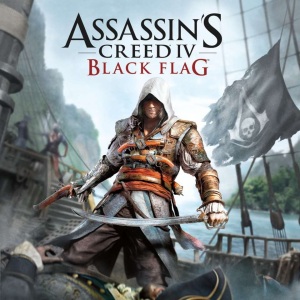
French game company Ubisoft has turned early American history into an age of booty. Over the past two years, the company has used early American history as the backdrop for three successive and successful titles in their Assassin’s Creed franchise: Assassin’s Creed III, Assassin’s Creed III: Liberation, and Assassin’s Creed IV: Black Flag. The most recent of these titles, Black Flag, is set in the Golden Age of Piracy during the early eighteenth century, and is easily the most profitable and well received of the three. Critics and players have praised Black Flag for its gameplay, graphics, and music—or rather, sea shanties.[1] But the biggest reason why this game has garnered accolades and high sales is because of its use, or misuse, of history. More than any other Assassin’s Creed game, Black Flag plays fast and loose with the historical record. It skews away from accuracy in favor of fun at almost every turn. Yet even as Black Flag thumbs its nose at the concerns of academic history, it nevertheless succeeds, perhaps better than any previous title in the series, in giving players a sensibility of the age. Continue reading
Introducing The History Carousel: Bringing the Past Full-Circle with the Present

The History CarouselWe at The Junto are very excited to announce the birth of a new podcast. “The History Carousel” will connect the past with the present, and will feature a rotating cast of Junto members and guests. It’s part of our equally-new podcast network, which is going to allow for all sorts of podcasting shenanigans—many thanks to Michael Hattem for helping to set it up. Continue reading

Review: The Larder: Food Studies Methods from the American South

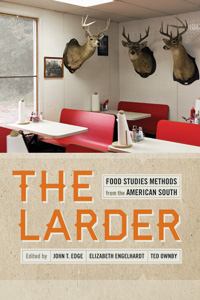
The larderIn his concluding remarks to The Larder: Food Studies Methods from the American South, Ted Ownby hopes it “likely that this book will be one of the last collections of academic essays in which any scholars feel the need to explain or defend their choice of foodways as a topic” (363). Ownby and co-editors John T. Edge and Elizabeth Engelhardt have done as much as they can to realize this aspiration; their collection of essays is timely and scholarly rigorous. By assembling a group of scholars who concentrate “not on food but on foodways”—which comprise the production, preparation, or consumption of food—the editors have delved into questions about food studies and southern studies that bridge boundaries between different disciplines and historical time periods (364). Continue reading

Preparing for Final Exams…Wait, What?

end of semesterI am still learning how things work in England. Prime example: a couple of months back, I referred to the place where one purchases delicious, delicious beer-battered cod and fries as a “fish and chippery” before a kind(?) soul on Twitter alerted me to the fact that it’s called a “chippy,” here. So perhaps it’s understandable that I still find it a little weird that my students are about to take their final exams. Continue reading

Connecting the Past with the Present: A Trip to the Grocery Store

Sainsbury'sI think it’s important for historians to try to make connections with the present, not only because it more thoroughly engages students, but also because the past is not static. I haven’t always been great at explicitly drawing these parallels, but when the first day of the U.S. government shutdown coincided with my first Revolutionary America class, I sort of lost it. I thought to myself, “I have to go into class prepared to talk about how people in thirteen disparate colonies—some of whom disliked each other immensely—managed to get it together enough to rebel against Great Britain?” It’s no wonder I ended up showing a pop music video and comparing the Revolution to the bad breakup of a dysfunctional relationship.[1] I assume that a teensy bit of pandering to students’ tastes didn’t hurt, either. Continue reading

Q&A with Edward E. Andrews, Author of Native Apostles

Ted AndrewsThe following is an interview with Ted Andrews, an assistant professor of history at Providence College in Rhode Island. Yesterday, Christopher Jones reviewed his book, Native Apostles: Black and Indian Missionaries in the British Atlantic World (Cambridge: Harvard University Press, 2013), and now Ted is speaking with The Junto about the process of writing it. Ted teaches early American, Atlantic, and Native American history, and he was recently awarded a grant from the National Endowment for the Humanities to explore his next project on global missionary connections among early modern Protestants. Native Apostles is his first book.
Continue reading

Mid-Semester Evaluations . . . Of You!

scantronWe’re barreling toward the end of the semester, which always feels closer once Thanksgiving’s over. As the Brits don’t celebrate Thanksgiving here, I’m in the midst of doing mid-semester evaluations with students this week  A) To remind them that the semester really is more than half over and B) To try to suss out what is and isn’t working in our class.

Today at The Junto, we’d like to ask you, our readers, to reflect on your teaching so far this semester, and to encourage people to use the comments to share ideas and troubleshoot.

Continue reading

Teaching the Declension Narrative

This semester I’m teaching Revolutionary America, a class which has allowed me to ease into teaching because my dissertation (ahem: book manuscript) focused on the more narrow topic of Native and enslaved foodways during and after the war.

I’ve framed the class around the question of how ordinary people experienced the Revolution. Lately I’ve been talking with students about the declension narrative pervasive in Native American history, because it’s one of the things I’m contemplating as I begin to think about revisions.[1] Continue reading

Notes from #BrANCH13

BrANCHlogoThis last weekend I visited Cambridge’s lovely Madingly Hall to attend the conference for British American Nineteenth Century Historians, or BrANCH. I teach Fridays, so I missed Pekka Hämäläinen’s plenary lecture on Indians, empires, and states in North America. People who attended thought it provided a very nice, sweeping overview of questions in Native American history, and I wish that I’d caught it. Due to “signalling problems” I didn’t make it to the Saturday morning panels, either—so what follows is a reflection on the sessions I attended.[1] Continue reading