T his week, Chief Curator Constance Cooper shares what’s next for the past at the Delaware Historical Society. Continue reading
Author Archives: Sara Georgini
Puritan Family Ties
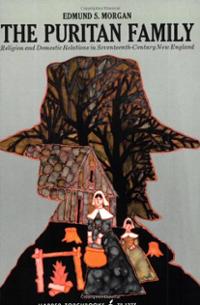 Family pictures can be the hardest to frame, and Puritans make for appealingly restless subjects. In tackling the early American narrative, scholars must confront the thorny task of portraying the Puritan family with equal parts theological dexterity and sociological skill, a problem that seventeenth-century artists and modern historians alike have sought to refine. Scholars who take on the Puritans must address sin, salvation, and community-building in a way that does not make American democracy feel inevitable; further, they must seize onto the seventeenth-century peculiarities of transatlantic intellectual life in which the Puritans flourished and fell. Wrapped in New England lore and either exalted or disowned by their descendants, the cultural memory of Puritan contributions to the project of nation-building has inspired a broad spectrum of historiographical views. In the early 1940s, then-Harvard doctoral student Edmund S. Morgan and his colleagues would have encountered a popular narrative of Puritanism, one seemingly destined to smother any effort at new work: America’s Puritan “tribe” had briefly inhabited a tau(gh)t sphere, bounded by covenant theology and laden with impossible ethics, peopled by censorious prudes who excelled at capitalist rhetoric and balked at the sinful frivolity of a stray dance. Or… did they? Continue reading
Buy, Sell, Read

How did eighteenth-century print networks really operate? This week, The Junto asked Jordan Goffin, Special Collections Librarian at the Providence Public Library, how mapping Rhode Island’s early book trade led to the creation of a new digital atlas. Continue reading
The Week in Early American History
 Let’s cool off with some early American history headlines. To the links! Continue reading
Collecting Pennsylvania
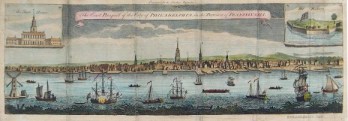
How is digital scholarship charting new prospects for our view of early America? Cathleen Lu, Digital Conversion & Bibliographic Specialist and Dana Dorman, Digital Projects Manager, at the Historical Society of Pennsylvania, kindly described how HSP produces and presents new digital content that’s open for research (along with the library) while renovations continue at 1300 Locust Street throughout early autumn 2013. Continue reading
Collecting Connecticut
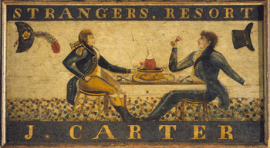 After enjoying the festivities of the Fourth, why not make it a whole weekend of early American history research? The Junto asked Barbara Austen, Archivist at the Connecticut Historical Society, to introduce the institution’s collections and digital projects. Continue reading
The Week in Early American History
Happy Sunday! Let’s head straight to the weekly highlights. Continue reading
Guest Post: Locating Gender in the Stacks
Today’s guest poster is Aaron M. Brunmeier, a PhD student focusing on early American and Atlantic world history at Loyola University Chicago. Aaron is currently finishing up his role as the new media assistant for Common-place Journal and will work next on an AHRC-funded project on Atlantic world library history.

Network analysis for the 11 women and all the texts they borrowed from the NYSL from 1789 to 1792.
I must confess that when it comes to digital history, I am very much a novice. My introduction into this brave new world occurred last semester in Dr. Kyle Roberts’ undergraduate digital history class that I was able to take for grad credit at Loyola University Chicago. The end goal of the course was to create our own collaborative digital history project. I teamed up with two smart, hardworking, and creative undergrads whose backgrounds weren’t even in history and what we produced was Gender in the Stacks (which I should point out is currently a prototype and definitely a work-in-progress). Continue reading
Guest Post: “Good Newes from ye olde World”
 Here at The Junto, we like to hear from early Americanists at work around the world. Today’s guest post comes from Lauric Henneton, Associate Professor at the Université de Versailles Saint-Quentin and Vice Président of the Réseau pour le Développement Européen de l’Histoire de la Jeune Amérique (REDEHJA).
In case the honorable readers of The Junto were wondering, we do Early American and Atlantic history in the “Old World” and not just in good old “Blighty.” This post is about how the Réseau pour le Développement Européen de l’Histoire de la Jeune Amérique (REDEHJA) came together and what we’ve done over the last few years. This is the story of a group of friends/colleagues who decided to come together institutionally after a few years holding small-scale events in and around Paris. Continue reading
At River’s End
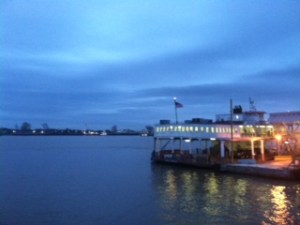
Last week, the Mississippi River surged against the levees, finally shattering restraints near St. Louis. Up and down the waterway, authorities hurried to secure hometowns, farmlands, and highways against the potential breach. “It could be anytime,” the Rivers Pointe fire chief told The St. Louis Post-Dispatch. “The hope is to keep Highway 94 open.” Even now, watching the water flow higher and faster still, it is worth thinking about how or why Americans have chosen to embrace life along the river: the shifting networks of politics and profit, the deep imprint of slavery on the region’s past, and the legacy of a South that may or may not have grown closer to the world, in the many ways that the Confederates or others have intended over time. This conscious construction of a river culture—as it was made and understood by the region’s black and white nineteenth-century predecessors, men and women who were also sensitive to sudden danger, but eager to maintain the dense traffic of the cotton trade—permeates Walter Johnson’s River of Dark Dreams and guides his expert analysis through their winding stories. Continue reading
 The Junto