 Last week, I attended the annual conference for the Society of United States Intellectual History, this year held in Irvine, CA. It was a fun time, and I learned enough and met enough people to consider the conference a success (and worth the 12 hour flight from London!). Yet one thing struck me the entire weekend, and was reinforced by Mark Peterson who gave words to my thoughts during his session response: why is there a paucity of work on early America within the recent surge of interest in US intellectual history? Or, to ask a different, but still related, question, why do so few historians of early America do work on intellectual history, or self-identify as intellectual historians? Continue reading
Category Archives: Conferences
Everyday Connections of Colonial Economies: Conference Recap
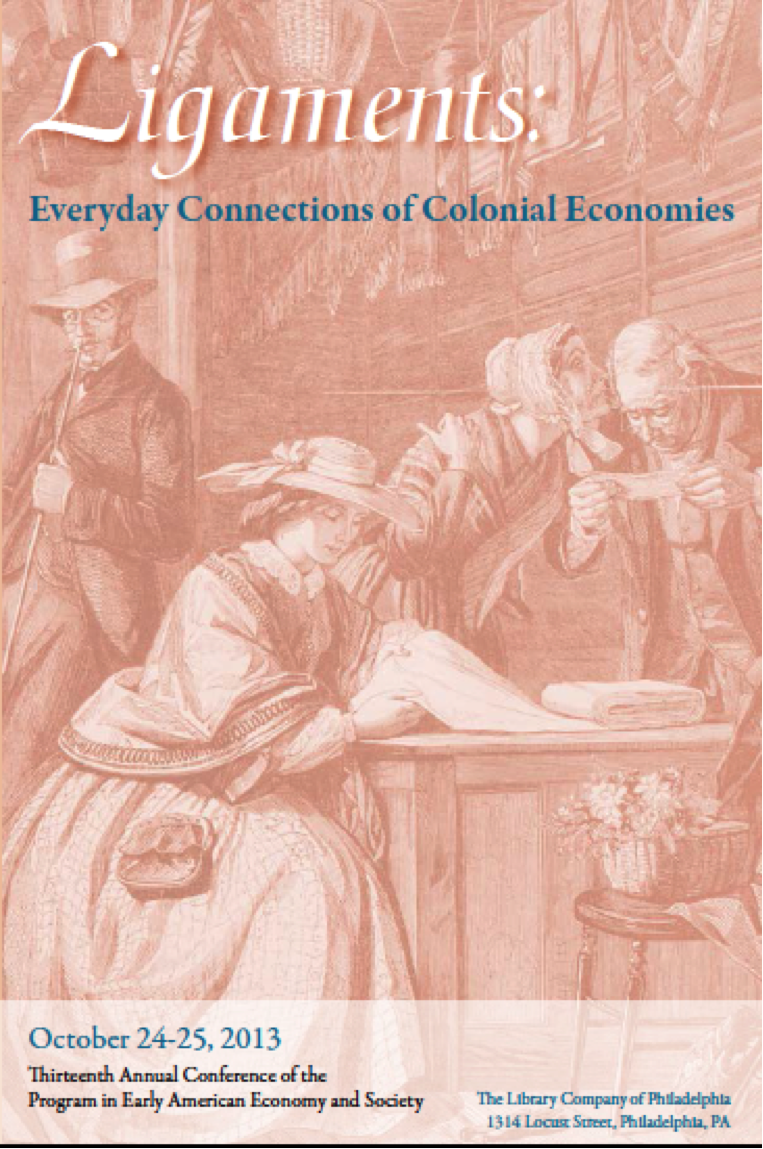 In our writing and teaching, we often refer broadly to “the early American economy,” suggesting that various systems of production, consumption, and exchange formed a collective whole. But what were connections that bound together this early American economy? Fifteen presenters—and a large and engaged audience—considered this question at the Program in Early American Economy and Society’s annual conference at the Library Company of Philadelphia on October 24th and 25th.
The conference title, “Ligaments,” referenced the connections and linkages that gave shape to the early modern economy. As PEAES director Cathy Matson explained in her introduction, the conference assembled some of the many scholars who are currently examining “ordinary, pragmatic economic connections” and using their investigation of these seemingly mundane topics to shed light on “big ideas” and longstanding questions. Continue reading
“Charles Beard at 100”: A Roundtable Recap
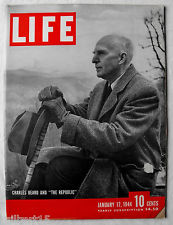 On October 14, Columbia University’s Center for American Studies sponsored the “Charles Beard at 100” roundtable to commemorate the centennial of Beard’s An Economic Interpretation of the Constitution of the United States. The event, organized by Columbia Historian and Director of the American Studies program Casey Blake, featured Eric Foner (Columbia), Jan Lewis (Rutgers), and David Waldstreicher (Temple) as panelists, with Herb Sloan (Barnard) as moderator. The following blog post synthesizes some of the main themes of the roundtable. I hope that many of the excellent points raised by the panelists can serve as a basis for discussion here on The Junto.
Guest Post: The Dutch Revolt and New Netherland: 36th Annual New Netherland Seminar
Elizabeth M. Covart (PhD, UC-Davis, 2011) is an independent historian located in Boston, Massachusetts, who specializes in early American history. She also blogs at Uncommonplace Book: An Independent Historian’s Blog and is a Contributing Editor for the Journal of the Early Americas and contributor to the Journal of the American Revolution.
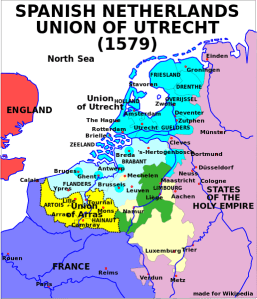
As my book project explores the cultural legacy of New Netherlanders who lived in Albany, NY, I attended the 36th Annual New Netherland Seminar on Saturday, October 5 at the New-York Historical Society. I admit that I attended the conference as an interloper; I study the revolutionary and early republic periods.
Notes from #BrANCH13
 This last weekend I visited Cambridge’s lovely Madingly Hall to attend the conference for British American Nineteenth Century Historians, or BrANCH. I teach Fridays, so I missed Pekka Hämäläinen’s plenary lecture on Indians, empires, and states in North America. People who attended thought it provided a very nice, sweeping overview of questions in Native American history, and I wish that I’d caught it. Due to “signalling problems” I didn’t make it to the Saturday morning panels, either—so what follows is a reflection on the sessions I attended.[1] Continue reading
Epilogue or Prologue? The Royal Proclamation Turns 250
 If you’ve heard of the Royal Proclamation of 1763, it’s probably in the form of the “Proclamation Line,” the imaginary line of masking tape across the Appalachian Mountains dividing English colonists along the coast from native populations in the interior of North America. According to a group of historians gathered at the Old State House in Boston this past Friday, it may have far greater significance. (Or not.)
Traces of Early America: Conference Recap
Today’s post is a joint effort between two contributors to The Junto: Michael Blaakman and Sara Damiano.
Three years ago, during a graduate-seminar discussion of Prospero’s America, Walter Woodward’s study of Puritans and alchemy, John Demos made a bold and challenging point.[1] After a century or so of professional scholarship, many of American history’s most obvious stories have been told in the ways it seems easiest to tell them. One of the greatest tasks for the rising generation of historians, Demos suggested, is to search beneath the surface of things for stories yet untold—for processes, events, ideas, and dynamics that subsequent history has largely obscured, and that often pose significant evidentiary problems for those who wish to write about them. In other words, the next generation of scholars will have to try harder than their predecessors to ask new questions and to find new methods for wringing answers out of the sources. Continue reading
Guest Post: On the Past’s Presence: Historians against Slavery
Today’s guest post comes from Nathan Jérémie-Brink, a Ph.D. student at Loyola University Chicago. His current research examines African-American print culture as it relates to religious and antislavery movements. Nathan also currently serves as the new media assistant for Common-place.
 Sept. 19-21, 2013 marked the first annual conference of Historians Against Slavery, at the National Underground Railroad Freedom Center in Cincinnati, Ohio. It is true that very few historians today would endorse John C. Calhoun’s opinion that slavery was in history or is now “a positive good.” Even so, historians rarely consider the valuable role that our research, and our teaching may play in present-day antislavery movements. The fear of presentism remains an obstacle to the historian’s meaningful involvement in modern-day activism. Certainly, historians must avoid anachronistic descriptions of slavery that undermine the specific realities of the early-modern Atlantic world and the early American republic. But there ought to be openness in the academy and in the discipline to let the historical record elucidate comparisons or contrasts between slaveries of the past and the present. Continue reading
When Was the Last Time You Loved America?
Few issues trouble historians of all stripes more than the disconnect between “popular” and “academic” history. Somewhere in the mists of the recent past the Age of Hofstadter gave way to, at best, the Age of McCulloch and, at worst, the Age of Barton.[1] The waning influence of professional historians in the public sphere particularly troubles the historical blogosphere. The popular-academic history disconnect is something addressed a lot here at The Junto, including with a podcast.
I am, as I said on the JuntoCast episode, particular dour about the possibility of bridging this gap. Academic historians, public historians, and interested members of the public more often than not talk past each other. How each group defines “good” or “useful” history is often so at cross-purposes that it sounds like one side is speaking English, another French, and another Dothraki.[2] My attention was recently drawn to a series of posts by Peter Feinman at New York History, which deeply entrenched my Eeyore-like-sullenness when it comes to these questions. Continue reading
Traces of Early America
Early American History, interdisciplinarity, digital humanities, invigorating conversation, and early-career camaraderie. What more could anyone ask from the McNeil Center for Early American Studies’s biennial graduate-student conference? The answer is: you.
 The Junto