 Happy American Archives Month! This week, The Junto spoke with Molly O’Hagan Hardy, Digital Humanities Curator and ACLS Public Fellow at the American Antiquarian Society. Continue reading
Category Archives: From the Archives
For Art’s Sake

Here’s a roundup of early American art on special exhibit throughout the autumn. Please share your links and thoughts on using early American art in the classroom in the comments, below. Enjoy! Continue reading
Guest Post: Rediscovering the Pamphlisphere
Today’s guest poster is Ariel Ron, who earned his PhD in history at the University of California, Berkeley, and is currently a visiting research associate at the McNeil Center for Early American Studies.
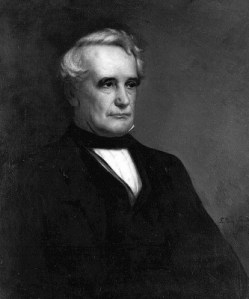
Three or four years ago, while doing research at the University of Pennsylvania’s Rare Book & Manuscript Library, I stumbled upon a lost cache of some ten-thousand pamphlets. I had been browsing the papers of Stephen Colwell, a nineteenth-century ironmaster and writer, when archivist John Pollack called me into the closed stacks behind the reading room. There he showed me Colwell’s personal pamphlet library, neatly bound into hundreds of volumes. The collection also included three thousand works from the library of Colwell’s friend, Henry C. Carey (see picture to right), without question the most important American political economist of the mid-nineteenth century. The sheer size of the corpus floored me. Continue reading
Historians Who Love Just a Bit
 I’ve never met anybody, living or dead, who fits their name quite as well as Peregrine Foster did. I encountered Peregrine in the papers of his brother, Dwight Foster, at the Massachusetts Historical Society, where I was looking for compilations of meaty correspondence that depicted land speculators at work. Peregrine was the youngest of three; his older brothers were Congressmen from Massachusetts and Rhode Island. Peregrine, though, wasn’t destined for such prominence.
In 1780, at the age of twenty-one, he more or less flunked out of the College in the English Colony of Rhode Island and Providence Plantations (now Brown University), complaining that his homework was eating him. “Though it is but only 23 Days since he began the 1st Vol of Blackstone’s Commentaries,” his oldest brother wrote, “he lost Flesh surprizingly and . . . is persuaded that it is not for his Interest to pursue his Books.”[1] Peregrine wanted to go to sea, but his brothers disapproved. So instead, after a few years of twenty-something idleness, he resolved to venture west in pursuit of a fortune through land speculation. Continue reading
Buy, Sell, Read

How did eighteenth-century print networks really operate? This week, The Junto asked Jordan Goffin, Special Collections Librarian at the Providence Public Library, how mapping Rhode Island’s early book trade led to the creation of a new digital atlas. Continue reading
“It is now translated to America”: British Hymns in the Revolutionary Era
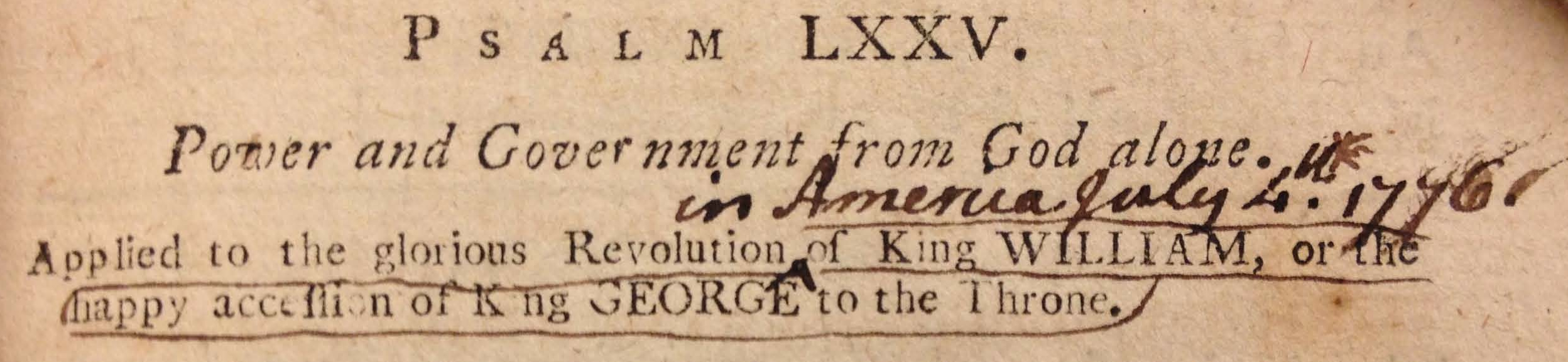 The Watkinson Library at Trinity College has an impressive collection of manuscript music from the late eighteenth century. Thanks to a grant from the Bibliographical Society of America, I spent a few weeks in June on a research road trip in New England, and Trinity was my first stop. Although I was focusing on musical commonplace books and copybooks, at the suggestion of librarian Sally Dickinson I also worked with their collection of annotated hymnals. It was while perusing these volumes that I came across something I hadn’t seen before: a hymnal in which every reference to Britain had been crossed out and replaced with the word “America” or related terms (New England, Western States, United States, etc.) As the assiduous penman noted at the bottom of one page, the entire volume had been “translated to America.”
Promised Land
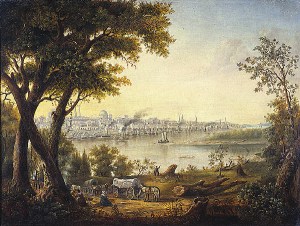
“Saint Louis in 1846”
Henry Lewis
This week, The Junto spoke with Lea VanderVelde, the Josephine R. Witte Professor of Law at the University of Iowa College of Law, a Guggenheim Fellow in Constitutional Studies, and principal investigator of the Law of the Antebellum Frontier project, which “seeks to digitally analyze the legal and economic mechanisms at work on the American frontier in the early 1800s.” She kindly took our questions on her work-in-progress, and why digital research transforms the early American legal history of how the West was run. Continue reading
Guest Post: Working for the Library
Today’s post is by guest blogger, David J. Gary, who received his MLS from Queen’s College (CUNY) in 2011 and his PhD in History from the CUNY Graduate Center in 2013. He is currently an adjunct assistant professor at the Graduate School of Library and Information Studies at Queens College (CUNY). He blogs at Function Follows Forme.
 I am grateful to The Junto for this chance to reflect on my experiences earning both a Master’s in Library Science and a PhD in American history and to advocate for others to consider joining me. Continue reading
The “Extra-Illustrated” Man: NYPL’s Emmet Archive
 When more than 10,000 early American documents find new life in the digital world, we at The Junto want to know more about the challenges and opportunities of the project. Thomas Lannon, Assistant Curator of the Manuscripts and Archives Division at the New York Public Library, kindly took our questions on Thomas Addis Emmet’s extra-illustrated archive. Continue reading
Forgotten Giant: Restoring Simms

“Washington Irving and His Literary Friends at Sunnyside.” Simms is seated at the left end of the table, shown in full profile.
(Christian Schussele, Oil on canvas, National Portrait Gallery, Smithsonian Institution, 1864)
Meet a Southern man of letters, William Gilmore Simms, through his life’s work of literature—much of it now available in the form of free, digital editions thanks to the Simms Intitiatives at the University of South Carolina. A well-known editor, critic, poet and historian of Southern life and culture in his day, Simms (1806-1870) occupies a unique position in early American literature, and (re)introducing him to modern readers has presented new challenges for scholars. The Junto asked the Initiatives’ Todd Hagstette, Simms Curator, to talk about creating a digital portrait of the author, and why Simms’s work belongs on the syllabus. Continue reading
 The Junto