Guest Post: Rediscovering the Pamphlisphere

Today’s guest poster is Ariel Ron, who earned his PhD in history at the University of California, Berkeley, and is currently a visiting research associate at the McNeil Center for Early American Studies.
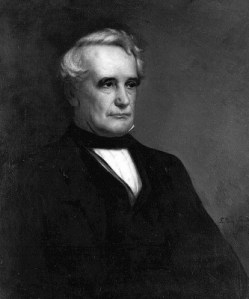
Henry Carey (National Portrait Gallery)

Three or four years ago, while doing research at the University of Pennsylvania’s Rare Book & Manuscript Library, I stumbled upon a lost cache of some ten-thousand pamphlets. I had been browsing the papers of Stephen Colwell, a nineteenth-century ironmaster and writer, when archivist John Pollack called me into the closed stacks behind the reading room. There he showed me Colwell’s personal pamphlet library, neatly bound into hundreds of volumes. The collection also included three thousand works from the library of Colwell’s friend, Henry C. Carey (see picture to right), without question the most important American political economist of the mid-nineteenth century. The sheer size of the corpus floored me. Continue reading

Guest Post: The Problem of Loyalism before the American Revolution

Today’s guest poster is Christopher Minty, a PhD candidate at the University of Stirling. His dissertation focuses on Loyalists in New York. 

Patriots and Loyalists

Over the past four years, I’ve been fortunate enough to work on a group of colonists who would go on to become Loyalists in the American Revolution. My dissertation examines 9,341 future Loyalists during the imperial crisis, 1763–1775, in New York and, essentially, tries to follow their collective paths to either voluntarily signing their name to a declaration, petition and/or subscription list affirming their continued allegiance to the prevailing political order or taking the oath of allegiance. Continue reading

Guest Post: An Academic Bridge Across the Atlantic

Today’s guest post comes from Lauric Henneton, Associate Professor at the Université de Versailles Saint-Quentin and Vice Président of the Réseau pour le Développement Européen de l’Histoire de la Jeune Amérique (REDEHJA). Junto readers: Have you attended the Summer Academy of Atlantic History? Please share your reflections in the comments.

Continue reading

Guest Post: Pauline Maier and the History of Women in History

Sara Damiano is a Ph.D. candidate at Johns Hopkins University. Her dissertation is entitled, “Gender, Law, and the Culture of Credit in New England, 1730-1790.”

How should we choose to remember the lives and works of historians, and what do these choices say about our profession? The recent deaths of Edmund Morgan and Pauline Maier have led me to ponder these questions. I have watched with interest as historians have taken to social media—blogs, H-Net listservs, Twitter, and Facebook—to celebrate the lives of Morgan and Maier and to critique commemorations in the national press.

Continue reading

Guest Post: Teaching with Legal Sources: The Case of Ann Hibbens

Today’s guest poster is Sara Damiano, a Ph.D. candidate at Johns Hopkins University. Her dissertation is entitled, “Gender, Law, and the Culture of Credit in New England, 1730-1790.”

As we plunge into syllabus-writing season, I would like to contribute to The Junto’s ongoing conversation on teaching with primary sources. (Joseph Adelman and Glenda Goodman have previously written on favorite sources in the survey and on music in the classroom, respectively.)  I’m a historian of gender and law, so I would like to make the argument for including legal sources in our syllabi, even for courses that aren’t explicitly focused on legal history. By way of illustration, I would also like to recommend one of my favorite legal history sources for teaching: the 1640 trial of Ann Hibbens before the First Church of Boston.

Continue reading

Guest Post: Sports Talk Radio, Sabermetrics, and Carl Becker

Mark Boonshoft is a PhD candidate at Ohio State University. His work focuses on colleges and academies, especially the networks forged in them, and their role in the formation of revolutionary political culture. 

WFAN 660 AM

“Long time listener, first time caller.” These are words I heard often as a kid. I grew up listening to sports talk radio—mostly 660AM, WFAN-New York—and this is how many a caller introduced themselves. I’ve limited my habit—I no longer keep a transistor radio quietly playing under my pillow while I sleep—but I have not shaken it entirely. Long car rides are still a good chance to binge, and binge I did this July Fourth weekend. Driving through Albany, I called in for the first time ever. Continue reading

Guest Post: Thomas Mundy Peterson and the Fifteenth Amendment

Gordon Bond is an independent historian/researcher. He has written an excellent biography of the colonial New York printer, James Parker, entitled James Parker: A Printer on the Eve of Revolution. He is also the author of Hidden History of South Jersey (2013) and North Jersey Legacies (2012). Currently, he is the Founder, Editor-in-Chief & Director of Garden State Legacies .

While a rejection is nothing any writer wants, sometimes it is what we need. Such was the case with my proposals to publishers for a book about Thomas Mundy Peterson. If you’ve heard of Peterson before, chances are it will be for the Wikipedia reason; in 1870, he became the first African-American to vote under the auspices of the Fifteenth Amendment to the United States Constitution. He was, of course, more than that moment.

Continue reading