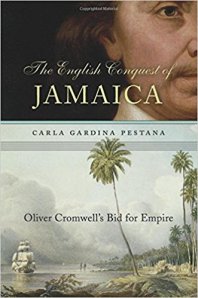
 To accompany the review by Casey Schmitt that was published yesterday, we are pleased to have this Question & Answer with Carla Pestana today regarding her new book, The English Conquest of Jamaica: Oliver Cromwell’s Bid for Empire (Harvard University Press, 2017). We thank Dr. Pestana for her time. Continue reading
Category Archives: Review / Q&A
Book Review: Carla Gardina Pestana, The English Conquest of Jamaica
Carla Gardina Pestana, The English Conquest of Jamaica: Oliver Cromwell’s Bid for Empire (Cambridge: The Belknap Press of Harvard University Press, 2017).
It is an exciting time to be a scholar of Caribbean history. From conferences to publications, the past decade has seen historians of early America, Latin America, and the Atlantic world turn to the Caribbean for insights into the development of empire, slavery, race, and commerce.[1] In this resurgence of Caribbean historiography, the seventeenth century has emerged as a pivotal period. That said, by taking a relatively well-known event like the Western Design, UCLA Professor and Joyce Appleby Endowed Chair of America and the World, Carla Gardina Pestana, demonstrates the value of exploring the early Caribbean in her new book The English Conquest of Jamaica: Oliver Cromwell’s Bid for Empire. Pestana’s work aptly shows the profound intellectual pay-off for historians willing to explore the seventeenth-century Caribbean with bigger questions about imperialism, race, religion, and gender. Continue reading
Q&A with Adrian Miller
 Today we’re featuring an interview with Adrian Miller, author of The President’s Kitchen Cabinet: The Story of the African Americans Who Have Fed Our First Families, from the Washingtons to the Obamas. Miller is a food writer, attorney and certified barbecue judge who lives in Denver, CO. He is currently the executive director of the Colorado Council of Churches and, as such, is the first African American and the first layperson to hold that position. Miller previously served as a special assistant to President Bill Clinton and a senior policy analyst for Colorado governor Bill Ritter Jr. He has also been a board member of the Southern Foodways Alliance. Miller’s first book, Soul Food: The Surprising Story of an American Cuisine, One Plate at a Time won the James Beard Foundation Award for Scholarship and Reference in 2014. Continue reading
Q&A: Ernesto Bassi, author of An Aqueous Territory
 Following up on James Hill’s review of Ernesto Bassi’s An Aqueous Territory: Sailor Geographies and New Granada’s Transimperial Greater Caribbean World (Durham: Duke University Press, 2017), we’re pleased to post this Q&A with Ernesto about his book and future research. Bassi is Assistant Professor of History at Cornell University. He is a historian of Latin America, the Caribbean, and the Atlantic world during the Age of Revolutions, whose work transgresses conventionally defined geographic units of analysis. Ernesto can be reached at eb577@cornell.edu. Continue reading
Guest Post: Review of Bassi, An Aqueous Territory
Today’s review is by James Hill, who received his Ph.D. from the College of William & Mary in 2016 and is currently an Assistant Professor of History at the University of the Bahamas. He has published articles in Early American Studies (Winter 2014) and the Florida Historical Quarterly (Fall 2014). His dissertation, “Muskogee Internationalism in an Age of Revolution, 1763-1818,” analyzes Creek and Seminole diplomacy. This will be followed tomorrow by a Q&A with the author.
Ernesto Bassi, An Aqueous Territory: Sailor Geographies and New Granada’s Transimperial Greater Caribbean World (Durham: Duke University Press, 2016).
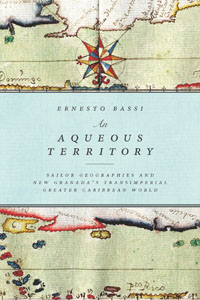
For decades, the historiographies of the Caribbean and the mainland Americas largely remained separate, with the modern constructions of nation-states influencing how scholars have framed the geographical parameters of their works, with some notable exceptions (New Spain, Guyana, Suriname). In recent years this has begun to change in the case of North America’s early modern ties to the Caribbean. Scholars such as Jane Landers, J. R. McNeil, and Shannon Lee Dawdy have emphasized transnational and transimperial connections between various Caribbean islands and the territories that eventually encompass the United States. Continue reading
Q&A: Spencer McBride, author of Pulpit and Nation
 Following up on Jonathan Wilson’s review of Spencer McBride’s Pulpit and Nation: Clergymen and the Politics of Revolutionary America (Charlottesville: University of Virginia Press, 2017), we’re pleased today to post this Q&A with Spencer about his book and his future research. McBride is a historian and documentary editor at The Joseph Smith Papers. He earned a Ph.D. in History at Louisiana State University, and is currently working on several book projects, which you can read about more here. Continue reading
Q&A: Patrick Spero and Michael Zuckerman
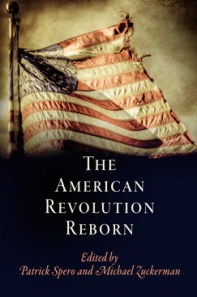 Following on from yesterday’s review of The American Revolution Reborn, The Junto was fortunate enough to get to ask a few questions of the volume’s editors. Both Patrick Spero, Librarian of the American Philosophical Society, and Michael Zuckerman, Professor of History Emeritus at the University of Pennsylvania, were instrumental in organizing the highly successful conference that led to the volume. In the Q&A below, the organizers/editors reflect back on both the conference and the volume, their effect on their own views of the Revolution, and their hopes for the legacy of both the conference and the volume. The Q&A is published here in its entirety. Continue reading
Q&A with Sowande’ Mustakeem
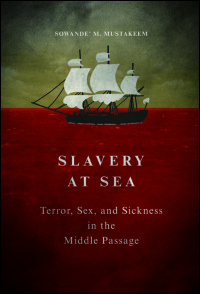 This is an interview with Sowande’ Mustakeem, who is an Assistant Professor in the departments of History and African and African American Studies at Washington University in St. Louis. Today she speaks with The Junto about her book, Slavery at Sea: Terror, Sex, and Sickness in the Middle Passage, which Casey Schmitt reviewed yesterday. Her previous work has appeared in journals such as Atlantic Studies and the Journal of African American History, and edited volumes such as Understanding and Teaching American Slavery, Teaching Lincoln: What Every K-12 Student Needs to Know, and Gender, Race, Ethnicity, and Power in Maritime America. Continue reading
Manufacturing Bodies: A Review of Slavery at Sea
Sowande’ Mustakeem, Slavery at Sea: Terror, Sex, and Sickness in the Middle Passage (Urbana: University of Illinois Press, 2016).
Writing a book review a day after Karin Wulf’s entertaining analysis of what makes for a good review might be hubris at its worst, or simply bad timing. And, while I will never have the expertise, style, and prose that made Annette Gordon-Reed’s review of Robert Parkinson’s The Common Cause: Creating Race and Nation in the American Revolution so good, I do hope this review will explore the central ideas of Slavery at Sea in anticipation of a Q&A between the author and The Junto’s own Rachel Hermann tomorrow. Stay tuned for that!
In the introduction of her new book, Assistant Professor of History and African and African American Studies, Sowande’ Mustakeem, writes that, “not all slaves endured the transatlantic passage in the same way.” That statement serves as the driving force behind an unflinching exploration of the “multiplicity of sufferings” endured by aged, infirm, and infant Africans carried across the Atlantic and into slavery. Despite the simplicity of that premise, Mustakeem’s concise monograph exposes how the focus on young and able-bodied African men as the predominant population of captives held in slave ships overshadows the experiences of the “forgotten” of the transatlantic slave trade. As a result Mustakeem’s narrative lingers on the painful details of what she describes as “a massively global human manufacturing process” that commodified the bodies of young and old, healthy and infirm, female and male (9). Continue reading
An Interview with Ann Little
 Today at The Junto we’re featuring an interview with Ann Little, an Associate Professor of History at Colorado State University, about her new biography, The Many Captivities of Esther Wheelwright. Little has previously authored Abraham in Arms: War and Gender in Colonial New England. She also writes regularly at her blog, Historiann: History and Sexual Politics, 1492 to Present.
In The Many Captivities of Esther Wheelwright, Little chronicles the life of a New England girl, Esther Wheelwright, who was captured by the Wabanakis in 1703 when she was seven years old. After living with the Wabenakis for several years, Wheelwright entered an Ursuline convent in Quebec at age twelve. She lived the remainder of her life there, voluntarily becoming a nun and taking on several leadership positions in the convent, including that of Mother Superior, during old age. Continue reading
 The Junto