 Welcome to this week’s news in Early American History! Continue reading
Presenting Your Final Four March Madness Competitors
 Results are in, and we’re in for some fun voting next week.
Junto March Madness: Elite Eight Voting
 We’re getting close to the finals here at The Junto. Elite Eight voting starts AND ends today at 5 p.m. EST. We’ll post results tomorrow and give you the weekend to mull over your final four choices.
Junto March Madness: Round 3 Results
So, there were quite a few close races this round, including one that came down to the last hour. (Literally!) CAN YOU FEEL THE MADNESS?!?!?!?!!!11?!?!
Jonathan Edwards and Thomas Paine clutched victory from the jaws of defeat by the slightest of margins. Benjamin Franklin is basically looking like this. And Harriet Jacobs and Frederick Douglass are heading for a slave narrative showdown.
There is a quick turnaround this week, so you have little time to catch your breath. Voting for the Elite Eight is tomorrow. Continue reading
Single-Perspective Narratives and the Politics of Marriage History
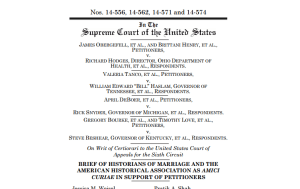 Earlier this month, the American Historical Association announced that it had signed a Supreme Court amicus curiae brief in support of legal same-sex marriage.[1] This well-written, scholarship-rich brief was apparently drafted by Nancy Cott, and it was signed by many other distinguished historians of marriage.
In discussions that followed on Twitter, some professional historians who were happy with this brief (as I imagine most were) told me they supported it on the basis of historians’ collective interest in historical accuracy. History has been distorted, they argued, by conservative arguments—specifically, by conservatives’ appeals to what marriage has supposedly always been like. They agreed with the AHA that conservatives have advanced not only an unconvincing interpretation but also a set of demonstrably false claims.[2] Specifically, it seems, they think it’s false to say that marriage historically “serv[ed] any single, overriding purpose.”[3]
Junto March Madness: Round 3 Voting
You know what’s totally anticlimactic? NCAA March Madness after the first two rounds. You know what only gets better and better? The Junto’s March Madness. Let’s do this.
Will Thomas Paine continue his domination? Will Graham Crackers continue destroying everything in their path? Will I have to keep coming up with rhetorical questions?
Voting closes Tuesday at 5pm. Continue reading
The Week in Early American History
Happy Sunday, and welcome to another edition of The Week in Early American History. Here at the Junto, we’re gearing up for the Sweet Sixteen beginning tomorrow (since Villanova, Iowa State, and Baylor have basically thwarted our brackets for that “other” March Madness). Here for your enjoyment before you get distracted by basketball (or by trying to avoid basketball), are today’s links.
Junto March Madness Round 2 Results
There were some close races this time around–a fact which bodes well for the Sweet Sixteen and Elite Eight voting next week. Results and match-ups for the next round follow after the jump. Continue reading
Junto March Madness Round 2 Voting: Brackets 3 & 4
As we move into voting for brackets 3 & 4, lots of questions remain unanswered: will Roger Williams’s Key Into the Languages of America continue its cinderella run? Will Graham Crakers gain more momentum? Will Junto readers be able to explain their excitement for this tournament without sounding imminently nerdy? Only time will tell.
Voting closes on Thursday at 5:00pm. Results for all four brackets will be announced on Friday. Continue reading
Guest Post: Why Shoes?
Kimberly Alexander is an Adjunct Professor in the History Department at UNH, Durham, where she teaches courses in museum studies and material culture. She earned her Ph.D. in Art & Architectural History from Boston University and was a founding Curator of Architecture and Design at the MIT Museum. She’s also served as Curator of Architecture and Design at the Peabody Essex Museum and Chief Curator of Strawbery Banke Museum in Portsmouth, NH. Dr. Alexander has published several books and essays, and has recently had papers presented at history of fashion conferences in London and Florence. Her current catalog and exhibition project is titled “Cosmopolitan Consumption: Georgian Shoe Stories From the Long 18th Century.”
 How does one select a sampling of dozens of pairs of eighteenth-century shoes and translate the assemblage into a coherent museum exhibit housed in one charming, but tiny gallery? How does one translate a five-year study of eighteenth-century consumption patterns, cultural diffusion, and gentility in the Atlantic shoe trade into a show that will excite the imaginations of early Atlantic scholars yet appeal to the general public? How does present a material culture and fashion history exhibition in a refined Athenaeum situated in a corner of New Hampshire? Continue reading
 The Junto
