 Happy Monday, everyone! You can cast your votes for Round 2 of Junto March Madness after the jump. Continue reading
Junto March Madness Round 1 Results
As always with March Madness, there have been some expected wins and some upsets–and man oh man am I excited for the next round. Results and match-ups for the next round follow after the jump. Continue reading
Junto March Madness: Round 1, Day 2 Voting (Brackets 3 and 4)
Today we commence with voting on Round 1, brackets 3 and 4. As a reminder, you can find the entire bracket here. Again, we’ve included arguments on behalf of various documents, written by either Junto bloggers or friends of the blog. Please feel free to add your arguments in the comments, because the purpose of this month’s “tournament” is to provide a resource for teachers of early American history.
Reminder: BGEAH CFP due March 20th
 Today we’re featuring a friendly reminder from our friends in the British Group of Early American Historians (BGEAH) that the deadline for abstracts is imminent. Continue reading
Junto March Madness: Round 1, Day 1 Voting
The time has come: trash talking is over; voting begins. As a reminder, you can find the entire bracket here. Today, we will vote on brackets 1 and 2; Wednesday, we will vote on brackets 3 and 4. We have included arguments on behalf of various documents, written by either Junto bloggers or friends of the blog. Please, feel free to add your arguments in the comments, because the purpose of this month’s “tournament” is to provide a resource for teachers of early American history.
Let the games begin! Continue reading
Junto March Madness 2015: The Unveiling of the Bracket
The wait is over. For the next few weeks, over-specialized nerds across the country will huddle over their desks, pencils in hand, brows furrowed, debating matchups and predicting winners. Lines will be drawn. Disagreements will be had. Relationships may be strained. The historiographical world as we know it may never be the same again.
That’s right, the Junto March Madness Bracket has finally arrived!
This year, the bracket is focused on primary sources. Specifically, primary sources that you would use in the classroom. These could be larger edited collections, single letters, or even an engraving. This is meant to introduce readers and teachers to new pedagogical tools designed to unlock the study of the past. Continue reading
Junto March Madness Nominations Open
It’s March here at The Junto (and, um, the rest of the world), which means it’s time for our annual March Madness tournament! By now you probably know the drill: you nominate, we bracket, and voting begins to establish a champion. Last year’s tournament can be found here: Michael Jarvis’s In the Eye of All Trade beat out a number of strong competitors to finally triumph in the tournament of nerdom.
Each year there’s been a twist, and this year is no different. Continue reading
Review: Shelby M. Balik, Rally the Scattered Believers
Shelby M. Balik, Rally the Scattered Believers: Northern New England’s Religious Geography. Bloomington: Indiana University Press, 2014.
 At the beginning of February, Wake Forest University hosted a symposium marking the 25th anniversary of the publication of Nathan Hatch’s The Democratization of American Christianity (Yale University Press). The list of participants was a “who’s-who” of American religious history: Catherine Brekus, Sylvester Johnson, Mark Noll, Amanda Porterfield, Harry Stout, Grant Wacker (on more of a “who’s-that?” note, I was there, too, feeling honored but absurdly under-credentialed in that company). Each offered reflections on the book’s influence and reach, on his or her personal experience with it, on how its arguments have aged. Hatch, now the president of Wake Forest, offered an eloquent response. (Video of the event is available here.) Continue reading
Guest Post: Bastard out of Nevis: Lin-Manuel Miranda’s “Hamilton”
We are pleased to feature a guest post from Benjamin Carp (@bencarp), the Daniel M. Lyons Professor of American History at Brooklyn College, CUNY. Carp is the author of both Defiance of the Patriots: The Boston Tea Party and the Making of America and Rebels Rising: Cities and the American Revolution.
“I want the historians to respect this.” –Lin-Manuel Miranda, according to Ron Chernow

In the lobby of the Public Theater, two statues flanked the doorway—the likenesses of Alexander Hamilton and Aaron Burr stretched out their arms and aimed their dueling pistols at one another, and it was hard not to feel as if I was standing in the middle. Lin-Manuel Miranda, the son of Puerto Rican immigrants, wrote the musical Hamilton and stars in the title role. He portrays the first Secretary of the Treasury as a “bastard, orphan, son of a whore and a Scotsman” and an immigrant striver made good; throughout his career, Hamilton is arrogant about his talents but perpetually insecure about his place. As told by Miranda, Hamilton is both self-made and self-unmade, wry and seductive and yet constantly raging against anyone who might hold him back. Continue reading
Q&A with Stephen R. Berry, Author of A Path in the Mighty Waters
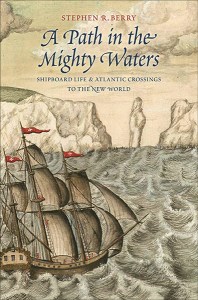 The following is an interview with Stephen R. Berry, an Associate Professor of History at Simmons College. My review of Berry’s recently-released book, A Path in the Mighty Waters: Shipboard Life and Atlantic Crossings to the New World (New Haven: Yale University Press, 2015) appeared on the blog yesterday. Today, he agreed to answer some follow-up questions about his book and his future research plans. Continue reading
 The Junto