Edward E. Andrews, Native Apostles: Black and Indian Missionaries in the British Atlantic World. Cambridge: Harvard University Press, 2013.
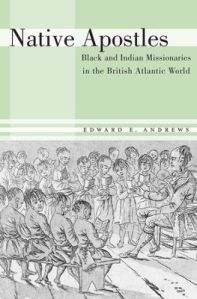 On the eve of the American Revolution, an unlikely band of ministers and benefactors devised a plan to send John Quamine, a free black man, and Bristol Yamma, a slave, as missionaries to Africa. The project was conceived by the two would-be missionaries themselves, and supported by controversial Congregationalist minister Samuel Hopkins and his more moderate colleague Ezra Stiles. In 1774, Stiles and Hopkins arranged for the duo to be sent to the College of New Jersey, where Presbyterian minister (and president of the College) John Witherspoon would train them. Their proposed mission gained some notoriety, and a diverse lot of supporters championed their cause, including Quaker abolitionist Anthony Benezet, New Jersey lawyer and politician Elias Boudinot, Scottish theologian John Erskine the noted black poet Phyllis Wheatley, Eleazar Wheelock and his Mohegan pupil-turned-preacher Samson Occum, and black Anglican missionary to Africa Phillip Quaque (though his endorsement came with serious reservations). The outbreak of war in 1775 and the subsequent death of Quamine in 1779 ultimately thwarted the planned mission. In spite of its failure, though, it remains an important but oft-ignored episode in what Edward E. Andrews calls “the tangled history of cultural encounter between Europe, Africa, and the Americas” (188). Continue reading
 For early Americanists, fall is conference-planning season. Proposals for the

 This coming weekend the American Studies Association descends on Washington, D.C. for the annual
  As I near the end of a somewhat unusual semester, I wanted to reflect a bit on my experiences as a Teaching Fellow for a course on the American Revolution. This semester I was fortunate enough to have the opportunity to deliver a number of lectures. And it has gotten me thinking about the lecture as both a piece of writing and a pedagogical tool. The purpose of this post is mostly to throw out some things that have occurred to me throughout the semester but to also get thoughts from those of you with experience giving lecture courses.
 Submitted for your approval . . . the November episode of “The JuntoCast.” This month, Ken Owen, Michael Hattem, and Roy Rogers discuss the Continental Congress, including a number of recent popular histories about it, its popular and academic historiography, and various aspects of its importance.
 The Junto