
Photograph in Charles Knowles Bolton, The Private Soldier Under Washington, New York, Charles Scribner’s Sons, 1902, p. 162 and detail from The Surrender of General Burgoyne at Saratoga, October 16, 1777, Yale University Art Gallery.
The following post is a guest post from Marta Olmos. Marta Olmos received her BA in History from Cornell University and her MLitt in Scottish History from the University of Glasgow. She works in public history and interpretation at Minute Man National Historic Park in Concord, MA. She is on Twitter @almostmartita
In her 1988 article Rayna Green said that “one of the oldest and most pervasive forms of American cultural expression… is a ‘performance’ I call ‘playing Indian.’” The Indian, in this context, is an amalgamation of white stereotypes of Native people, and the performance of “playing Indian” is carried out by white bodies, using the Indian to explore their own identities, fears, and cultures.[1] As the American Revolution dawned, the Indian was everywhere. Hunting shirts, the makeshift uniform of the Continental Army, were at the center of a movement around “playing Indian.” By exploring the discourse around the hunting shirt, and the performance of “playing Indian” that accompanied it, we can better understand the role of the Indian, and backcountry culture, in forging an early American military identity during the early 1770s.[2] Continue reading
 Kacy Tillman,
  Professor Michal Jan Rozbicki passed away on July 31, 2019 after retiring from teaching this June. As a student of his, I would like to take this opportunity to revisit his contributions to the early American history and hopefully stimulate some further reflections or conversations. In the summer of 2011, when I went to New York to conduct research for my master’s thesis, I found his book, Culture and Liberty in the Age of the American Revolution, in a bookstore. After reading few pages, I was so attracted by his ideas and viewpoints that I knew I wanted to contact this author and see if I could be his student. That was what I did, and that was how I came to Saint Louis.
  THE AGE OF REVOLUTIONS
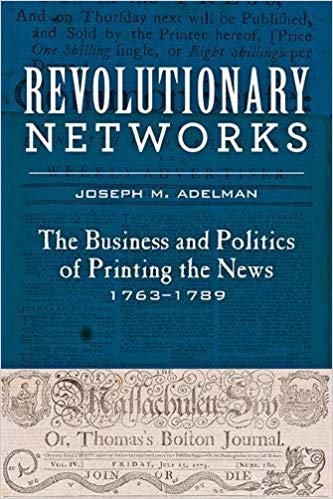
 Today, The Junto interviews our own Joseph Adelman about his new book Revolutionary Networks: The Business and Politics of Printing the News, 1763–1789. Jordan Taylor’s
  Joseph M. Adelman,
 Sari Altschuler is an assistant professor of English, associate director of the Humanities Center, and founding director of the minor in Health, Humanities, and Society at Northeastern University. Her book
  The Junto