 George Wythe represented the best of the Revolutionary-era Virginia gentry. Wythe, as a law professor, instructed and inspired many of the leading lights of the Patriot movement, including Thomas Jefferson. Wythe was also a racial liberal. After his wife’s death he freed the family’s slaves and even went as far as to adopt and pay for the education of one of their number, a young man named Michael Brown. By the opening years of the nineteenth century Wythe served as chancellor of Virginia’s court of equity where he handed down a monumental decision in the case of Wright v. Hudgins, which held that the burden of proof in cases of runaway slaves rested with the enslaver – not the accused runaway.
Tag Archives: book review
History Is Not Science
Over at Slate last week, our Junto colleague Eric Herschthal reviewed some of the latest popular histories of revolutionary America, including two new studies of the years around 1776 by Richard Beeman and Joseph Ellis. Eric takes a very critical view of the analytical stance of the books–arguing that they are too in thrall to outdated and invalidated historical techniques; focusing too much on elites and ‘leadership’ at the expense of more recent trends in scholarship, such as the new emphasis on those who stayed (or tried to stay) neutral during the Revolutionary War.
Perhaps the most provocative part of the review is this statement:
“If you bought a popular book on science, one that came with a similar sheen of intellectual prestige, and learned that it essentially ignored years’ worth of scholarship, you’d demand your money back. Why should history be any different?”
To me, the answer seems self-evident. Continue reading
Looking for Religion in all the Right (and Wrong) Places
James P. Byrd, Sacred Scripture, Sacred War: The Bible and the American Revolution. New York: Oxford University Press, 2013.
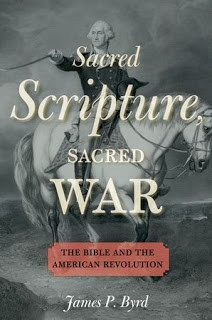 “The Revolution may be the most important event in American history,” James P. Byrd reminds us. Many of the readers of this blog will likely agree with him in that. Fewer, perhaps, will agree with one of the central arguments of his (very) recent Sacred Scripture, Sacred War: The Bible and the American Revolution that “the Bible was arguably its [the Revolution’s] most influential book.”[1] At the recent OIEAHC conference in Baltimore I was able to get my hands on a copy of this excellent new book and Sacred Scripture, Sacred War has given me a lot (despite it’s relatively conciseness) to chew on over the last two weeks.
Continue reading
Reprint This! Thomas Buckley’s “Church & State in Revolutionary Virginia”
 Every sub-field has its classic books. It should not take long for most of us to rattle off a couple of titles. In my field of church-state relations in the early American republic (particularly in the upper South), few books tower over the field more than Thomas E. Buckley’s Church and State in Revolutionary Virginia, 1776-1787.[1] Despite being published thirty-six years ago references to this classic litter the footnotes of subsequent books from fellow classic histories like Rhys Isaac’s Transformation of Virginia to more recent works such as David Sehat’s Myth of American Religious Freedom.[2] Anyone grappling with the politics of religion in early national Virginia, that overheated cauldron of disestablishment, must grapple with Buckley’s work. But this great historian did not stop there; in a series of articles Buckley expanded his analysis to include much of the evolution of religious freedom in the Old Dominion over the nineteenth century.[3] Continue reading
“Anonymous and Cacophonous Pleasures”
Jared Gardner, The Rise and Fall of Early American Magazine Culture. Urbana, Chicago, and Springfield: University of Illinois Press, 2012.
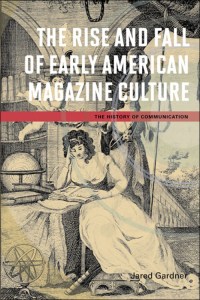 Almost by definition, studying communications media means examining the nature of rationality and the meaning of citizenship. So literary historians generally see the novel, which privileges dialogue and individual subjectivity, as helping to constitute a liberal social order, while political historians see newspapers as essential to various expressions of republicanism and democracy. In The Rise and Fall of Early American Magazine Culture, Jared Gardner contributes to the history of American citizenship by arguing that early-national American literary intellectuals mostly had their minds on a different print medium – and that they embraced a neglected model of rational public discourse.
The Agonies of “Christian Republicans”
This is not, sadly, a post about the troubled relationship between the modern Republican Party and politicized Christianity. I’d like to discuss, rather, a powerful and provocative synthesis of American political, theological, and religious history published a decade ago – Mark Noll’s America’s God. Noll’s magisterial tome brings together over a generation of scholarship on the relationship between American politics and religion (the “democratization thesis”), civic humanism (the “republican thesis”), and Scottish commonsense philosophy in the early national and antebellum United States.[1] America’s God is in many ways a capstone to Noll’s truly outstanding career as a great historian and public intellectual. Continue reading
Jay Gitlin’s French Frontier
Jay Gitlin, The Bourgeois Frontier: French Towns, French Traders, and American Expansion. The Lamar Series in Western History. New Haven: Yale University Press, 2010.
Jay Gitlin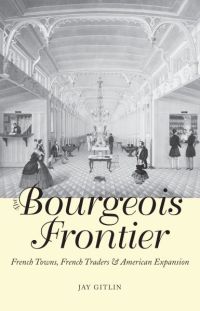 begins this history of the francophone West with geologist William Keating, on an 1823 scientific expedition to the United States’s western frontier, marveling at the number of French speakers he encountered in the Mississippi basin. Who were these people? And why were so many of them still around, six decades after the Seven Years’ War had supposedly terminated the French presence in North America? The Bourgeois Frontier aims to answer these questions, and to explain why—two centuries later—Americans remain as ignorant of these people as Keating had been. The result is a compelling account of the francophone towns that formed a crescent-shaped constellation along the western fringe of the early American republic. In eight chapters of buoyant prose chronicling the 1760s through the Civil War, Gitlin shows how the French Creoles who inhabited these towns adjusted and adapted as American expansion changed their world. Continue reading
The Early Americanist Holiday Book List; Or, My Favorite Books from 2012
If there is a better purpose for an academic blog than to make lists of must-have books and dents in your Amazon budget, I am not aware of it. As the first of what I hope will be an annual tradition, here are ten of my favorite books from the past 12 months. It is obvious that I have particular interests and tastes (early republic, religion, politics), but I tried to expand my comfort zone and include a few titles from other fields. So if you are looking for books you may have missed, need a reminder for books you still need to buy, or require evidence to present to your significant other, you have come to the right place.
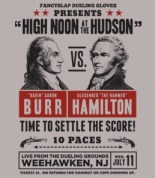 (Placing any of these books on your holiday book list, of course, assumes that you have already purchased this year’s “must have” gift for early Americanists, the Aaron Burr/Alexander Hamilton duel t-shirt, seen to the right.) Continue reading
Jeffersongate: The Case of Henry Wiencek

On October 16, Farrar, Straus and Giroux published Henry Wiencek’s third book, Master of the Mountain: Thomas Jefferson and His Slaves. His previous works both dealt with slavery, most notably his well-received An Imperfect God: George Washington, His Slaves, and the Creation of America. By contrast, his latest work has come under fire from leading Jefferson scholars around the country. Within days of the book’s release, highly critical reviews by academics appeared in online magazines. These reviews started online exchanges that have played out over the last two months and continue to do so.
Historians much more up to the task than myself—including Annette Gordon-Reed, Jan Lewis, and Lucia (Cinder) Stanton—have called into question Wiencek’s use of sources (both primary and secondary), his overall interpretation, and his motives. Therefore, I will not recapitulate all of them here. I have included a chronology with links to all the relevant articles below, with J.L. Bell’s posts at Boston 1775 providing excellent summaries of the most contentious points. Instead, I want to touch on two things: the main part of Wiencek’s argument and how it reflects his broader approach to history and the effects of Wiencek’s treatment of the historiography, both having to do with the larger relationship between popular and academic history. Continue reading
 The Junto