 Later this week, thousands of women’s and gender historians will convene in Toronto for triennial meeting of the Berkshire Conference on the History of Women. The Berks lineup attests to the vibrancy of scholarship in early American gender history. To help you navigate the 198-page conference program, we thought we’d spotlight panels with papers on early America and the early modern Atlantic World. Continue reading
Tag Archives: conferences
Guest Post: “Early Modern France and the Americas” Conference Recap
Craig Gallagher is a PhD candidate in History at Boston College. His dissertation analyzes Scots and their religious and economic networks in the late seventeenth century British Atlantic World.
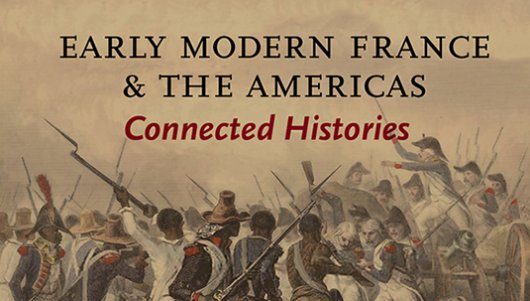 Atlantic history has always had at its heart a simple enough goal: to connect the histories of Europe, Africa, and the Americas so that historians can better understand each in relation to the others. Scholars have disagreed about how best to realize this goal, and about whether it is a goal worth realizing at all, but few have denied that Atlantic history as a pursuit has enriched our understanding of the early modern world. Although this has been particularly true for historians of the British and Spanish empires in the Americas, it is a more recent development among scholars of the French empire. By convening the “Early Modern France and the Americas: Connected Histories” Symposium (Program; #FrenchAtlantic on Twitter) at Boston College on May 2-3 – an event co-sponsored by the Institut des Amériques – the organizers, Owen Stanwood (Boston College) and Bertrand van Ruymbeke (Université de Paris VIII), sought to showcase those historians of France and French North America whose work, either in print or in progress, has extended an Atlantic perspective to the history of France and its early modern empire in the Americas.
Yes, Virginia, there was an American Enlightenment
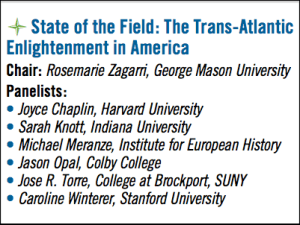 Thanks to John Fea’s live-tweeting and subsequent reflections on OAH panels this past weekend, I would like to address some of the points and comments made during the panel entitled, “State of the Field: The Trans-Atlantic Enlightenment in America.” Since Twitter is problematic in getting across complex ideas due to its 140-character limitation, I have chosen a few of the tweets in which the comments seemed to me to be common arguments or perceptions that I have previously encountered.
Is Blogging Scholarship? Reflections on the OAH Panel
 On Sunday, at the 2014 OAH Annual Meeting, I was part of a roundtable discussion entitled “Is Blogging Scholarship?” Several other participants have posted their thoughts on the subject; there was also a great deal of live-tweeting, and our own Joe Adelman has also joined (and developed!) the conversation. The discussion itself was fantastic, and was videotaped for later broadcasting. But in reflecting on the panel, I’ve found there are some points I wish to re-emphasize, and some problems I have with the way the entire roundtable was framed. Continue reading
The Week in Early American History

Happy New Year, dear readers! Hope you had a merry Christmas. Did you watch the ball drop in Times Square? The technology dates back to the early 19th Century, when the Royal Navy ruled the waves and captains needed a way to periodically recalibrate their ships’ chronometers. In the New Netherlands, Dutch colonists spent New Year’s Day going over to each other’s houses for nieuwjaarskoeken. We here at The Junto, meanwhile, have been busy collecting all the links of note you may have missed over the holidays. Continue reading
The Week in Early American History

‘TWEAH, two nights before Christmas, when thr’out the blog roll
Not a creature was stirring, not even a troll;
The grades were all posted to Blackboard with care,
In hopes that strong evals soon would be there;
The grad students were nestled all snug in their beds,
While visions of fellowships danc’d in their heads,
And Ben Park in his ‘kerchief, and I in my cap,
Had just settled our brains on an early Americanist recap.
The Week in Early American History

I may be imagining things, but it seems that every time I take a turn with TWEAH there’s a major weather event going on outside my window. That may not be the case, but this edition comes to you with the first New England snow of the season. So if you’re stuck inside this morning, or just back from shoveling, take a few minutes to make a hot drink and see where The Junto may lead you.
Conference Panels and Intellectual Connections
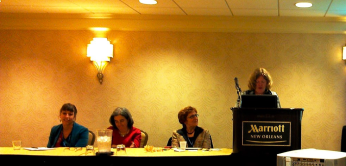 For early Americanists, fall is conference-planning season. Proposals for the Omohundro Institute Conference were due in mid-September, SHEAR is accepting proposals until December 1, and a bevy of other conferences have posted CFPs in recent months. Watching this flurry of activity has led me to think about the intellectual goals that structure the formation of conference panels.
Of course, the conference panels we form—and whom we invite to participate in them—are partly functions of pragmatism. Each of us wants to find our way onto the program of our desired meeting, and mobilizing our networks is one way to do this. We scramble to find friends, colleagues, friends-of-friends, and acquaintances from research trips and prior conferences to join us on our panels. But if one of the goals of conferences is to enter into scholarly conversations, rather than simply to share our work with academic audiences, then it is essential to think about the kinds of questions our panels are asking and answering. Continue reading
Everyday Connections of Colonial Economies: Conference Recap
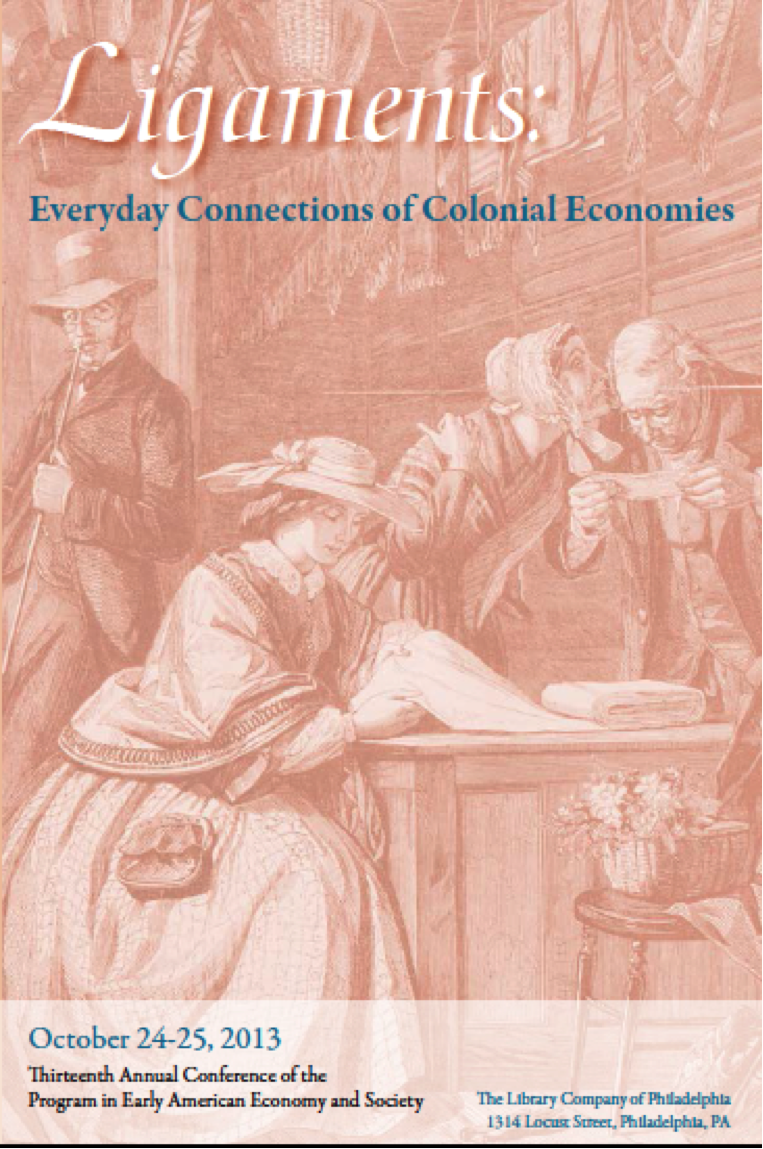 In our writing and teaching, we often refer broadly to “the early American economy,” suggesting that various systems of production, consumption, and exchange formed a collective whole. But what were connections that bound together this early American economy? Fifteen presenters—and a large and engaged audience—considered this question at the Program in Early American Economy and Society’s annual conference at the Library Company of Philadelphia on October 24th and 25th.
The conference title, “Ligaments,” referenced the connections and linkages that gave shape to the early modern economy. As PEAES director Cathy Matson explained in her introduction, the conference assembled some of the many scholars who are currently examining “ordinary, pragmatic economic connections” and using their investigation of these seemingly mundane topics to shed light on “big ideas” and longstanding questions. Continue reading
Guest Post: The Dutch Revolt and New Netherland: 36th Annual New Netherland Seminar
Elizabeth M. Covart (PhD, UC-Davis, 2011) is an independent historian located in Boston, Massachusetts, who specializes in early American history. She also blogs at Uncommonplace Book: An Independent Historian’s Blog and is a Contributing Editor for the Journal of the Early Americas and contributor to the Journal of the American Revolution.
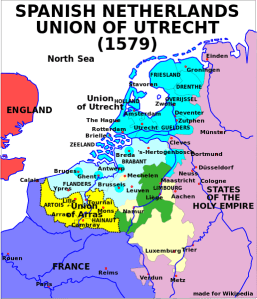
As my book project explores the cultural legacy of New Netherlanders who lived in Albany, NY, I attended the 36th Annual New Netherland Seminar on Saturday, October 5 at the New-York Historical Society. I admit that I attended the conference as an interloper; I study the revolutionary and early republic periods.
 The Junto