Articles of Note: Spring and Summer 2013

Many months ago, I posted the first of what I hoped to be a quarterly series highlighting recent articles I enjoyed, and inviting readers to do the same. Sadly, life got in the way, and so I have a bit to make up. As a recap for this roundup’s purpose: there are so many journals publishing quality articles in the field of early American history that it is difficult, if not impossible, to keep up. So this list serves as a reminder that you need to catch up on new issues, a identify articles I found especially important, as well as a chance to highlight the work of young scholars and friends. Just because an article doesn’t make the list doesn’t mean I didn’t like it—in fact, I am way behind on my own reading—but it is an invitation to list your own favorite recent articles in the comments below.

The following articles were published between March and September, and obviously reflect my own interests and background. Also, remember the fantastic articles in the special WMQ issue on families and the Atlantic world that I highlighted a few months ago. Continue reading

Policy and Constitutional Principle

As a Brit teaching early American history in the US, I’m often asked how I came to be fascinated by the American Revolution. My answer is generally some version of the following: I’m fascinated by the American Revolution because there are so many reasons why it shouldn’t have ended with the creation of an American republic. Not only was the notion of independence from Britain a daring and risky move, but there were many reasons why the North American colonies could not cohere once they had broken with the mother country. Investigating the ways in which Americans tried to bridge the many gaps between themselves to create powerful and lasting governmental structures is one of the key themes of my research.

A large part of the answer to that conundrum, at least once historical focus shifts to the early republic, is the Constitution. Though, as I have written elsewhere, the mechanics of writing and ratifying the Constitution were scarcely the pristine and perfect process of popular imagination, the longevity of the Constitution must rank as one of the most significant achievements of the revolutionary era. Yet a close look at pretty much any period of American history sees the Constitution wielded as a partisan weapon as often as it is venerated as a ligature holding the separate states together. That is a curious paradox, for there is an implicit and serious criticism in describing a governmental act as “unconstitutional.” It suggests a lack of patriotism and a lack of common feeling; it implies mistrust, rather than emphasizing shared responsibility. Continue reading

After Democratization?

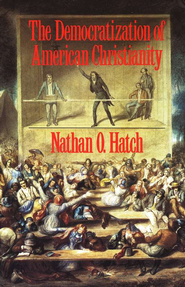
democratizationofamericanchristianityNext year marks the twenty-fifth anniversary of the publication of Nathan Hatch’s seminal The Democratization of American Christianity.[1] Few books have had as wide an influence and impact in my field of the cultural and political history of religiosity in the early American republic. In his masterwork Hatch achieves what most scholars yearn for throughout their entire careers. Democratization crystallized an interpretative scheme (the “democratization thesis”) and shoved its rival interpretation into the historiographical abyss. Continue reading

Primary Sources in the Classroom: Politics and Pedagogy

This is my first “real” blog post for The Junto, though I’ve been a spectral presence each Sunday with a gathering of links on early American history (which the past month or so has revolved a great deal around Lincoln and Django Unchained). One of my aspirations in agreeing to contribute, and one of my hopes for a developing conversation, centered on the opportunity to discuss teaching early American history, from the 100-level survey to upper-level courses. So I offered for this post to write something about teaching primary sources, without at the time knowing quite what I would say.

Then, last week, the National Association of Scholars released a report assailing colleges in Texas (the flagships – UT-Austin and A&M) for teaching too much “race, class, and gender,” and not enough political, diplomatic, and economic history. I wrote about a few of the report’s shortcomings at Publick Occurrences 2.0 on Friday. You can read the substance over there, but as I was writing I realized that I want to extend my thoughts to think more deeply about what we do in the classroom. Continue reading

National Identity and the American Revolution

In his recent review of Kevin Phillips’s 1775: A Good Year for Revolution, Jack Rakove argues that in tackling the causes of independence, “Phillips deals with political loyalties more fundamental than the mere matter of party allegiance.” The inference is clear—deciding to be a member or an activist for a political party is one thing; but your nationality is something that defines you in perpetuity. Once revolutionaries chose to take on the label ‘American’, there was no turning back. It was who they were; while that American identity might be complex and multifaceted, there is something about “national character” that stands above the rough and tumble of party politics. Continue reading

The Agonies of “Christian Republicans”

This is not, sadly, a post about the troubled relationship between the modern Republican Party and politicized Christianity. I’d like to discuss, rather, a powerful and provocative synthesis of American political, theological, and religious history published a decade ago – Mark Noll’s America’s God. Noll’s magisterial tome brings together over a generation of scholarship on the relationship between American politics and religion (the “democratization thesis”), civic humanism (the “republican thesis”), and Scottish commonsense philosophy in the early national and antebellum United States.[1] America’s God is in many ways a capstone to Noll’s truly outstanding career as a great historian and public intellectual. Continue reading

The Founders, the Tea Party, and the Historical Wing of the “Conservative Entertainment Complex”

Following the recent election, much has been made of the alternative reality created by the “conservative entertainment complex.” However, conservative media has not only created its own contemporary reality; it has also created its own historical reality, through what one might call the historical wing of the conservative entertainment complex.

In recent years, men like David Barton, Bill O’Reilly, and Glenn Beck, among numerous others, have written a number of books on eighteenth-century figures and events. But though they claim to be getting their principles directly from “the founders,” what they are really doing is giving their principles to the founders and the eighteenth century, more generally. This revisionism, promoted by conservative think tanks, was lapped up by hardcore conservatives and perhaps no group of people has been a more receptive audience than those who identify themselves as supporters of the Tea Party. Continue reading

Herman Husband and Failures of the Historical Imagination

At this time of the semester, amid my ever-increasing piles of grading, my thoughts naturally turn to the syllabi for next semester’s courses. One of my guiding principles in preparing syllabi is the importance of introducing students to the breadth of historical writing; to demonstrate the ways in which diverse groups of people reacted to the same event in very different ways. When teaching early American history, this often casts me in the position of “debunking” various myths about the past—or, at least, forcing my students to think more clearly and carefully when making statements about the foundations of America. This, I like to think, serves the useful purpose of demonstrating how ordinary citizens—those outside the pantheon of “Founding Fathers”—imagined the development of their society, and to show how their vision of political participation was often very different from that claimed today as ‘what the Revolution was all about’.

In many ways, though, my take on the Revolution relies less on “debunking” myths than in widening the participants in the historical story. I suppose “problematizing” or “complicating” the myths is a more accurate description—after all, it’s impossible to escape the fact that the historical significance of the American Revolution rests on the creation of a new nation-state and several new political polities. More recently, though, I’ve come to wonder exactly what I’m hoping to achieve with the broadening of the understanding of the past. No matter how far we widen “founding myths” to encompass a variety of explanations for the promise of America, reliance on these myths can never help us explain the present—they can be a guide only. At my most cynical, I wonder even what sort of guide they can be. Continue reading