Today’s guest poster, William S. Cossen, is an Atlanta-based historian of the nineteenth- and twentieth-century United States, specializing in the intersection of religion and nationalism. He serves as the book review editor for H-SHGAPE (Society for Historians of the Gilded Age and Progressive Era) and am a member of the faculty of The Gwinnett School of Mathematics, Science, and Technology, the top-ranked public high school in Georgia. Cossen received his PhD in History from The Pennsylvania State University and is currently revising a book manuscript entitled, Making Catholic America: Religious Nationalism in the Gilded Age and Progressive Era.
Maura Jane Farrelly, Anti-Catholicism in America, 1620-1860 (New York: Cambridge University Press, 2018).
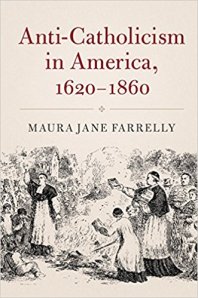 Whether John Higham was correct in describing anti-Catholicism as the “most luxuriant, tenacious tradition of paranoiac agitation in American history” is a matter of debate.[1] Not as disputed, though, is the reality that, until relatively recently, a great many Americans did view Catholicism as one of the principal threats to liberty and order in the United States. Maura Jane Farrelly’s masterful new volume, Anti-Catholicism in America, 1620-1860, traces the development of anti-Catholicism in the United States (or what would eventually become that country) from the establishment of Plymouth Colony to the coming of the Civil War. Farrelly’s work is at once a survey bringing together several decades of scholarly work on American religious, social, and political history, and an impressive example of primary-source research in its own right. For Farrelly, a professor of American studies at Brandeis University, the history of American anti-Catholicism extends beyond questions of religiosity, instead encompassing the meaning and composition of the nation. As she explains in the book’s introduction, “Any understanding of anti-Catholicism…requires us to interrogate the meaning of American freedom and, by extension, the promise of American identity.”[2] Continue reading
 As I type, President Donald Trump is tweeting: “
 After a total of 8,175 votes cast, we are pleased to announce that the winner of Junto March Madness 2017 is…
  The Round of 32 voting is completed and we have out Sweet Sixteen match-ups. See the bracket below for results. Below that, begin voting for the next round. Voting for the Round of 16 will conclude Thursday, March 23rd at 5pm EST. Results and the Round of 8 match-ups will be posted on the morning of Friday, March 24th. Happy voting!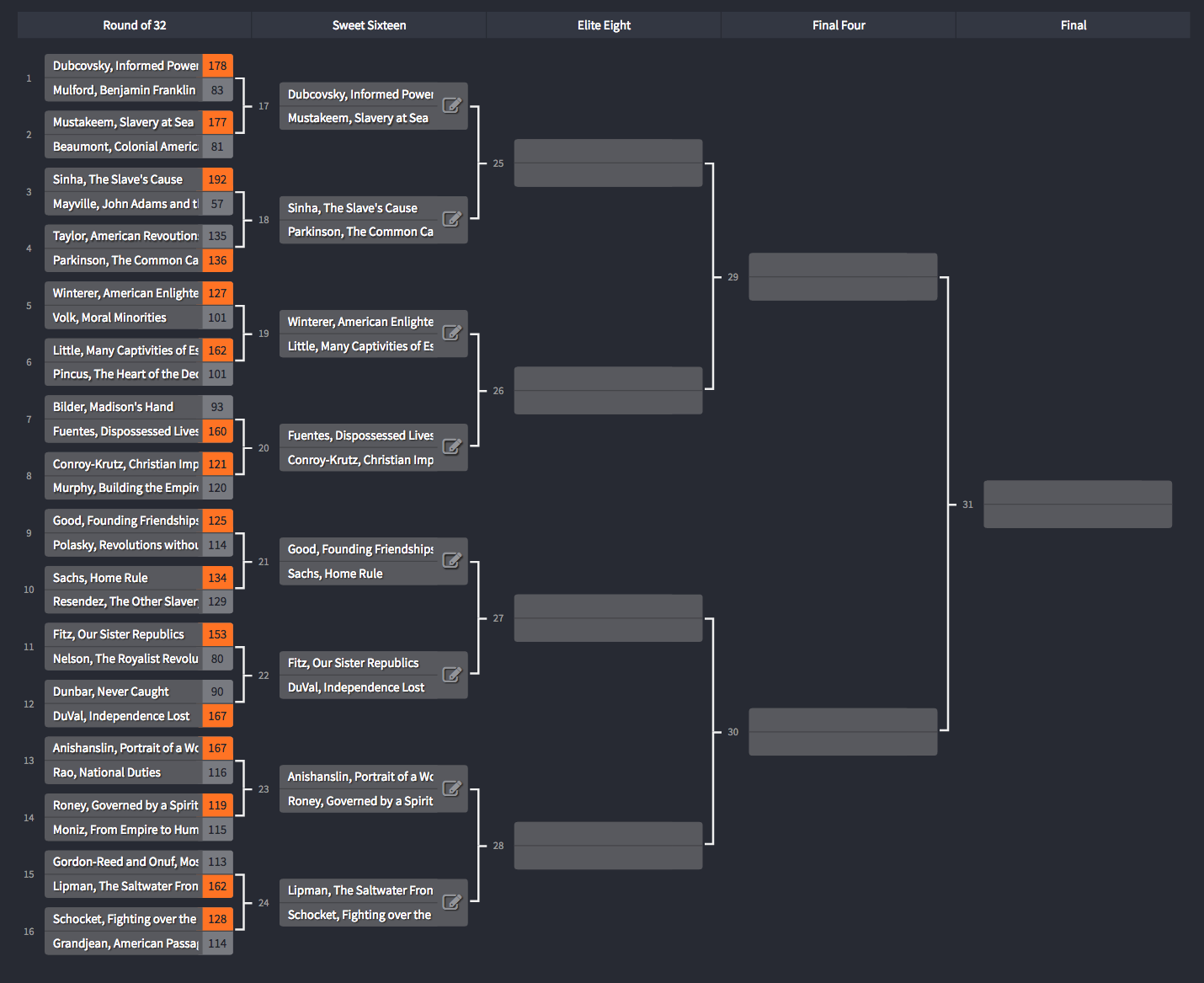
 Welcome one and all to the 5th annual Junto March Madness (#JMM17). This year’s tournament will cover books in early American history (broadly defined) published since 2014. There are, however, a few key differences from past years. First, this year’s tournament will feature 32 books rather than 64. Moreover, we have decided to forego the open nomination process. The 32 works in the bracket below were selected by the 25 members of the blog. Before voting begins, let me also offer our usual disclaimer: JMM is meant to be fun and to expose more people to excellent recent scholarship on early America. It is not meant to determine the “best” book on early American history since 2014 but to show the favorites of our readers. As always, we encourage participants to use both the comments here on the blog and our hashtag (#JMM17) to discuss these works. With that out of the way, here is this year’s bracket (click for full-size):
  The Junto