Today’s guest post comes from Spencer W. McBride, who has blogged with us before. Dr. McBride received his PhD at Louisiana State University in 2014 and is now a historian and documentary editor at the Joseph Smith Papers. His research examines the politicization of clergymen during the American Revolution and in the early American republic.
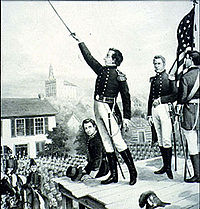 Of the ten amendments that comprise the United States Bill of Rights, the third amendment is arguably the least controversial. Go ahead, think back to your high school civics class and try to remember what rights are protected by the third amendment. Can’t remember? Don’t feel too bad. It is rarely invoked by politicians and political activists, it does not often spark heated debates in the media, and the U.S. Supreme Court has never heard a case in which it was the primary basis. Let’s face it, since the adoption of the first ten amendments to the Constitution, Americans have not been overly concerned that the government will quarter troops in the homes of private citizens without their consent. Continue reading
 The
The  Such is the line that Alfred Young opened his classic The Shoemaker and the Tea Party: Memory and the American Revolution (Boston: Beacon Press, 1999). In a way, the phrase captures much of his overall scholarship. Other contributions to this roundtable have/will cover(ed) how he did this in his influential books, essays, and edited collection. In my post, I want to focus on how he translated his approach into a work that is probably read more than any of his other books. Indeed, Shoemaker and the Tea Party is a popular book in the classroom, both undergrad and graduate, since it tells a fascinating tale with an important message.
  ndro Institute and the University of Southern California-Huntington Library Early Modern Studies Institute are pleased to announce the tenth in a series of William and Mary Quarterly-EMSI workshops designed to identify and encourage new trends in understanding the history and culture of early North America and its wider world.

 The Junto