We at The Junto are thrilled to host this guest post from Erik J. Chaput and Russell J. DeSimone, who are the historians-in-residence on the Dorr Rebellion Project Site sponsored by Providence College. Chaput is the author of The People’s Martyr: Thomas Wilson Dorr and His 1842 Rhode Island Rebellion (University Press of Kansas, 2013). DeSimone is the author of Rhode Island’s Rebellion (Bartlett Press, 2009). Chaput and DeSimone have collaborated on a number of projects, including this article on Common-place.org. Chaput and DeSimone welcome feedback on the site. They can be contacted at: echaput@providence.edu and russbook1@cox.net.
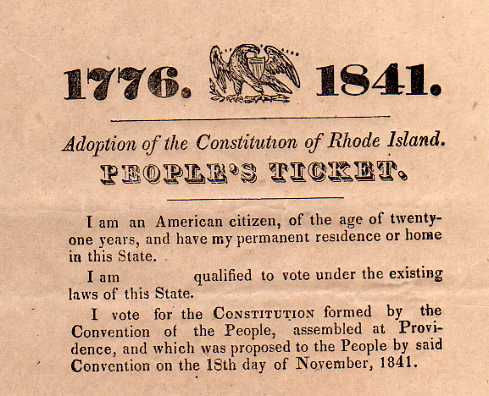
The “People’s Ticket,” with a direct reference to 1776, served as a connection between the American and Dorr Rebellions.
When Rhode Island finally ratified the U.S. Constitution in May 1790, the state sent back to Congress eighteen amendments. These amendments revealed a deep suspicion of the new central establishment, a suspicion that had been increased by the failure to include a bill of rights. The first line of the lengthy third amendment declared that “the powers of government may be reassumed by the people, whensoever it shall become necessary to their happiness.” Continue reading
 This week at The Junto, we are pleased to offer a roundtable review on Walter Johnson’s recent
 I planned on doing another “Articles of Note” post for today since it’s been a few months since the last one, and lots of new articles are indeed noteworthy, but I’m feeling lazy today. Plus, as a more legitimate excuse, the William and Mary Quarterly just put out an issue that is worth highlighting by itself. What originated as a conference sponsored by the OIEAHC and the Institute for Historical Studies at the University of Texas at Austin, “Centering Families in Atlantic History” addresses an important (and often neglected) issue in the vibrant, popular, yet often uneven field of study based around the Atlantic Ocean. In brief, two of the lessons that stood out the most to me were 1) the importance of family connectedness within an era usually dominated by an emphasis on empires and states, and 2) the much-needed diversification that encompasses much more than just Anglo-America (perhaps the biggest problem with the “Atlantic History” field.)