 It’s that time of the week and it’s my turn to do the roundup, so let’s just get started with some links from the past week or so… Continue reading
Author Archives: Michael D. Hattem
Historians and Documentary Editing
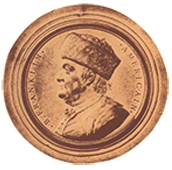 On this—the 223rd anniversary of the death of Benjamin Franklin—I thought I would use this space to say a few words about my experience over the last year working at the Papers of Benjamin Franklin here at Yale University from the perspective of a graduate student. Last June, I was fortunate enough to be given a regular (part-time) position at the Franklin Papers. Officially, I am a Research Assistant and have done a number of small research projects designed to provide the editors with reference materials on Pennsylvania in the 1780s as they finish up the volumes covering Franklin’s stay in Paris. I have also been given the opportunity to tackle more editorial-type duties including fact-checking, drafting annotations, and proofreading transcriptions. Through these experiences and my innumerable conversations with the chief Editor, Ellen Cohn, I have gotten an inside look at scholarly editing, which often goes either unnoticed or under-appreciated by academic historians. Continue reading
The Week in Early American History
I’d like to start this week’s roundup by reminding everyone that the Junto March Madness begins tomorrow. In case you live under a rock (or—shudder at the thought—have a life outside books and blogs), we here at The Junto are combining two of our favorite things: basketball and historiography. On Thursday, we asked readers to nominate five books each to help fill out NCAA tournament-style brackets. One three-hour Google Hangout later and the brackets were set. Check here for a full explanation of Junto March Madness and here to download the brackets. Voting in Brackets 1 & 2 begin tomorrow and will continue through subsequent rounds into next week (see John Fea’s predictions here). I cannot stress enough that this should not be taken too seriously (particularly the “seedings”). The primary purpose of it—unlike the actual NCAA tournament—is not to find a winner; it is to spark discussion between the blog members and our readers.
Reconsidering Edmund Morgan’s The Birth of the Republic, 1763-89
 In line with Matt Karp’s look back on Eric Hobsbawm’s Age of Revolution from last month, I’d like to take this opportunity to reconsider a classic work in early American history, Edmund Morgan’s The Birth of the Republic, 1763-89, which has just recently made it to its fourth edition. I have a long relationship with this slim volume. For many years before I began my undergraduate work as a 30-year old non-trad, I had been reading early American history, particularly classic works in the historiography, which has fascinated me since the beginning. I spent years going through the New York and Brooklyn Public Libraries’ 970 shelves and one of the earliest books I read was Birth of the Republic. A decade later, I am now extremely fortunate to be doing my doctoral work at Yale University, where Morgan taught and worked for three decades. Though he has long since retired into reclusion (having just turned 97 last month), he still casts a large shadow over the department. Graduate students here (myself included) whisper about a rare Morgan sighting and get excited when they find one of his books at a book sale with his name (and/or marginalia) written in it. So I very much appreciate this opportunity to return to and reassess this work. Continue reading
Review of “New Netherland in a Nutshell”
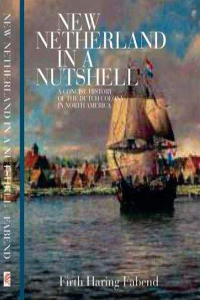 Public history can take many forms. We, here at The Junto, are committed to engaging with and covering public history regarding early America. The New Netherland Institute is an excellent example of an organization dedicated to bringing early American history to the public. I want to use this space to talk about its most recent publication, Firth Haring Fabend’s New Netherland in A Nutshell: A Concise History of the Dutch Colony in North America.
Fabend is an independent historian (though she holds a PhD in American Studies from NYU) and is the author of numerous books of fiction as well as two award-winning works of history also dealing with New Amsterdam, both of which were published by Rutgers University Press. Continue reading
Review: Todd Andrlik, “Reporting the Revolutionary War”
 My interests in the late colonial and revolutionary periods include print culture and history of the book. Ever since I was an undergraduate and first accessed a Readex database, I have been fascinated with colonial newspapers and not just the content but with the mechanics, logistics, and persons involved. Every major research project I have undertaken has made significant use of newspapers and pamphlets. In that time, I have come to understand and appreciate the centrality and importance of newspapers to colonial life, particularly in but not limited to urban areas. Indeed, I have always felt quite privileged to have access to such primary sources and perhaps it is part of the standard vanity of the historian but I also always suspected that general readers—the kind who buy books about the Revolution by the truckload—would be just as interested in seeing and just as excited by these primary sources as I continue to be. Todd Andrlik thought the same thing and his book, Reporting the Revolutionary War: Before it was History, it was News, appears to have proven me right. Continue reading
More Public than Spherical: The NNPH and the “Public Sphere”
 Historians of early America often stereotype each other as being adverse to the use of theory. However, a closer look at the historiography of early America over the last century does not bear out that claim. In the first decades of the twentieth century, Progressives derived their materialist conception of history from Marx.[1] The Progressive interpretation held for decades until the 1960s when a group of historians based at Harvard University displaced it with an interpretation influenced by the sociological theories of anthropologist, Clifford Geertz.[2] Even though postmodernism and postcolonialism, as theories, never took a strong hold on the field, there have been early American historians who have sought to incorporate, in a general sense, their broader modes of inquiry.[3] The historiography of early America has hardly been devoid of theory over the last one hundred years.
Nevertheless, a deeper look into each of these examples shows us that early Americanists’ relationship with theory has been anything but obsequious. Perhaps, it is best defined as casual or, better yet, utilitarian. The Progressives appropriated the generalities of Marx’s historical materialism without embracing either his sociological analysis or his broader dialectic. Similarly, the ideological historians of the 1960s and 1970s used Geertz’s definition of ideology as the mediation of experience into the structure of consciousness without attempting to apply the rest of his intricately complex theory regarding cultural systems. Following in that tradition, early Americanists over the last twenty years, particularly those associated with the New New Political History, have loosely appropriated the Habermasian concepts of the “public sphere” and “civil society” while casting aside both small but fundamental details and the much larger particulars of Habermas’s argument.[4] Continue reading
Where Have You Gone, Gordon Wood?
Gordon S. Wood is perhaps the most prominent of the many Bernard Bailyn-trained historians to emerge from Harvard in the 1960s and 1970s, including Richard Bushman, Michael Kammen, Michael Zuckerman, Lois Carr, James Henretta, Pauline Maier, Mary Beth Norton, and many others. In the late 1960s, Wood’s dissertation-turned-first-book, The Creation of the American Republic, 1776-1787, had arguably as large an impact on the field as his mentor’s Ideological Origins of the American Revolution did a few years before, both helping to usher in the heady days of the “republican synthesis.” This is all to say that Wood had earned himself a prominent spot in the field of early American history from pretty much the very start of his career. However, subsequent generations of early Americanists have grown increasingly hostile to not only Wood’s work but to the man himself. This leads to the question: Why is it acceptable (or even praiseworthy) behavior among early Americanists to treat one of the most important historians in the field in the last century disrespectfully? In this piece, I’d like to talk about Gordon Wood’s career trajectory, suggest that other historians’ reactions to him reflect not only Wood but on historians themselves, and ask whether that might give us even a fleeting insight into generational differences between early Americanists. Continue reading
The AHA and the Future of the Profession

This past weekend, historians from all over the country invaded the Big Easy for the American Historical Association’s 2013 Annual Meeting. Thanks to Twitter, those of us unfortunate enough to not be in attendance were kept abreast of the discussions occurring regarding the state of the field. Most notably, the traditional AHA Presidential Address by outgoing President William Cronon has sparked much debate among historians as well as articles in the New York Times and the Chronicle of Higher Education. Before that, Cronon oversaw a panel entitled “The Public Practice of History in and for a Digital Age,” which explored academic historians’ failures to reach the general public and the profession itself failing to sufficiently adapt to the rise of digital technology. Changes to the profession discussed included a renewed focus on storytelling and narrative to better engage the general reader in academic history, weighing digital history equally with print history (when of equal value), and rethinking the monograph as the standard mode of delivery of academic historians’ work. Due to my lack of attendance, I am indebted to the excellent Twitter and blog coverage of these events by John Fea, Lincoln Mullen, and others, as well as the History News Network‘s video recording of Cronon’s address (see below). Continue reading
American Revolution: The Game
 Warning: Please be advised that there are a few spoilers in terms of the game’s storyline in the fourth paragraph of this post.
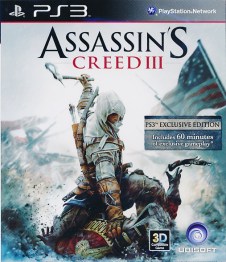
This is a strange topic for me to be writing on, i.e., a video game. After all, I am not what some younger Juntoists might call “a gamer.” But when I saw the trailers for Assassin’s Creed III last summer I found my anticipation for the game growing. Assassin’s Creed III is a historical fiction-based game in which the main character—a half-English, half-Mohawk warrior called Connor—finds himself at the center of many of the most important events of the American Revolution. Let me start with a little background on the game.
 The Junto