 I read our roundtable on second book projects while filing away information for the future. As I made those mental files, I also found myself making a list of some of the more mechanical issues I encountered while turning my dissertation into my first book. That book isn’t done—it’s back in the press’s and readers’ hands for the moment, so I’m sure I might have some additional ideas down the line—but today I’d like to offer a preliminary list of stuff I wish I’d known. I also hope that other Juntoists will chime in with their experiences; several of us have published books now, or will very shortly do so. This isn’t the first time I’ve written about the dissertation-to-book process, but I think of some of the things I’ve written before as general advice for scholars in different fields. Today I wanted to offer some more general advice, and to also delineate some thoughts that are pretty specific to historians. Continue reading
Author Archives: Rachel Herrmann
Q&A with Adrian Miller
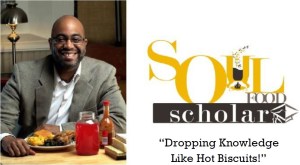 Today we’re featuring an interview with Adrian Miller, author of The President’s Kitchen Cabinet: The Story of the African Americans Who Have Fed Our First Families, from the Washingtons to the Obamas. Miller is a food writer, attorney and certified barbecue judge who lives in Denver, CO. He is currently the executive director of the Colorado Council of Churches and, as such, is the first African American and the first layperson to hold that position. Miller previously served as a special assistant to President Bill Clinton and a senior policy analyst for Colorado governor Bill Ritter Jr. He has also been a board member of the Southern Foodways Alliance. Miller’s first book, Soul Food: The Surprising Story of an American Cuisine, One Plate at a Time won the James Beard Foundation Award for Scholarship and Reference in 2014. Continue reading
“We lost our appetite for food”: Why Eighteenth-Century Hangriness Might Not Be a Thing
The following post has been cross-posted from an ongoing series about diet and nutrition over at Nursing Clio. I am grateful for permission to re-post it here; if you have time, definitely go read the other blog posts!
In August 2015, Oxford Dictionaries declared that the word “hangry” had entered our common vocabulary. Surely most people living in the twenty-first century have experienced the sense of being simultaneously hungry and angry. During the eighteenth and nineteenth centuries, hunger was also everywhere. A recent NPR essay examines how slaveholders withheld food from enslaved people, such as Frederick Douglass, because hunger gave them greater control over people of African descent. Historian Alan Taylor has written about periods of famine after the American Revolution. During some of these years of food shortages that Taylor describes, Iroquois clan mothers pressured other Native Americans into ceding land because they wanted “peace and food relief,” as they did in 1785 at Fort Herkimer.[1] Hunger has been, and continues to be, a key facet of power relations. Continue reading
A Grammatical Declaration of Independence
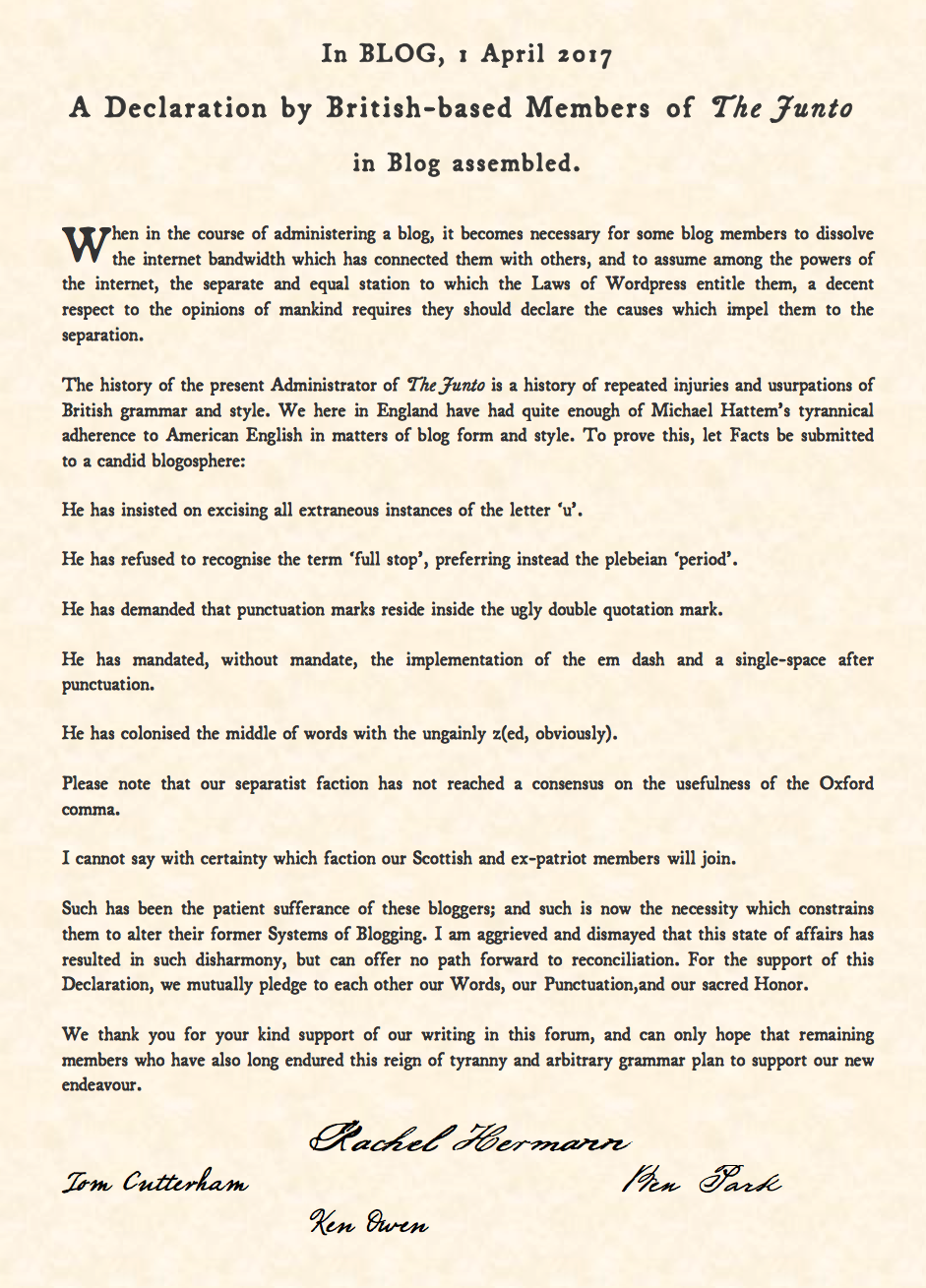 As a result of the misbehaviour of several Juntoists, I am quite sorry to announce that I, along with several other members, will be leaving The Junto and forming a new online forum for the study of early America. Our declaration follows: Continue reading
A Pedagogical Ode to Google Docs
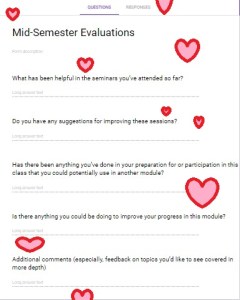 Well team, I’ve made it to Easter Break after my first post-sabbatical return to teaching, and if my silence on the blog has been any indication, it’s been busy. The sabbatical was obviously good for thinking about research and book stuff, but what I hadn’t anticipated was that the end of my sabbatical would also push me to reassess the ways that I teach. More specifically, it prompted a reexamination of the preparatory work that I do before seminars, and raised questions about the relationship between the amount of time I spend prepping and the extent to which my students benefit from my prep. Lately, I’ve been doing less prep myself and using various types of Google tools—Docs, Forms, and Sheets, mostly—to make students more responsible for their learning. Here’s how and why: Continue reading
Guest Post: Dress and West African Desire
Jessica Blake is a PhD candidate in U.S. History at the University of California-Davis, where she is completing a dissertation entitled, “A Taste for Africa: Imperial Fantasy and Clothes Commerce in Revolutionary-era New Orleans.” She is currently a dissertation fellow at the Winterthur Museum and Archive.
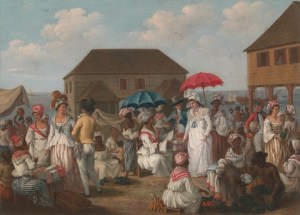
Linen Market, Dominica, by Agostino Brunias (1780), Yale Center for British Art
In 1808, the New Orleans trader John Joly placed an advertisement in the Moniteur de la Louisiane for a shipment of large Angola shawls (grands shals d’Angola), a rectangular cloth of African construction meant to drape over the shoulders. Joly marketed the cloth for the general consumer, making no indication that he considered it a product intended solely for use by enslaved or free people of color.[1]
Continue reading
Q&A with Sowande’ Mustakeem
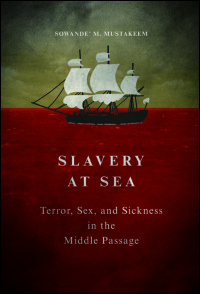 This is an interview with Sowande’ Mustakeem, who is an Assistant Professor in the departments of History and African and African American Studies at Washington University in St. Louis. Today she speaks with The Junto about her book, Slavery at Sea: Terror, Sex, and Sickness in the Middle Passage, which Casey Schmitt reviewed yesterday. Her previous work has appeared in journals such as Atlantic Studies and the Journal of African American History, and edited volumes such as Understanding and Teaching American Slavery, Teaching Lincoln: What Every K-12 Student Needs to Know, and Gender, Race, Ethnicity, and Power in Maritime America. Continue reading
Star Wars, Food Diplomacy, and Second Book Projects
 Over the winter break I was back in Austin, catching up with grad school friends and reveling in a week’s worth of breakfast tacos. Part of this week included a trip to the Alamo Drafthouse to see Rogue One, because we all know work/life balance is important. For the uninitiated, the Drafthouse is a magical movie theater where you can view new movies while eating and drinking. They’re famous for their all-day Lord of the Rings marathon, complete with second breakfast and elevenses. So I was pretty excited to see what themed food and beverages the theater managed to create using inspiration from the Star Wars cannon. Remember how I said work/life balance is important? Well it is, but sometimes I have trouble switching off.[1] Continue reading
Call for Papers for the British Group of Early American Historians’ next conference
BGEAH 2017: “Land and Water: Port Towns, maritime connections, and oceanic spaces of the early modern Atlantic World.” Call for Papers
The British Group of Early American Historians will hold its annual conference at the University of Portsmouth, 31 August – 3 September 2017.
Drawing on Portsmouth’s historic significance as a port town this year’s conference theme is: “Land and Water: Port Towns, maritime connections, and oceanic spaces of the early modern Atlantic World.” Portsmouth was a site of embarkation for those who shaped (or attempted to shape) the political, social, and demographic contours of the Atlantic World: the Roanoke colonists departed from the town in 1587; as did Admiral Nelson for the Battle of Trafalgar in 1805. It was a hub of imperial force in the form of the Royal Navy and intimately connected with the imperial conflicts across the globe, and also of the protection and then prevention of the transatlantic slave trade. Yet, as with all port towns, the social space between water and land was a space for contestation and conflict; a space for opportunity and escape. Continue reading
J. K. Rowling, History, and Revisionism

Source: allnightavenue on Flickr
I feel like I’m writing more than a few pieces lately that start with “I love [X], BUT . . .” and apparently today is no different. I’ll just come out and say it: I love Harry Potter, but I have trouble with J. K. Rowling’s treatment of history. Harry Potter was immensely important to my young adulthood. I read the books as a teenager, went to more than one midnight movie release, bought and consumed Bertie Bott’s Every Flavour Bean, and dressed as a character from the books for Halloween.[1] I tend to re-read the novels once a year, when I’m looking for ways to improve my ability to tell a story. I wasn’t a historian when I first started reading the books, so I didn’t look too critically at Rowling’s characterizations of history and historians. Now that I am a historian, I’ve come to the conclusion that although Rowling’s portrayal of our discipline is wrong, her depiction of the wizarding world’s past—and how people interpret and at times attempt to change and revise it—is much more in keeping with the task that muggle historians daily confront. Continue reading
 The Junto