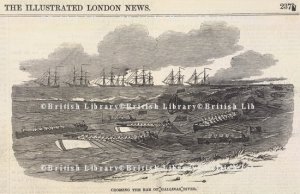
Crossing the bar of Gallinas River, near Sierra Leone and Liberia. During the 1820s and 1830s, slave ships stopped at the mouth of the Gallinas River, to collect slaves. Image taken from The illustrated London News. Originally published/produced in London, 1849. British Library Images Online, Shelfmark P.P.7611.237, filename 080997
This summer I started research for my second book project, which I will admit feels a bit ridiculous when my first book project is still in process. I’m blithely ignoring this problem at the moment. In brief, the project, currently-horribly-titled “Aquatic Foodways” asks two related questions: 1) Where, why, and how did people fight over food when crossing water in the early modern Atlantic, and 2) What happened when people disembarked and interacted with indigenous peoples as they searched for sustenance? After a month of preliminary research at the British Library this summer, I’m decidedly more interested in the second question, but have a sense that I’ll need to answer the first question before proceeding forward. Continue reading →
 It’s March here at The Junto (and, um, the rest of the world), which means it’s time for our annual March Madness tournament! By now you probably know the drill: you nominate, we bracket, and voting begins to establish a champion. Last year’s tournament can be found here: Michael Jarvis’s In the Eye of All Trade beat out a number of strong competitors to finally triumph in the tournament of nerdom.
 Here are your links this week, broken into cleverly categorized paragraphs!
 So you know what’s hilarious? Trying to revise your dissertation into a book during the semester. I will admit that I am in the middle of editing my worst dissertation chapter, and am yelling out of a metaphorical pit of despair that’s been dug by a combination of bad prose and end-of-the-semester angst. Part of these struggles have to do with the fact that even after writing the chapter, submitting it, and defending it, I’m still not really sure what this chapter’s argument needs to say. This problem is directly tied to the fact that I found (and continue to find) myself befuddled by late-eighteenth-century Southern Indian affairs. So many factions! So much switching of sides! So many different ways I manage to mis-type Scots-Creek go-between Alexander McGillivray’s last name!



 The Junto