 Historian Thomas Kidd recently published some suggestions on the dos and don’ts of promoting your academic book. His recommendations, which included suggestions of not joining social media just for the purpose of promoting your book was good. My aim here is not to repudiate Kidd, but rather to add my own thoughts. Since the content of The Junto is written primarily by early career scholars, I thought I might also contribute some points that may be self-evident to more senior historians, but perhaps less obvious to those who are newer to the field. This advice is also mainly geared towards those who publish with academic presses. Trade publishers function differently.
Category Archives: Academia
Can Class Participation Be Taught?


Class participation has bothered me since I graded a set of midterm exams from my first solo-taught course. As I sat down to read through those signature blue books, I felt anxious about how my students would perform. Had they learned anything? Did the lectures thus far sink in at all? To gauge the potential quality of the exams, I scanned through some of the responses of my “better” students and felt fairly confident grading the rest.
At the end of the stack, however, I came across an exam that has stuck with me. The student in question had me worried all semester. Not only did this student refuse to participate in class discussions but she frequently looked irritated whenever I asked the class a question that wasn’t rhetorical. Continue reading
Early America Comic Con: Drawing the American Revolution

Chan Lowe/Tribune Content Agency
“Welders make more money than philosophers,” Marco Rubio said in a recent G.O.P. debate. “We need more welders and less philosophers,” he continued, proudly. It was a decent line from the presidential hopeful. But not long after these words echoed around the Milwaukee Theatre, it was shown to be a somewhat clumsy statement, not least when seen alongside figures from the Bureau of Labor Statistics (comparative wages: philosophers & welders). Thus over the days following Rubio’s line, it was caricatured, with one cartoonist picking up on Rubio’s wording. This G.O.P. presidential candidate is not alone: All of the 2016 presidential candidates, Democrat and Republican, have been caricatured. So, too, are their worldwide equivalents on a regular basis. Continue reading
Roundtable: Academic Book Week—What’s an Academic Book Anyway?
 Is Rachel Carson’s Silent Spring an academic book? Is Mary Wollestonecraft’s Vindication of the Rights of Woman? The list of twenty nominees for “the academic book that has most changed the world,” part of the UK’s Academic Book Week, is a pretty confusing collection. Plato’s Republic is a product of the academy, sure, but is George Orwell’s 1984? In the US, we’re in the middle of University Press Week, which is a much more easily-identifiable category. We should all celebrate the important role of university presses in preserving scholarly endeavour from the rapacious maw of the market. In the face of ever-deeper cuts, they deserve our vigilant support. Continue reading
Finding Its Way: Gordon Wood and the William and Mary Quarterly
 Gordon Wood’s essay, “History in Context,” published in The Weekly Standard in February 2015, whirled up a Twitterstorm. His thoughts on twenty-first-century historians’ scholarship were provocative, and many took umbrage at many of his points. One of Wood’s perhaps overlooked arguments was his statement on the William and Mary Quarterly. “The William and Mary Quarterly,” Wood argued, “now publishes articles on mestizos in 16th-century colonial Peru, patriarchal rule in post-revolutionary Montreal, the early life of Toussaint Louverture, and slaves in 16th-century Castile. The journal no longer concentrates exclusively on the origins of the United States. Without some kind of historical GPS, it is in danger of losing its way.” Was Wood’s assessment—or, perhaps more astutely, diagnosis—correct? Has the William and Mary Quarterly lost its way? To answer this question, let’s build upon yesterday’s post and crunch some numbers. Continue reading
Guest Post: The Art of Absconding: Slave Fugitivity in the Early Republic
Guest Poster Shaun Wallace (@Shaun_Wallace_) is an Economic and Social Research Council-funded Ph.D. candidate at the University of Stirling. His dissertation examines how reading and writing influenced and aided slave decision-making in the early republic. Shaun holds a B.A. (Hons.) and a MRes. from the University of Stirling and is president of Historical Perspectives, a Glasgow-based historical society run by and for graduate students in the United Kingdom.
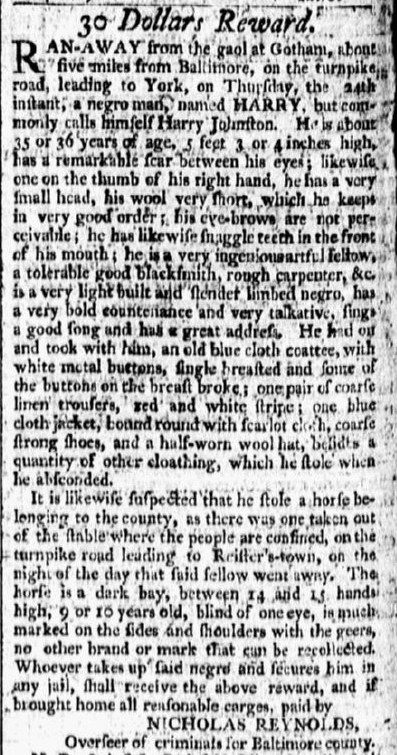 A “very ingenious artful fellow” appears a peculiar description of a runaway advertised for recapture. The advertisement, for Harry or Harry Johnstone, featured in Baltimore’s Federal Gazette newspaper, on May 2, 1800, at the request of Nicholas Reynolds, overseer of criminals for Baltimore County. Harry had absconded from Gotham gaol, near Baltimore. Reynolds described Harry as a “tolerable good blacksmith” and a “rough carpenter.” A “very talkative” slave, he was a man of “great address.” On first impression a relatively congenial description; in actuality, Reynolds’s use of the term “artful” condemned the runaway.[1]
Continue reading
The Origins of the American Revolution: Religion
Yesterday, Tom Cutterham kicked off our week-long roundtable on the Origins of the American Revolution with a discussion of Nick Bunker’s recent book, An Empire on the Edge. Today, we continue with a discussion of religion and the American Revolution.

George Whitefield Preaching in Philadelphia
In 1781, as the American Revolution raged, a Connecticut magazine reported that a spectral George Whitefield (1714-1770) had appeared over a regiment of British troops, including Benedict Arnold. So frightened were these British regulars, the magazine claimed, that they burned their British finery. Those familiar with the consumer politics of the Revolutionary period will recognize the political statement implicit in the burning of British goods. With refinement, British clothing, textiles, and other goods had become attractive to well-heeled colonists, who emulated the latest London fashions. As T.H. Breen and others have noted, the wearing of British fashions became problematic during the Revolution. Textiles and other factories began to crop up in the northeast, the start of an American industry.[1]
Post Removal
The Junto has removed the post on Hamilton: An American Musical, published July 17, 2015, at the request of the show’s producers and creative team. We apologize for any inconvenience this may cause.
Teaching Trauma: Narrative and the Use of Graphic Novels in Discussing Difficult Pasts
Roy Rogers kicked off yesterday’s 4-day roundtable with a review of the graphic novel, Rebel. For day two of our roundtable on graphic novels and history, I will discuss the use of graphic novels in teaching traumatic histories.
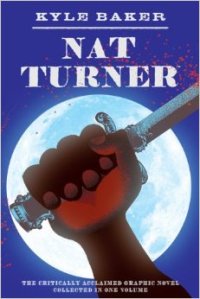 As anyone who has taught the history of slavery knows, it can be challenging. It is an important, but also emotionally loaded subject that can provoke spirited responses from students. Some students are resistant to discussing what they view as an ugly event in the past. Others may become defensive. And, for others, the history of slavery may be personal. The challenge becomes presenting the history in a thoughtful way that will engage students, but does not whitewashing history. Other traumatic events—genocide, war, etc.—can present similar pedagogical challenges.
SHEAR 2015 Annual Meeting Preview
 The 37th annual meeting of the Society for Historians of the Early American Republic will take place in Raleigh next week (July 16-19). I could not be more excited. To help spread the conference cheer, I’m going to offer a brief preview of a few sessions that caught my eye. Continue reading
 The Junto