 Gordon Wood’s essay, “History in Context,” published in The Weekly Standard in February 2015, whirled up a Twitterstorm. His thoughts on twenty-first-century historians’ scholarship were provocative, and many took umbrage at many of his points. One of Wood’s perhaps overlooked arguments was his statement on the William and Mary Quarterly. “The William and Mary Quarterly,” Wood argued, “now publishes articles on mestizos in 16th-century colonial Peru, patriarchal rule in post-revolutionary Montreal, the early life of Toussaint Louverture, and slaves in 16th-century Castile. The journal no longer concentrates exclusively on the origins of the United States. Without some kind of historical GPS, it is in danger of losing its way.” Was Wood’s assessment—or, perhaps more astutely, diagnosis—correct? Has the William and Mary Quarterly lost its way? To answer this question, let’s build upon yesterday’s post and crunch some numbers. Continue reading
Category Archives: Commentary
Hamilton, Art, History, and Truth
 By now you’ve probably heard or read something about Hamilton: An American Musical, the hip-hop biography of Alexander Hamilton now running on Broadway. (If not, you can start with our reviews by Chris Minty and Nora Slonimsky and Ben Carp.) I went to see it last week with a group of historians (how’s that for a nerdy event?) and had an amazing time. First of all, the show is fantastic on all of the standard measures of the experience—the acting, the music, the singing and choreography, the set—they’re all great. You should see it if you can, because it’s really that good. But what makes Hamilton a bit different is how interesting it is as a vessel for conveying history to the general public, the argument it makes about Hamilton’s life, and the use of artistic license to make such an incisive historical argument.
The American Revolution within the British Imagination
 Four months ago, I reviewed Andrew D. M. Beaumont’s Colonial America and the Earl of Halifax. A biography of an often overlooked figure, Beaumont makes a strong case for including Halifax in standard interpretations of the coming of the American Revolution. As Beaumont showed, to enrich our understanding of colonial British America, including the 1760s and early 1770s, we must appreciate the importance of high-ranking British officials. We also need to isolate and account for the behavior of the people underpinning and changing the constitutional relationship between Britain and its colonies in North America. Continue reading
The Origins of the American Revolution: Religion
Yesterday, Tom Cutterham kicked off our week-long roundtable on the Origins of the American Revolution with a discussion of Nick Bunker’s recent book, An Empire on the Edge. Today, we continue with a discussion of religion and the American Revolution.

George Whitefield Preaching in Philadelphia
In 1781, as the American Revolution raged, a Connecticut magazine reported that a spectral George Whitefield (1714-1770) had appeared over a regiment of British troops, including Benedict Arnold. So frightened were these British regulars, the magazine claimed, that they burned their British finery. Those familiar with the consumer politics of the Revolutionary period will recognize the political statement implicit in the burning of British goods. With refinement, British clothing, textiles, and other goods had become attractive to well-heeled colonists, who emulated the latest London fashions. As T.H. Breen and others have noted, the wearing of British fashions became problematic during the Revolution. Textiles and other factories began to crop up in the northeast, the start of an American industry.[1]
Historians Attend Lin-Manuel Miranda’s Hamilton: An American Musical
This post was written by Christopher Minty and Nora Slonimsky, who, many moons ago, woke up early on a Sunday morning to purchase tickets to the opening-night preview performance of Hamilton: An American Musical, which took place on July 13, 2015, at the Richard Rodgers Theater in New York City. This post was originally posted on July 19, 2015. It was removed as a courtesy to the show’s creative and promotional teams. It has been reposted with significant alterations and additions.
 Hip-hop is on Broadway, not just in a popular YouTube video. On Monday, July 13, 2015, Lin-Manuel Miranda’s hit off-Broadway musical, HAMILTON, made its debut on the big stage. On August 6, 2015, rebranded as Hamilton: An American Musical, a much-applauded, diverse cast returned to perform in the official opening of a much larger, hopefully long-running production at the Richard Rodgers Theater.
Are Your People Getting Mad?
“Are your people getting mad?,” George Washington asked Benjamin Lincoln when he heard the news of what was happening in New England in the autumn of 1786. “Many of them appear to be absolutely so,” the Massachusetts general replied, “if an attempt to annihilate our present constitution and dissolve the present government can be considered as evidences of insanity.”[1] By the end of the 1780s, America’s revolutionary elites increasingly resorted to the same explanation. What could possibly explain the conflicts that were starting to tear apart the new republic? How could the same people who fought for the Revolution now have such different ideas about what its outcome should be? Continue reading
Post Removal
The Junto has removed the post on Hamilton: An American Musical, published July 17, 2015, at the request of the show’s producers and creative team. We apologize for any inconvenience this may cause.
Graphic Novels in the Classroom
 This week we’ve discussed the graphic novels as historical fiction, the strengths of using graphic novels to discuss fraught material, and complex process of adapting historical research to sequential art. We would like to end our roundtable discussing more broadly the possibilities of using graphic novels in the classroom.
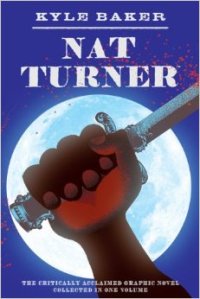
The first strength of graphic novels is their novelty. Assigning works like Kyle Baker’s Nat Turner or Fetter-Vorm and Kelman’s Battle Lines is a surprise to most students. By not being another monograph or set of primary sources, graphic novels shake up a syllabus. This is good for students, who may be interested in exploring a subject in a more unconventional way, and for teachers, for it forces us to reconsider how to teach subjects we may have taught many, many times. This novelty also adds some additional accessibility for students who might be skeptical of reading more traditional assignments. Continue reading
Teaching Trauma: Narrative and the Use of Graphic Novels in Discussing Difficult Pasts
Roy Rogers kicked off yesterday’s 4-day roundtable with a review of the graphic novel, Rebel. For day two of our roundtable on graphic novels and history, I will discuss the use of graphic novels in teaching traumatic histories.
 As anyone who has taught the history of slavery knows, it can be challenging. It is an important, but also emotionally loaded subject that can provoke spirited responses from students. Some students are resistant to discussing what they view as an ugly event in the past. Others may become defensive. And, for others, the history of slavery may be personal. The challenge becomes presenting the history in a thoughtful way that will engage students, but does not whitewashing history. Other traumatic events—genocide, war, etc.—can present similar pedagogical challenges.
The Writer Assumes All Responsibility
For the week of July 13-17, The Junto is hosting “Graphic History: Sequential Art & History,” a roundtable examination of relationship between history and graphic novels. We will explore graphic novels as historical fiction, as histories, and their uses in the classroom. For our first entry, Roy Rogers reviews a new comic book series about the American Revolution from award-winning writer Brian Wood.

What does a historical epic of the American Revolution look like in the twenty-first century? Continue reading
 The Junto