 As most, if not all, of our readers are aware, this past weekend was the “So Sudden an Alteration” conference hosted by the Massachusetts Historical Society in commemoration of the 250th anniversary of the Stamp Act.[1] It was the second of three conferences dedicated to rebirthing Revolution studies, hence, the hashtag #RevReborn2. (NB: You can find the immense backchannel coverage of the conference Storified here: Day 1, Day 2, and Day 3. You can also find Joseph Adelman’s interactive TAGSExplorer that chronicled the Twitter coverage). This post is not intended to be a standard Junto-type conference recap. Instead, I just want to offer some afterthoughts on the conference, specifically in light of the piece I wrote before the conference, entitled “Have Cultural Historians Lost the Revolution?” as well as numerous other pieces I have written about the historiography of the Revolution and the state of Revolution studies for the blog, particularly before the first #RevReborn conference back in 2013. Continue reading
Category Archives: Conferences
Live Coverage of “So Sudden an Alteration” Conference
As you know from last week’s posts by Michael and Ken, this weekend is the second major conference in two years on the American Revolution, So Sudden an Alteration, hosted by the Massachusetts Historical Society.
There have already been a number of great papers, and some hot debates on the meaning of studying the Revolution, with more to come today.
We will have full coverage next week, but in the meantime, you can keep up with the conference on Twitter by following the hashtag, #RevReborn2, or Juntoists at the conference, including me (@jmadelman), Jessica Parr (@ProvAtlantic), Michael Hattem (@MichaelHattem), and Tom Cutterham (@tomcutterham).
You can also follow several friends of the blog: Liz Covart (@lizcovart), John Bell (@Boston1775), and the MHS institutional account (@MHS1791).
UPDATE (4/12, 8pm): Now that the conference is over, you can also check out several summations of the conference.
Michael Hattem created a Storify for each of the three days of the conference:
And there is also a more basic archive of tweets and an interactive explorer.
No Politics, No Revolution
 If there is a current orthodoxy among historians of the American Revolution, it is that the study of the Revolution has lost its focus. In their introduction to the Common-Place edition recapping the McNeil Center’s “The American Revolution Reborn” conference, Patrick Spero and Michael Zuckerman wrote of “a field that had grown stale” and that was “losing its verve, and worse, its center.” The call for papers for the forthcoming Massachusetts Historical Society conference effectively described the field as being stuck in a historiographical rut. There is a reason that study of the Revolution has lost its center. It has failed to concentrate its focus on politics. Continue reading
Have Cultural Historians Lost the American Revolution?
 In just over a week from now, the Massachusetts Historical Society is hosting, “‘So Sudden an Alteration’: The Causes, Course, and Consequences of the American Revolution,” an important conference on the American Revolution in recognition of the the 250th anniversary of the Stamp Act. This is the second of three conferences dedicated to rediscovering or re-energizing study of the American Revolution, the first of which, “The American Revolution Reborn,” was hosted by the McNeil Center for Early American Studies in the spring of 2013. And so with the conference fast approaching, I want to use this piece to think about the specific moment and circumstances in which American Revolution studies currently finds itself, which has been the catalyst for this series of conferences, and suggest possibilities going forward. The primary circumstance of that moment, with which many seem to agree, is that the study of the Revolution is in a rut, plodding along in the same “well-worn grooves of historical inquiry” for the “past fifty years,” according to the conference’s call for papers. Continue reading
Deadline approaching for Cannibalism in the Early Modern Atlantic
 Do you like cannibalism? As a topic, obviously, not a personal preference. Of course you do! If research travels will take you to England this summer (or if you reside in the UK or nearby), please consider submitting a proposal for a conference I’m organizing at the University of Southampton this June. Continue reading
The Week in Early American History
 Happy 2015 to our Junto readers! Continue reading
The Junto Guide to Early America at #AHA2015
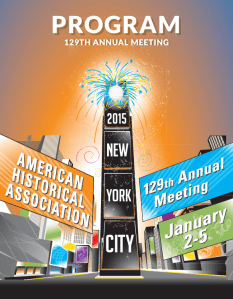 Happy New Year from all of us at The Junto! We hope you had a restful and enjoyable holiday break. For historians, the turn of the calendar to 2015 means that many of us are en route to the AHA Annual Meeting in New York City. Having grown up in the area, I’d like to welcome you all to New York, where the bagels and pizza are really just better, and we stand “on line” for coffee, not “in line.”
Guest Post: “Fear in the Revolutionary Americas” Conference Recap
Elizabeth M. Covart is an early American historian, writer, and podcaster. Presently she is working on her first book manuscript about cultural community creation in Albany, New York, 1614-1830. Liz also writes a practical blog about history and how to make it more accessible at Uncommonplacebook.com and her new podcast, “Ben Franklin’s World: A Podcast About Early American History,” seeks to bring the work of academic and public historians to history lovers everywhere.
 October 31, 2014. On the most fearsome day of the year, Tufts University convened “Fear in the Revolutionary Americas, 1776-1865,” a one-day conference designed to explore the question: What role did fear play in the revolutions that occurred in North and South America between 1776 and 1865? Continue reading
WMQ-EMSI Workshop CFP: Early American Legal Histories
The Omohu ndro Institute and the University of Southern California-Huntington Library Early Modern Studies Institute are pleased to announce the tenth in a series of William and Mary Quarterly-EMSI workshops designed to identify and encourage new trends in understanding the history and culture of early North America and its wider world.
Participants will attend a two-day meeting at the Huntington Library (May 29–30, 2015) to discuss a precirculated chapter-length portion of their current work in progress along with the work of other participants. Subsequently, the convener may write an essay elaborating on the issues raised at the workshop for publication in the William and Mary Quarterly. The convener of this year’s workshop is Sarah Barringer Gordon of the University of Pennsylvania. Continue reading
CFP: Consent in Early America, 1600-1900
 What does it mean to give consent? Or to withhold it? In what situations is it asked for? When isn’t it? And why? These are questions that most historians of early America face some time, some way or another. But the range of uses of consent is vast, from the many senses of government through relations of labour, exchange, sex, and kinship. Next March at the Rothermere American Institute in Oxford, Kathryn Olivarius and I will hold a conference with the aim of drawing connections and patterns across these disparate realms. Continue reading
 The Junto