Digital Pedagogy Roundtable, Part 1: Students’ Access to Sources

This week, The Junto will feature a roundtable on digital pedagogy, in which we discuss our different approaches to using digital sources in the classroom. Today, Rachel Herrmann talks about the challenge of access. Jessica Parr, Joseph Adelman, and Ken Owen will also contribute.
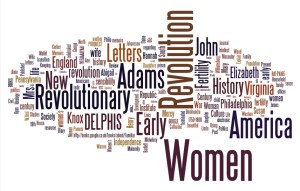
A Wordle made from sources my undergraduates located for our in-class source-finding competition

A Wordle made from sources my undergraduates located for our in-class source-finding competition

Let me preface this post by saying that I’d hesitate to call myself a digital humanist; I don’t code or map or mine texts. As Lincoln Mullen pointed out a while back, however, digital practices exist on a spectrum. There are some things I do for my own research and in the classroom—tweeting, running my department’s social media accounts, using Amazon’s “Look Inside” feature to chase up a footnote so as not to use up one of my precious Interlibrary Loan requests, and of course, blogging for The Junto—that digital humanists also do. These approaches have been helpful in my teaching for three problems related to access to sources. Continue reading
Guest Post: 84th Annual Anglo-American Conference Recap, Fashion

Kimberly Alexander holds the Ph.D. in Art and Architectural History from Boston University. A museum professional and scholar, she is adjunct faculty in the History Department at University of New Hampshire. Her book, “Georgian Shoes Stories From Colonial America” will be published by Johns Hopkins University Press in 2016.

The 84th Anglo-American Conference of Historians was held in London at the Institute of Historical Research, University of London, and the Victoria and Albert Museum. This year’s theme was “fashion.”

tumblr_njavpyZfz11soj54lo1_500

For the first time in its distinguished history, the AACH selected ‘fashion’ as its theme, confirming for many scholars the recognition that the field of fashion history, and its attendant subfields, have attained validation. To quote the conference program:

“Fashion in history is a topic which has come of age in recent years, as scholars have turned to addressing what is chic and what is style over the ages and across different cultures. The history of fashion, and the role of fashion in history, is not just confined to the study of dress and costume, but encompasses design and innovation, taste and zeitgeist, treats as its subjects both people and objects, and crosses over into related disciplines such as the history of art and architecture, consumption, retailing and technology.” Continue reading

Graphic Novels in the Classroom

This week we’ve discussed the graphic novels as historical fiction, the strengths of using graphic novels to discuss fraught material, and complex process of adapting historical research to sequential art. We would like to end our roundtable discussing more broadly the possibilities of using graphic novels in the classroom.

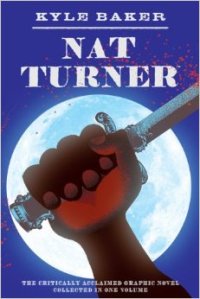
The first strength of graphic novels is their novelty. Assigning works like Kyle Baker’s Nat Turner or Fetter-Vorm and Kelman’s Battle Lines is a surprise to most students. By not being another monograph or set of primary sources, graphic novels shake up a syllabus. This is good for students, who may be interested in exploring a subject in a more unconventional way, and for teachers, for it forces us to reconsider how to teach subjects we may have taught many, many times. This novelty also adds some additional accessibility for students who might be skeptical of reading more traditional assignments. Continue reading

Graphic Novels Roundtable Q & A: Ari Kelman, Battle Lines: a Graphic Novel of the Civil War

We continue day three of our graphic novels roundtable with an interview with historian Ari Kelman, who co-authored Battle Lines: a Graphic History of the Civil War. Previously Jessica Parr discussed using graphic novels to explore painful histories and Roy Rogers reviewed Rebels from Dark Horse Comics

Battle-Lines-coverAri Kelman is the McCabe Greer Professor of History at Pennsylvania State University, specializing in the Civil War, Reconstruction, Memory Politics, and Environmental History. In addition to Battle Lines: a Graphic Novel of the Civil War, he is the author of two award-winning books. A Misplaced Massacre: Struggling Over the Memory of Sand Creek (Harvard, 2013) was the recipient of the Bancroft Prize, the Avery Craven Award, the the Tom Watson Brown Book Award, and the Robert M. Ultey Prize. A River and Its City: The Nature of Landscape in New Orleans (University of California Press, 2003) won the Abbott Lowell Cummings Prize. Continue reading

Teaching Trauma: Narrative and the Use of Graphic Novels in Discussing Difficult Pasts

Roy Rogers kicked off yesterday’s 4-day roundtable with a review of the graphic novel, Rebel. For day two of our roundtable on graphic novels and history, I will discuss the use of graphic novels in teaching traumatic histories.

51m-NxiSLdL._SY344_BO1,204,203,200_As anyone who has taught the history of slavery knows, it can be challenging. It is an important, but also emotionally loaded subject that can provoke spirited responses from students. Some students are resistant to discussing what they view as an ugly event in the past. Others may become defensive. And, for others, the history of slavery may be personal. The challenge becomes presenting the history in a thoughtful way that will engage students, but does not whitewashing history. Other traumatic events—genocide, war, etc.—can present similar pedagogical challenges.

Continue reading

The Writer Assumes All Responsibility

For the week of July 13-17, The Junto is hosting “Graphic History: Sequential Art & History,” a roundtable examination of relationship between history and graphic novels. We will explore graphic novels as historical fiction, as histories, and their uses in the classroom. For our first entry, Roy Rogers reviews a new comic book series about the American Revolution from award-winning writer Brian Wood. 

What does a historical epic of the American Revolution look like in the twenty-first century? Continue reading

Remembering Christopher Schmidt-Nowara, 1966-2015

150630_schmidt-nowara_insideHistorian Christopher Schmidt-Nowara passed away suddenly in Paris on Saturday, June 27th at the age of 48. Schmidt-Nowara was a prolific chronicler of the history of slavery and emancipation in the Hispanic world, as well as politics and ideas in the Spanish empire. He received his B.A. from Kenyon College in 1988. He completed his PhD from the University of Michigan in 1995, under the direction of Rebecca Scott, and taught at Fordham University in New York City for over a decade before joining the faculty at Tufts University in 2011. At the time of his death, he was Prince of Asturias Chair of Spanish Culture and Civilization at Tufts.


Continue reading

Guest Post, Vaughn Scribner: “Fabricating History PART TWO: The Curious Case Continues”

A few weeks ago, we hosted a guest post from Vaughn Scribner on mermaids. Since sequels are all the rage in Hollywood, we are having him back for seconds.

Mermaid 1

Figure 1: Image from Gottfried’s Histora Antipodum oder Newe Welt (1631). Image after de Bry. Accessed via ULB Sachsen-Anhalt.

Well, here we go again. Just when I thought I had figured out the riddle of Captain John Smith’s alleged seventeenth-century mermaid sighting, research threw me a curve ball. A quick recap: in a recent Junto post, I argued that Alexandre Dumas added a brief (supposedly legitimate) story of Smith meeting a mermaid into his fictional 1849 adventure tale. Dumas’ fabricated account, I demonstrated, steadily gained a life of its own as subsequent historians cited it as fact. I had solved the “Curious Case of John Smith, a Green-Haired Mermaid, and Alexandre Dumas.” Or so I thought. Continue reading

Guest Post: The Payroll Union’s Paris of America

Pete David is a songwriter from Sheffield, who performs with the band, The Payroll Union. They have produced two EPs—Underfed & Underpaid and Your Obedient Servant—and have two albums: The Mule & The Elephant and their most recent, Paris of America.

Andrew Heath (@andrewdheath) is a lecturer in American History at the University of Sheffield in the UK. He spent several years in grad school in Philadelphia, where he became fascinated by the city’s nineteenth-century past.

The album cover of Paris of America.

The album cover of Paris of America.

Paris of America, a new album by the Sheffield U.K.-based band The Payroll Union, is the product of a two-year collaboration between  songwriter Pete David and historian Andrew Heath. With the help of funding from Sheffield University, Pete and the band explored the turbulent history of antebellum Philadelphia: a city in which racial, religious, and social strife earned it the title of “mob town” of the Union. Here, they reflect on the project, and the possibilities of exploring the history of the Early Republic beyond the more familiar routes of text and film.   Continue reading

Q&A: Jessica Roney, Governed by a Spirit of Opposition

RoneyYesterday, Chris Minty reviewed Jessica Choppin Roney’s book, Governed by a Spirit of Opposition: The Origins of American Political Practice in Colonial Philadelphia. Today, she speaks with The Junto about the book project and the process of turning the dissertation manuscript into a book. She received her MA at the College of William and Mary and her PhD at The Johns Hopkins University. She is currently Assistant Professor of History at Temple University in Philadelphia and is organizing a global early modern conference this November: Port Cities, 1500-1800, hosted by Temple University, the Program in Early American Economy and Society, and the McNeil Center for Early American Studies. Continue reading