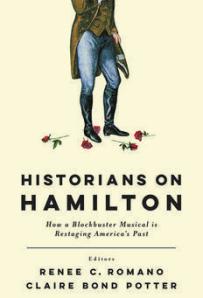
 Early this morning, two hundred and fourteen years ago, Alexander Hamilton was shot in an infamous duel with rival Aaron Burr. Hamilton died the next day, Burr’s days as a legitimate political candidate were over, and both soon faded into relative historical obscurity. Some centuries later, their tale fell into the hands of Broadway force Lin Manuel Miranda, who was fresh off the success of his first full length production, In the Heights. Hamilton’s life and death were about to make an epic comeback, styled to powerhouse ballads, rap battles, and New York city fanfare. Continue reading
Category Archives: Special Features
Q&A with Christopher Grasso, author of Skepticism and American Faith: From the Revolution to the Civil War
 Christopher Grasso earned his PhD from Yale in 1992, taught at St. Olaf College, and came to William and Mary in 1999. From 2000 to 2013 he served as the Editor of the William and Mary Quarterly. He is the author of A Speaking Aristocracy: Transforming Public Discourse in Eighteenth-Century Connecticut (OIEAHC/UNC Press, 1999) and the editor of Bloody Engagements: John R. Kelso’s Civil War (Yale University Press, 2017). His most recent book, Skepticism and American Faith: From the Revolution to the Civil War, was just published by Oxford University Press earlier this month. Dr. Grasso generously agreed to answer a few questions about the book. Continue reading
Q&A: Francis Spufford, author of Golden Hill
 Today, we conclude our week-long round table on Francis Spufford’s Golden Hill: A Novel of Old New York with an interview with Spufford himself. If you missed our earlier posts on the novel, you can find them here. Continue reading
Golden Hill Roundtable: Retracing Mr. Smith’s Steps Through Eighteenth-Century Manhattan
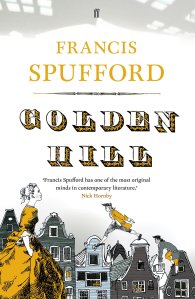 “Had a map been drawn . . . of Mr. Smith’s movements through the streets of New-York. . . a tangled hydra indeed would have been revealed,” begins the second chapter of Francis Spufford’s book Golden Hill (53). As my fellow Junto reviewers have discussed, Spufford’s exhilarating read follows Mr. Smith through the escapades and perils of mid-eighteenth-century New York as he attempts to convince those he encounters of his “credit worthiness.” As he meanders through the tangled web of city streets, Smith’s journey from the island’s southern tip to its northern outposts is filled with adventures and twists at every turn. The reader soon learns that many of the men and women he encounters have secrets to hide. There is much to like about Golden Hill. For this urban historian, one of the most enjoyable aspects is the book’s sense of place. Continue reading
Golden Hill Roundtable: Courage and Cowardice?
This guest post is the third entry in our week-long roundtable on Francis Spufford’s novel, Golden Hill. Its author is Hannah Farber, an assistant professor at Columbia University. Her scholarship has appeared in the New England Quarterly, Early American Studies and the Journal of the Early Republic; she is at work on a monograph on marine insurance, tentatively titled Underwriters of the United States.
 What a pleasure it is to wander around mid-eighteenth-century New York City with Francis Spufford, admiring the city’s homes with their “stepped Dutchwork eaves” (17) and their “blue-gray pediment[s] of Connecticut pine” (11). What a pleasure, too, to join him in pawing through the humbler artifacts of daily life in the colonial city. Pap (1). Milk punch (42). A bog-wig (2). Every page of Golden Hill overflows with weird stuff like this, and it’s just great. Continue reading
Golden Hill as Historical Historical Fiction
Francis Spufford’s historical novel Golden Hill introduces us to mid-eighteenth century New York City through the eyes of a London visitor named Richard Smith. For Smith, it’s a strange place. In the book’s first scene, as Tom discussed yesterday, he exchanges some of his own currency for local money. But he is baffled to receive an irregular stack of paper from around the continent divided into various denominations.
I immediately empathized. Only a few days before I began the novel, I had been trying to untangle what I had initially thought would be a fairly straightforward problem for an article manuscript involving colonial wage rates and commodity prices. But I had quickly found myself waist-deep in conversion charts, glossaries, and historical data about the foreign, colonial, and metropolitan currencies that circulated in eighteenth-century Anglo-America. Old tenor, new tenor, pounds, shillings, pence, halfjoes, Spanish dollars—it was a world of currency only slightly less confusing than blockchain. Continue reading
Golden Hill Roundtable: “Commerce is Trust”
This week at The Junto, we’ll be featuring a roundtable on Francis Spufford’s 2016 novel, Golden Hill (London: Faber & Faber, 2016). Set in colonial New York city, and written in self-conscious homage to eighteenth-century literary style, Golden Hill has plenty of resonance for anyone interested in the period. Following my post today, we’ll hear from Junto members Jordan Taylor and Katy Lasdow, as well as Hannah Farber, and a Q&A with Spufford himself. We will warn you if a post contains plot spoilers!
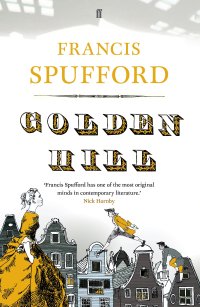 Many novels are about struggles to know the truth, and to live in a world of ambiguity, secrets, and false pretences. In Golden Hill, those themes are given eighteenth-century specificities. They appear in all sorts of symbolic guises, but none more frequently and clearly stated than the murky, miscellaneous substance of eighteenth-century money. If Golden Hill is a novel about what it means to take something—or somebody—at face value, that metaphor is made literal when the protagonist Richard Smith walks into a merchant’s office in the book’s opening pages and presents “a paper worth a thousand pounds.” Continue reading
Q&A: Jeremi Suri, author of The Impossible Presidency
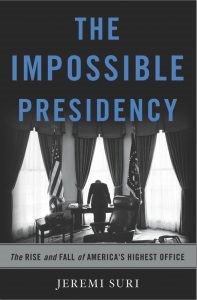 The question of whether the office of the Presidency is too unwieldy with its ever-expanding duties has once again engaged pundits. Most recently, journalist Scott Dickerson’s article raised the issue, a piece which includes the recent study by Jeremi Suri, The Impossible Presidency (New York: Basic Books, 2017). Presidents often used similar rhetorical messages–from Washington to Franklin D.Roosevelt. Suri views one of the mounting obstacles to the presidency as being a discursive problem. Interestingly, the use of language, so central to the presidency, with its surprisingly similar messaging overtime, produced unintended, and often times, inverted outcomes in its collision with capitalism and technology. Suri is currently Mack Brown Distinguished Chair for Leadership in Global Affairs and Professor in the Department of History and the LBJ School of Public Affairs at University of Texas, Austin. Continue reading
Guest Review: Benjamin Park, American Nationalisms
Skye Montgomery is a historian of the nineteenth-century United States, specializing in Anglo-American relations and the transformation of American national identity. She is currently completing a postdoctoral fellowship at the Kinder Institute on Constitutional Democracy at the University of Missouri-Columbia. Skye earned her DPhil in History at Corpus Christi College, Oxford, and is revising a book manuscript entitled, Imagined Families: Anglo-American Kinship and the Formation of Southern Identity, 1830-1890.
Benjamin E. Park, American Nationalisms: Imagining Union in the Age of Revolutions, 1783-1833 (New York: Cambridge University Press, 2018).
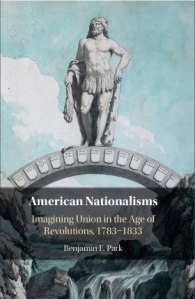
In his seminal 1882 lecture, Ernest Renan posed the deceptively straightforward question, “What is a Nation?” Although recent historiography is generally more concerned with answering the adjacent questions of how and why nations come to be, scholars of European history have produced myriad reflections on Renan’s question in the decades since the Second World War. In contrast, however, histories of early America taking nationalism as their primary category of analysis have been relatively few and focused primarily upon understandings of nationalism yoked to the nation-state. Benjamin Park’s new volume, American Nationalisms: Imagining Union in the Age of Revolutions, 1783-1833, offers a convincing explanation for this omission and makes commendable strides towards rectifying it. Continue reading
Q&A: Benjamin Park, author of American Nationalisms
 Today’s interviewee hardly needs introduction for readers of The Junto. Ben Park is an assistant professor of history at Sam Houston State University in Texas; he earned his PhD in Britain’s second-best history department, at Cambridge University; and went on to hold a postdoctoral fellowship at the Kinder Institute on Constitutional Democracy. Far more importantly, of course, he is also the founder of this blog, and author of the recent monograph American Nationalisms: Imagining Union in the Age of Revolutions, 1783-1833 (Cambridge University Press, 2018). Ahead of our review of the book tomorrow, I asked him a few questions about it. Continue reading
 The Junto