When lines were drawn by Englishmen in 1763, the Proclamation Line probably looms largest in the historian’s mindset. But another line also appeared for the first time in 1763, when Charles Mason and Jeremiah Dixon set out to survey the line that would come to bear their name. Jeremiah Dixon is of particular interest to me, as I am also a County Durham native who hopes to make his name through close and careful study of Pennsylvania. So when my parents told me about an upcoming exhibition at the Bowes Museum in Barnard Castle, County Durham, dedicated to the life of Jeremiah Dixon, I knew it was something I wanted to check out. Continue reading
Driving the Dissertation
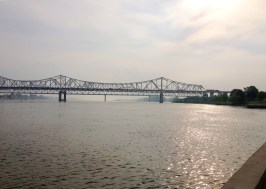 For the past several days, I’ve been on the road, driving highways and back streets of Pennsylvania, West Virginia, Kentucky, and Tennessee. Weeks before, with an invitation to an Alabama wedding, and a school year (and orals) finally behind me, I realized I had the perfect opportunity for a road trip. And being the impossibly hip grad student that I am, I also decided I’d be driving my dissertation.
Part of my research entails recovering the mid-eighteenth-century transportation and communication paths that cut across and radiated out from Ohio Valley. While I’ve studied maps, charts, letters, and travel accounts, I’d never traveled on or along those waterways, roads, or footpaths—even the well-known routes of Braddock’s and Forbes Roads.
The Week in Early American History
 Let’s get to the links…
Summer Reads
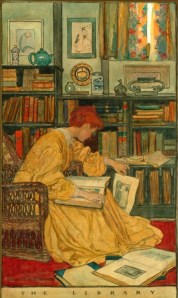
Elizabeth Shippen Green
Happily, summer revives that treasured list of must-reads that we shoved aside for coursework, research, grading, and gaming. Here are a few new releases in early American history that I plan to check out. What’s on your summer reading list? What can you recommend for us to review here at The Junto? Continue reading
An Alt Canon of Early American Primary Texts?
 We hear a lot about the “canon wars” of the 1980s and 1990s, when conservative (and neoconservative, and Straussian anti-anti-liberal, and pre-New-Left liberal) critics raised the hue and cry against relativizing multiculturalism, which was replacing War and Peace and The Scarlet Letter on college reading lists with just any random thing that wasn’t written by a wealthy straight white man. Or, if you prefer, when left-wing critics advanced the radical notion that women, homosexuals, minorities, and the poor are conscious human beings too. Or when cynical politicians and self-important idealists conspired together to undermine public confidence in higher education and the humanities. Or whatever.
Teaching Narrative in Graduate School
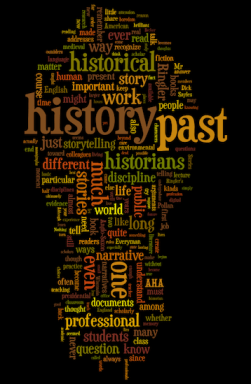
This past Monday I turned in my final paper in a graduate seminar given by John Demos entitled, “Narrative and Other Histories.” I initially registered for the class not long after watching Bill Cronon’s Presidential Address at this year’s AHA Annual Meeting and engaging in conversation about it on Twitter as well as in a piece for The Junto. With all the focus on “storytelling” and narrative as a means for carving out a twenty-first-century model of the historical profession, the course offering appeared quite timely. Continue reading
Art & Soul
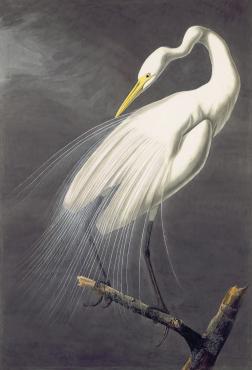
“Great Egret,” John James Audubon
I’ve always thought that John Adams knew the enduring value of a good museum trip, and the power of art to sharpen the mind while refreshing a work-weary soul. How else would he have known to share this insight with wife Abigail, written at just about this time in another May spring, that of 1780: “I must study Politicks and War that my sons may have liberty to study Mathematicks and Philosophy. My sons ought to study Mathematicks and Philosophy, Geography, natural History, Naval Architecture, navigation, Commerce and Agriculture, in order to give their Children a right to study Painting, Poetry, Musick, Architecture, Statuary, Tapestry and Porcelaine.” With those words in mind, here’s a quick survey of early American art currently on special exhibit throughout the country. Please share more links in the comments. Continue reading
Thomas Hobbes and Post-Revolutionary American Citizenship
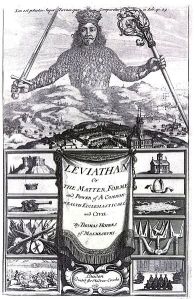 “Considered broadly,” says Douglas Bradburn, “the problem of ‘citizenship’ remains one of the most compelling contexts to attempt to understand the process, limits, and meaning of the American Revolution.”[1] This post is a brief exercise in the problem of American citizenship in the immediate post-revolutionary era (and a note towards an article-length project on international law in the new republic). It begins with the dilemma of dealing with the fallout of a civil war like the War of Independence, and it follows the reception of a slightly unexpected figure in the history of American political thought: Thomas Hobbes.
 Continue reading
The Week in Early American History
Happy Mother’s Day! Go call your Mom, then come back and take a look at our weekly round-up.
First, in honor of the holiday, one above-the-fold link: Heather Cox Richardson, writing at the Historical Society blog, looks at the origins of Mother’s Day. Hint: it’s not about “people be[ing] nice to their mothers.”
Savage Song
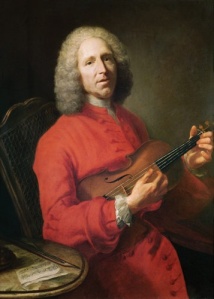 Recently I’ve been taken by the music of Jean-Philippe Rameau, a French Baroque composer and Enlightenment-era music theorist. Rameau was a divisive figure in his day because he broke from the supremely elegant and nuanced style that had made the court of Louis XIV the center of late-17th-century musical life in Europe. This excerpt from Jean-Baptiste Lully’s 1676 opera Atys gives a sense of the sensitivity and sophistication of 17th-c. French music. Compared to Lully, Rameau’s music was daring and experimental. He turned the orchestra into a powerful beast and wrote music that more dense, more harmonically adventuresome, and more aggressive. He was Frank Sinatra to Lully’s Bing Crosby, the Rolling Stones to Herman’s Hermits, N.W.A. to De La Soul; etc. (making analogies is curiously addictive). Continue reading
 The Junto