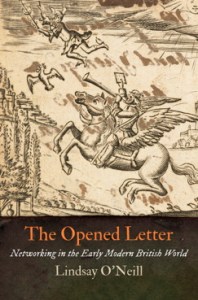
 Yesterday, Jessica Parr reviewed Lindsay O’Neill’s new book, The Opened Letter: Networking in the Early Modern British World (Philadelphia: University of Pennsylvania Press, 2015). O’Neill received her PhD from Yale University and is now Assistant Professor of History at the University of Southern California. Today, she speaks with The Junto about her book project. Continue reading
Careful Hands, Epistolary Spaces: Review of The Opened Letter
Lindsay O’Neill, The Opened Letter: Networking in the Early Modern British World (Philadelphia: University of Pennsylvania Press, 2015).
Social networks are having a moment in history. They are another approach to understanding how people came together either via proximity, social status, values, or goals, with the analytical focus on what serves as the bond in the relationship(s).[1] Social theorists have ascribed a 4-part process which entails a) similar people coming together, b) influence within these groups making its members more alike, c) people winding up in the same place, and d) shared space making people more alike.[2] In short, networks are primarily about building consensus. For historians, networks are “messy,” “fragile,” “fluid,” and disregard geographic boundaries.[3] Continue reading
Q&A: Keith Grant and Denis McKim, Borealia: A Group Blog on Early Canadian History
 We’re pleased to kick off this week with an interview featuring Keith Grant and Denis McKim, the scholars behind the latest addition to the historical blogosphere, Borealia: A Group Blog on Early Canadian History. If you have not already done so, be sure and bookmark their blog immediately and add it to your regular reading list. You can also follow Borealia on twitter @earlycanada. Continue reading
CFP: Rethinking Women’s History (Paris, June 2016)
For your Sunday, we present a call for papers for a conference to be held in Paris next June on the history of women in the early United States.
Guest Post: British Group in Early American History Conference Recap
Today’s guest post comes from Abigail B. Chandler, an Assistant Professor of History at the University of Massachusetts-Lowell.
 The annual British Group of Early Americanists Conference was held from September 3-6 at the University of Sheffield in Sheffield, England and drew a wide variety of scholars from the United Kingdom, the United States and France. In keeping with BGEAH traditions, there were many excellent papers, a key note address on Thursday night, a book club discussion on Friday and a conference dinner on Saturday, while newer traditions were started with some panels providing pre-circulated papers.
Finding Its Way: Gordon Wood and the William and Mary Quarterly
 Gordon Wood’s essay, “History in Context,” published in The Weekly Standard in February 2015, whirled up a Twitterstorm. His thoughts on twenty-first-century historians’ scholarship were provocative, and many took umbrage at many of his points. One of Wood’s perhaps overlooked arguments was his statement on the William and Mary Quarterly. “The William and Mary Quarterly,” Wood argued, “now publishes articles on mestizos in 16th-century colonial Peru, patriarchal rule in post-revolutionary Montreal, the early life of Toussaint Louverture, and slaves in 16th-century Castile. The journal no longer concentrates exclusively on the origins of the United States. Without some kind of historical GPS, it is in danger of losing its way.” Was Wood’s assessment—or, perhaps more astutely, diagnosis—correct? Has the William and Mary Quarterly lost its way? To answer this question, let’s build upon yesterday’s post and crunch some numbers. Continue reading
Guest Post: MEAD: The Magazine of Early American Datasets
Today’s guest post comes from Andrew M. Schocket, Professor of History and American Culture Studies and Director of American Culture Studies at Bowling Green State University, and Billy G. Smith, the Michael P. Malone Professor of History, & Distinguished Professor of Letters and Science at Montana State University.
 Data. Before postmodernism, or environmental history, or the cultural turn, or the geographic turn, and even before the character on the old Star Trek series, historians began to gather and analyze quantitative evidence to understand the past. As computers became common during the 1970s and 1980s, scholars responded by painstakingly compiling and analyzing datasets, using that evidence to propose powerful new historical interpretations. Today, much of that information (as well as data compiled since) is in danger of disappearing. For that and other reasons, we have developed a website designed to preserve and share the datasets permanently (or at least until aliens destroy our planet). We appeal to all early American historians (not only the mature ones from earlier decades) to take the time both to preserve and to share their statistical evidence with present and future scholars. It will not only be a legacy to the profession but also will encourage historians to share their data more openly and to provide a foundation on which scholars can build. Continue reading
CFP: Writing To and From the Revolution: A Special Issue
 The editorial teams at the William and Mary Quarterly and the Journal of the Early Republic have asked us to share the call they’ve put out for a special joint issue on “Writing to and From the Revolution.” In addition to the journal publication, the editors are planning a conference next year hosted by the Fred W. Smith National Library for the Study of George Washington. See below for details, including contact information for the journal editors.
Guest Post: A Series of Fortunate Events: Navigating the Eighteenth-Century World with George Galphin
Today’s guest post comes from Bryan Rindfleisch, Assistant Professor of History at Marquette University. Bryan received his Ph.D. from the University of Oklahoma, in 2014, where he specialized in early American, Native American, and Atlantic world history. His book manuscript focuses on the intersections of colonial, Native, imperial, and Atlantic histories, peoples, and places in eighteenth-century North America.
It’s inevitable. At some point, a friendly conversation about my research—with family and friends, colleagues, students, or even a random stranger at the local coffee shop—will take an unfortunate turn. All it takes is that one question: “Who is George Galphin?” Continue reading
Interview: Saul Cornell and the Originalism Debate
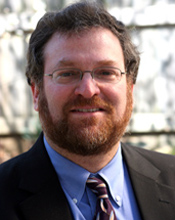 Saul Cornell is a legal and constitutional historian at Fordham University, and the author of The Other Founders: Anti-Federalism and the Dissenting Tradition in America (1999) and A Well-Regulated Militia: The Founding Fathers and the Origins of Gun Control in America (2006). As an active participant in public debate over gun regulation, as well as the scholarly debate over constitutional interpretation, Cornell is a historian who does not fear to tread in dangerous political territory. Today for The Junto, he explains originalism’s complex impact, and its strange relationship to the past. Continue reading
 The Junto