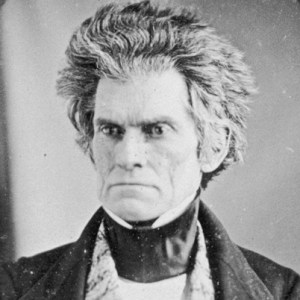
 Ever since Richard Hofstadter called John C. Calhoun the “Marx of the Master Class,” at least, American historians have pondered the relationship between the pro-slavery critique of Northern wage labor and later left-wing critiques of capitalism. One of Calhoun’s great themes, as Hofstadter noted, was the inevitable “conflict between labor and capital,” a conflict that threatened to overwhelm the “free institutions” of the North. Continue reading
Tag Archives: Abolitionism
The Week in Early American History

Archiving Abolition
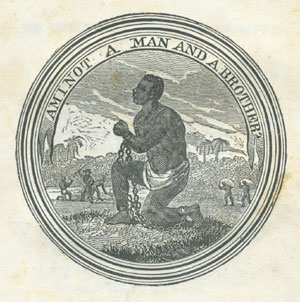 Today, we chat about making digital history with Lauren Klein, Assistant Professor in the School of Literature, Media, and Communication at the Georgia Institute of Technology. Her writing has appeared in Early American Literature and American Quarterly, with a piece forthcoming in 2014 in American Literature. She is currently at work on two book projects: the first on the relationship between eating and aesthetics in the early republic, and a second that provides a cultural history of data visualization from the eighteenth century to the present. Continue reading
The Abolitionists: A Recap
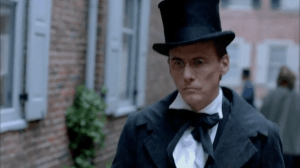 Over the last three weeks, Jonathan Wilson and Ken Owen have reviewed the PBS documentary series The Abolitionists. Their reviews of part 1, part 2, and part 3 are already available for you to read. In this final post, Wilson and Owen will discuss the series as a whole, focusing especially on its value for history professors in the classroom.
Ken: Jonathan, I thought that we might start this discussion by looking at the producers’ public statements on what they were attempting with the series. For reference, there is a video entitled ‘Why We Made The Abolitionists‘, and an article ‘From The Executive Producer‘. For me, the most striking statement of the video is the opening assertion that no transformative moment in American history ‘stems from the actions of ordinary Americans as much as the abolitionists’. The producers then say that the five characters that they chose were deliberately intended to invoke different strands of the abolitionist movement.
The Abolitionists Go to War: Part 3
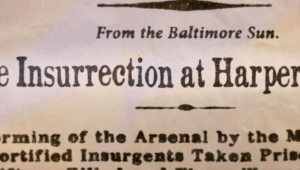 The final episode of The Abolitionists aired this week on PBS. The entire three-hour documentary is now available online here (Part 3 begins at the 1:40 mark). A full transcript is also available. Kenneth Owen and Jonathan Wilson previously discussed the first two episodes for The Junto. Today, we discuss the final hour.
Jonathan Wilson:
We’ve been fairly hard on The Abolitionists thus far, so I’m happy to say I thought the final chapter of the film is the strongest, both historiographically and dramatically. This episode reflects recent scholarship on slave rebellions, and on John Brown in particular, by meditating in a fairly sophisticated way on the uses and languages of violence.
The Abolitionists Ride Again: Part 2
 Last week, The Junto brought you a pair of responses to Part 1 of PBS’s new American Experience documentary on The Abolitionists. Kenneth Owen and Jonathan Wilson were cautiously critical of the first episode–particularly its treatment of religious belief and the activities of less famous abolitionists. Today, they weigh in again with brief responses to the second episode, which aired Tuesday night. (It is still available to watch online; skip ahead to Chapter 8 or the 50:40 mark.) Continue reading
The Abolitionists in Primetime: Two Responses
 This week, PBS’s American Experience aired the first episode of The Abolitionists, a new three-part documentary. If you missed it, you can still watch it online. It is written and directed by Rob Rapley. The next two episodes will air on January 15 and 22.
The film profiles Frederick Douglass, William Lloyd Garrison, Harriet Beecher Stowe, John Brown, and Angelina Grimké. Part I covers the 1820s and 1830s, fitting it comfortably into The Junto’s portfolio. Kenneth Owen, an Assistant Professor of History at the University of Illinois at Springfield, and Jonathan Wilson, a PhD candidate at Syracuse University, have a review.
 The Junto