Today’s guest poster, Craig W. Gill, is the Editor-in-Chief and Assistant Director of the University Press of Mississippi. He has worked at the Press for more than 17 years and has served in publishing for almost 25 years. He acquires primarily in American history, Southern history, Caribbean history, folklore, and music, as well as regional books on Mississippi, Louisiana, and the Gulf South.
 Almost all university presses prefer to first receive a proposal from a potential author, rather than a full manuscript. Alas, no editor anywhere has the time to read the huge number of manuscripts that come our way, and the situation would be even worse if we attempted to read manuscripts from every potential author seeking a publisher. This makes the proposal an ideal introduction to a topic and a crucial step in the process towards publication. Although an author may have chatted with an editor prior to submitting a proposal (if not then I urge you to get to an academic conference and chat up editors in the exhibit hall), the proposal is the first formal representation of a book project from the author to the publisher. Continue reading
 Two weeks ago, 175 historians descended upon the Massachusetts Historical Society (MHS) in Boston for a three-day conference that considered the political, social, economic, and global parameters of the American Revolution. The conference consisted of eight panels (with pre-circulated papers), two keynotes, and some special presentations on digital projects. The conference proceedings were live-tweeted under #RevReborn2, and fellow Juntoist Joseph Adelman provided some
  Welcome to another edition of This Week in Early American History! We wish a safe and healthy holiday to those
 Today, The Junto interviews
 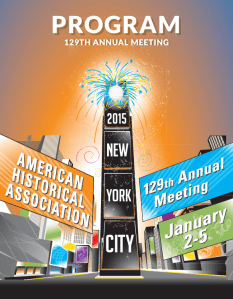 Happy New Year from all of us at The Junto! We hope you had a restful and enjoyable holiday break. For historians, the turn of the calendar to 2015 means that many of us are en route to the AHA Annual Meeting in New York City. Having grown up in the area, I’d like to welcome you all to New York, where the bagels and pizza are really just better, and we stand “on line” for coffee, not “in line.”
 Public history is having a bit of a renaissance right now. The data is a few years old now, but in 2008, job announcements in public history rose 27.9 percent. There was an increase the following year.[1] Most in the history profession will note 2008 not only as the year of the recession, but also as a year that saw a sharp downturn in the already-atrocious academic job market. This job market data refers to faculty jobs to train public history, but it is indicative of an increased focus by history departments to expand or introduce public history curricula.
 The Junto