History Carnival 121

hlogoThe Junto is excited to be this month’s host of the 121st History CarnivalFor those unfamiliar with History Carnival, it is guest-hosted by a different history blog on the 1st of each month and gathers up links to some of the best history blog-writing on the web. Think of it as The Junto‘s “The Week in Early American History” but for a whole month and not limited to early American history.

Let me begin by saying that the process of hosting History Carnival has been quite an enlightening experience. I realize now that I had little perception of just how much history blogging is going on outside of my own field and sub-fields, and, especially, how much high-quality history blogging is being done. Now on to the links…

Reading and Writing the Early American City described its taking part in the exciting new “Just Teach One” project, which gets faculty to agree to teach one of the project’s documents and keep a record of how they used it.

Digesting the Medical Past explored the Victorian obsession with digestion and stomachs, in particular.

Randall Stephen gave tips on turning a dissertation into a book at Religion in American History.

American Orchard tackled the relationship between apples and Puritans.

Over at Chronikos, Greg Rogers looked at the diary and story of Capt. William Rice in “Constraints on Projecting Imperial Power: The Ordeal of William Rice.”

At The Appendix, Carolyn Arena discussed a valuable priest’s diary for sources about women in “Bellette and Yarico: Working Women in the Colonial West Indies.”

Not Even Past has two entries in this month’s History Carnival. The first one looked at both a Muslim slave in North Carolina and the Constitution. The second is actually two itself . . . “Digital History: A Primer (Parts 1 & 2).”

At the VAHS, Jon Weier looks at how World War I affected the YMCA.

While, at Think Shop, Paul Doolan looks at the broader importance of a television interview by a Dutch soldier who fought in Indonesia in which he revealed Dutch atrocities.

The London Sound Survey examines the ties between “street noise” and “the taming of Victorian London.”

Discover Historical Travel does a great job bringing to life the nation’s “worst tornado disaster” in “The Great Tri-State Tornado of March 1925.”

By now, most American historians are familiar with the work of David Barton, a conservative activist who promotes the idea that the United States was founded by (more or less) evangelical Christians as a Christian nation. This month, Robert Tracy McKenzie, chair of the history department at Wheaton College, looked at Barton’s historiographic forebears, discussing Peter Marshall Jr.’s and David Manuel’s highly influential 1977 book, The Light and the Glory.

At In the Service of Clio, Nick Sarantakes expands on a recent Perspectives essay, proposing a clearer distinction between “public history” and “applied history” as forms of engagement with the concerns of people in various walks of life.

In “Globalizing the Nineteenth Century,” Joseph L. Yannielli discusses what “moral maps” reveal about Americans’ and Europeans’ understanding of themselves as part of the world.

Will the history of the Holocaust have to change as the last generation of survivors passes away? And how might that process illuminate the histories of other horrors? At Civil War Memory, Kevin Levin reflects on an editorial by Rabbi Hillel Goldberg, provoking a lively discussion in the comments.

In April, dozens of bloggers celebrated the tenth anniversary of the Old Bailey Proceedings Online, a landmark of digital history scholarship.

At Early Modern Notes, Sharon Howard reflects on some of the project’s useful, and unexpected, implications for scholars.

At medievalfragments, Erik Kwakkel discusses the business of bookselling in medieval Europe, which was more like the modern trade than one might expect.

We’d like to thank everyone who submitted nominations. Next month’s History Carnival will be hosted by Performing Humanity on June 1.

The Future of the Past Is Now: Digital Humanities Resource Guide

Inspired by the work of colleagues @ the new Digital Public Library of America and others we’ve interviewed here at The Junto, here are some bookmark-worthy links to what’s going on in the ever-evolving field of the digital humanities. We’ll update this list as projects develop, so if you’re working on a digital history initiative, please let us know so we can add it to the Resources page.

If you use new media in the classroom, how effective do you find it to be in communicating historical content/class themes? Please share your views on digital pedagogy in the comments. Continue reading

A Library for the Digital Republic: The DPLA Is Launched

DPLA-logo-blueFour years ago, Robert Darnton, historian and librarian at Harvard, wrote in the New York Review that “we [had] missed a great opportunity.” Instead of digitizing America’s print heritage in a public project, perhaps managed by “a grand alliance of research libraries,” the United States had allowed a private corporation to control the scanning and storing of books. Depending on the outcome of federal lawsuits, Google Books would enjoy a virtual monopoly on books still in copyright.

“We could have created a National Digital Library—the twenty-first-century equivalent of the Library of Alexandria,” Darnton wrote. “It is too late now. Not only have we failed to realize that possibility, but, even worse, we are allowing a question of public policy—the control of access to information—to be determined by private lawsuit.”

Continue reading

Spring at the “History Harvest”

C & I Harvest

Currier & Ives, 1849

This week, we talk to University of Nebraska-Lincoln historians William Thomas and Patrick Jones, co-directors of History Harvest, a community-based approach to creating a new people’s history of America online using the real “stuff” of our past.

JUNTO: How did you get the idea (and support) for History Harvest? What are the goals of “community-based history,” and how is it a model for the profession?

THOMAS: The original idea for me goes all the way back to my work on The Valley of the Shadow Project in the mid-1990s with Ed Ayers and Anne Rubin. We ran a small community history harvest in that project, but neither the public awareness of digitization nor the technical infrastructure to do large scale digitization on site were available. Still ever since then, I have been interested in expanding the idea. And we have seen in every digital history project that the community often comes forward with materials to contribute. So in 2010 we started The History Harvest Project here at the University of Nebraska. Continue reading

Tracing the Path of “American Journeys”

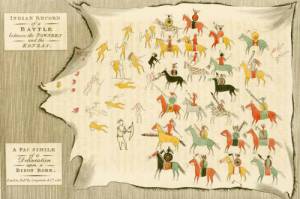
Edwin James, "An Account of an Expedition from Pittsburgh to the Rocky Mountains, Performed in the Years 1819, 1820."

Edwin James, “An Account of an Expedition from Pittsburgh to the Rocky Mountains, Performed in the Years 1819, 1820.”

Still searching for new sources to use in your survey, or maybe a new midwinter project to research? The Wisconsin Historical Society’s American Journeys site is a hub for 18,000 pages’ worth of diaries, eyewitness accounts, manuscripts, images, and travel narratives of exploration and settlement in North America– all set in a timeline that stretches from the Vikings to the Rockies. Michael Edmonds, Head of Digital Collections & Web Services in the Library-Archives Division of WHS, told us how the site has transformed the research process, on both sides of the library desk. Continue reading

Forgotten Giant: Restoring Simms

"Washington Irving and His Literary Friends at Sunnyside." Simms stands, leaning against the chair, center left.

“Washington Irving and His Literary Friends at Sunnyside.” Simms is seated at the left end of the table, shown in full profile.
(Christian Schussele, Oil on canvas, National Portrait Gallery, Smithsonian Institution, 1864)

Meet a Southern man of letters, William Gilmore Simms, through his life’s work of literature—much of it now available in the form of free, digital editions thanks to the Simms Intitiatives at the University of South Carolina. A well-known editor, critic, poet and historian of Southern life and culture in his day, Simms (1806-1870) occupies a unique position in early American literature, and (re)introducing him to modern readers has presented new challenges for scholars. The Junto asked the Initiatives’ Todd Hagstette, Simms Curator, to talk about creating a digital portrait of  the author, and why Simms’s work belongs on the syllabus. Continue reading

Early America, with a Brooklyn Accent

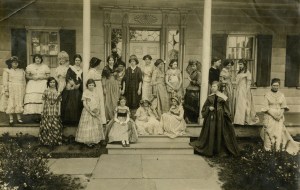
Historic reenactors at Lefferts House, Prospect Park (1938)

Last week, we asked how digital projects are transforming our study of early American life and culture. Here’s the first in a series of interviews with historians who tell us what worked, how digital tools shaped the narrative, and where they want to go next on the digital frontier. This week, we asked the Brooklyn Historical Society for a peek at the making of a special digital exhibit on the Lefferts family of New York. As Breuckelen becomes Brooklyn, readers can link to local sites where the Lefferts family lived and worked, including the Lefferts Historic Homestead in Prospect Park (shown here: Historical re-enactors gathering on the front steps in 1938). The Leffertses were influential landowners, politicians, historians, financiers—and also one of the county’s biggest slaveholding families. Their letters, farm accounts, and recipe books offer a new and very personal window on New York’s development.Our thanks to Jacob Nadal, the Director of Library and Archives, and Julie Golia, Public Historian and Curator, who kindly took our questions on bringing nearly four centuries of Brooklyn to digital life. Continue reading

Brave New World: Digital Early America

As settlers and explorers, early Americans navigated intricate webs of trade, created dynamic intellectual networks, and (often, thankfully) left us a paper trail of discoveries great and small. Presented with that past in the archive or on the screen, historians increasingly turn to digital resources for a new arc of insight. Thanks to digitized books and manuscripts, online reference tools like Google Books, amplified search methods, new digital libraries, and GIS mapping, there are plenty of opportunities for new research. We can follow foreign consuls, read a Southern man of letters, watch a Brooklyn family put down roots, or hear a podcast about Native American family life in Virginia. That’s just a small sample of the many digital projects transforming what we know of American history. The wave of new media has benefitted professional training, too. For digital scholars of all stages, there’s a welcoming set of training opportunities like THATCamps, summer institutes, and winter training sessions. Continue reading