 Submitted for your approval . . . the November episode of “The JuntoCast.” This month, Ken Owen, Michael Hattem, and Roy Rogers discuss the Continental Congress, including a number of recent popular histories about it, its popular and academic historiography, and various aspects of its importance. Continue reading
Tag Archives: historiography
Wood & Holton on the Constitution
 Was the purpose of the constitution to protect democracy from being ruined by the people or to protect commerce from being ruined by democracy? This was one of the questions put to Gordon Wood and Woody Holton in a debate held a few weeks ago at the University of South Carolina. A full video of the event has just been released on YouTube, and is embedded below. For anyone familiar with the work of these two historians, the debate will constitute a useful recap of the distinction between their two interpretations of the origins of the federal constitution. And for others, I hope it might be a kind of teaser for their excellent books! Continue reading
Teaching the Declension Narrative
This semester I’m teaching Revolutionary America, a class which has allowed me to ease into teaching because my dissertation (ahem: book manuscript) focused on the more narrow topic of Native and enslaved foodways during and after the war.
I’ve framed the class around the question of how ordinary people experienced the Revolution. Lately I’ve been talking with students about the declension narrative pervasive in Native American history, because it’s one of the things I’m contemplating as I begin to think about revisions.[1] Continue reading
On Counting: A Reflection on Quantitative Research
 This summer, I counted. My dissertation, as my Contributor page at The Junto helpfully notes, includes both qualitative and quantitative analysis. And so, to enrich the latter portion of my project, I spent July at the archives, counting. Perhaps more so than most other forms of archival work, counting is an exercise in delayed gratification, the overall picture springing into focus only once the research and subsequent analysis are complete. This meant I had plenty of time to reflect on my methodology as I scanned through microfilm, paged through record books, examined case files, and counted, and counted, and counted. Continue reading
The JuntoCast, Episode 4: Religion in Early America
The Junto is happy to present the fourth episode of “The JuntoCast.” In case you missed our first three episodes, “The JuntoCast” is a monthly podcast in which members of The Junto discuss issues of both academic and general interest related to early American history, pedagogy, and public history.
In this month’s episode, Ken Owen, Michael Hattem, and Roy Rogers discuss religion in early America, including its relationship to the American Revolution, historiographical developments, and, being the history nerds that they are, which 18th-century Protestant denomination’s theology best represents each panelist’s pedagogical style.
You can click here to listen to the mp3 in a new window or right-click to download and save for later. You can also subscribe to the podcast in iTunes.
The Paradox of Popular Sovereignty
If Inventing The People is a work of consensus history, it is not one that seeks to celebrate blindly the development of an Anglo-American tradition of popular sovereignty. “The popular governments of Britain or the United States rest on fictions as much as the governments of Russia and China” (13). Indeed, many of Morgan’s most important conclusions in the book are remarkably radical—reminding us that all power is at some level arbitrary, and that appeals to rationality alone cannot justify any single system of government. Indeed, governments that try and conform to the letter of their appeals to the people could not long hope to survive. “The fiction must approach the fact but never reach it” (91). Thus, while Morgan unquestionably concludes there is a coalescence of ideas of popular sovereignty, it is not a reassuring consensus. The consensus on the dominance of popular sovereignty is necessary, for else a community can never be made fit to govern. Continue reading
Ed Morgan and the American Revolution
 Ed Morgan changed the way historians understood the American Revolution. Over a period of about ten years, from 1948 to 1957, he published three important research articles, a monograph, an essay aimed at a general audience, and a historiographical article, all having to do with the coming of the Revolution. It was an amazing burst of work that elevated Morgan to the upper echelons of American historians. Of course, Morgan had previously worked on Puritanism and would go on to do groundbreaking work on colonial Virginia and slavery. But he made his bones with the American Revolution. Continue reading
History Is Not Science
Over at Slate last week, our Junto colleague Eric Herschthal reviewed some of the latest popular histories of revolutionary America, including two new studies of the years around 1776 by Richard Beeman and Joseph Ellis. Eric takes a very critical view of the analytical stance of the books–arguing that they are too in thrall to outdated and invalidated historical techniques; focusing too much on elites and ‘leadership’ at the expense of more recent trends in scholarship, such as the new emphasis on those who stayed (or tried to stay) neutral during the Revolutionary War.
Perhaps the most provocative part of the review is this statement:
“If you bought a popular book on science, one that came with a similar sheen of intellectual prestige, and learned that it essentially ignored years’ worth of scholarship, you’d demand your money back. Why should history be any different?”
To me, the answer seems self-evident. Continue reading
Looking for Religion in all the Right (and Wrong) Places
James P. Byrd, Sacred Scripture, Sacred War: The Bible and the American Revolution. New York: Oxford University Press, 2013.
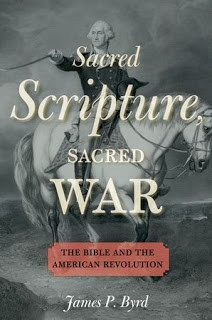 “The Revolution may be the most important event in American history,” James P. Byrd reminds us. Many of the readers of this blog will likely agree with him in that. Fewer, perhaps, will agree with one of the central arguments of his (very) recent Sacred Scripture, Sacred War: The Bible and the American Revolution that “the Bible was arguably its [the Revolution’s] most influential book.”[1] At the recent OIEAHC conference in Baltimore I was able to get my hands on a copy of this excellent new book and Sacred Scripture, Sacred War has given me a lot (despite it’s relatively conciseness) to chew on over the last two weeks.
Continue reading
#RevReborn, Periodization, and the American Revolution
Two weeks ago, anticipating the McNeil Center’s “The American Revolution Reborn” conference, I wrote a post about my own thoughts on the place (and future) of the American Revolution in the historiography of early America. In that piece, I pointed out that issues relating to causality had gone largely unexplored for a few decades now as attention in the field shifted to the early republic. Both during and after the conference, there has been a substantial amount of internet chatter, from live-tweeting the conference to storifying those tweets to in-depth, panel-by-panel blog recaps. Off the top of my head, I cannot think of another theme-specific historical conference that has gotten this level of internet coverage, though I’m sure some have done. But almost all of the coverage has been about recounting the ideas and themes that came out of the conference, with not much attention given to commenting on them. In this piece, I’d like to comment on one of the most fundamental themes that hung in the air over the entire conference: periodization. Continue reading
 The Junto