Today’s guest post comes from Peter Kotowski, a Dissertation Fellow at the McNeil Center for Early American Studies and a Ph.D. candidate at Loyola University Chicago. His research uses the lived experiences of indentured servants to explore Pennsylvania’s development within the Atlantic economy and the extent to which the colony was “the best poor man’s country.”
 In the introduction to their 2008 edited collection, Class Matters, Simon Middleton and Billy G. Smith make the bold proclamation that “as a mode of historical analysis of early North America and the Atlantic World, class is dead – or so it has been reported for the last two decades.”[1] The subsequent collection of essays makes a convincing case that class is not, in fact, dead. For Smith, this volume was merely a continuation of a decades-long commitment to class as a primary mode of analysis. It was in the spirit of Smith’s work that dozens of scholars converged on the McNeil Center for Early American Studies in Philadelphia from November 7-9 for what was affectionately dubbed “Billyfest.”
Continue reading
 If you’ve heard of the Royal Proclamation of 1763, it’s probably in the form of the “Proclamation Line,” the imaginary line of masking tape across the Appalachian Mountains dividing English colonists along the coast from native populations in the interior of North America. According to a group of historians gathered at the Old State House in Boston this past Friday, it may have far greater significance. (Or not.)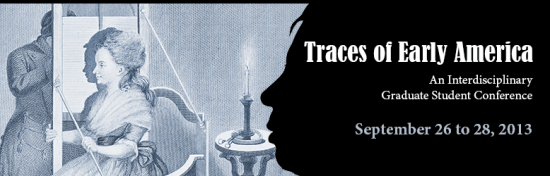
 Here at The Junto, we’ve spent the last week with our noses buried in one really, really good book. But there’s been much afoot elsewhere, both on the web and beyond.
 Looking forward to attending one of the largest conferences on the American Revolution in a generation this week in Philadelphia, I thought I would take a moment to reflect on the title of the conference—”
 The Junto