 Every president has a past, and to his regret, John Adams did not save all of it for history’s sake. “Whatever you write preserve,” he directed his grandsons in 1815. “I have burned, Bushells of my Silly notes, in fitts of Impatience and humiliation, which I would now give anything to recover.” Continue reading
Tag Archives: research
Serial, Microhistory, and the Perils of Historical Research
 I’ve been listening to Serial again. Part of this is the spate of articles and interviews that attack (perhaps not persuasively) the foundations of Sarah Koenig’s research and reporting. Another reason is that, as someone in the midst of researching and writing a dissertation, I find Serial’s storytelling and depth of research very compelling and inspiring. At the same time, as a historian, the popular podcast has left me deeply troubled and uncomfortable with its final product. Continue reading
Q&A with Kyle T. Bulthuis, Author of Four Steeples over the City Streets
 The following is an interview with Kyle Bulthuis, an assistant professor of history at Utah State University. Jonathan Wilson’s review of Kyle’s recently-released book, Four Steeples over the City Streets: Religion and Society in New York’s Early Republic Congregations, appeared on the blog yesterday. Kyle agreed to sit down and answer a few follow up questions about the book and his future research plans, which we are happy to post today. Continue reading
Guest Post: Researching en Français: French Archives, and Why They’re Worth It for All Early Americanists
Hannah Bailey, a PhD candidate in History at the College of William & Mary, studies the interconnectivity between developing notions of race and the expansion of the African slave trade in the early modern French Atlantic. She graduated with honors from the University of Wisconsin-Madison in 2010, with degrees in History and French, and a minor in Gender and Women’s Studies. Her master’s thesis focused on how women like Eliza Jaquelin Ambler Brent Carrington remembered, defined, and recorded their experiences during the American Revolution for her master’s thesis. Her dissertation uses histories of West Africa written by individuals like Jean-Baptiste Labat to help explain why, in early eighteenth-century accounts of the region, the fiction of African inferiority began to supersede the fact of African political and economic dominance on the West African coast.
 I never learned the verb “rebobiner” in any of my nine years’ worth of French courses. I don’t blame my French teachers or professors for this. Neither they nor I had any idea that it would one day become an integral part of my vocabulary as I commenced my dissertation research in the Archives Nationales d’Outre-mer in Aix-en-Provence, France. As it happens, “rebobiner” means “to rewind the bobbin of microfilm that you spent twelve minutes learning how to load onto the microfilm reader, because microfilm is always complicated and is triply so when the directions are in a foreign language,” or…something like that. Despite my attempts to prepare myself for my time in the French archives, I experienced more “trials by fire” than I might care to admit. All of my listening to French radio, reading complex French secondary sources, and frantic scouring of French online archival inventories only got me so far. Despite the best efforts of the kindest and most helpful archival staff I’ve yet encountered, I often had to learn by doing, and that wasn’t always easy. It was, however, always worth it. Continue reading
The Documentary Record on Fire and Reading Intentionality
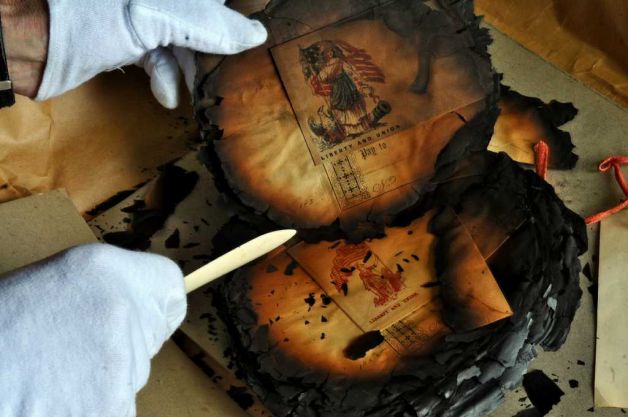
On March 29, 1911, a fire tore through the New York State Capitol Building. From the third floor of the Assembly Library, where books and papers served as kindling, it shot up to the capitol’s iconic towers. By the early morning, much of the building was in ruins, and many of the books and manuscript papers housed within it reduced to melted ink and char.
Anyone who’s used the Papers of Sir William Johnson knows the fire well. Every other page is a reminder of the embers that destroyed letters, accounts, conference minutes. It’s also a reminder that the current documentary record has been shaped in ways that—while often times hidden away—were also bright and fiery and loud. Continue reading
Guest Post: Sir James Wright and Jenny, his free “black servant”
Today’s guest poster is Greg Brooking (PhD, Georgia State University). His dissertation on Sir James Wright, royal governor of Georgia, is entitled, “‘My zeal for the real happiness of both Great Britain and the colonies’: The Conflicting Imperial Career of Sir James Wright.” He is the recipient of two fellowships from the David Library of the American Revolution and authored a chapter in General Nathanael Greene and the American Revolution in the South (University of South Carolina Press, 2012). He currently teaches at Kennesaw State University and Southern New Hampshire University. This is his first guest post for The Junto.
 I’ve just begun the arduous task of transforming my recently completed dissertation about colonial and revolutionary Georgia into a work worthy of an academic press. Part of this process, for me at least, has been to re-examine my notecards (actually an enormous Excel spreadsheet), seeking new gems, ideas, and angles. In so doing, I’ve rediscovered a tidbit that I want to further develop during the manuscript process and I humbly submit this post as a solicitation to the blog’s readers, seeking their varied and expert insights. Specifically, this tidbit relates to a caveat in the final will and testament of Sir James Wright (1716-1785), which calls for an annuity for his free “black servant,” Jenny. Continue reading
On Counting: A Reflection on Quantitative Research
 This summer, I counted. My dissertation, as my Contributor page at The Junto helpfully notes, includes both qualitative and quantitative analysis. And so, to enrich the latter portion of my project, I spent July at the archives, counting. Perhaps more so than most other forms of archival work, counting is an exercise in delayed gratification, the overall picture springing into focus only once the research and subsequent analysis are complete. This meant I had plenty of time to reflect on my methodology as I scanned through microfilm, paged through record books, examined case files, and counted, and counted, and counted. Continue reading
History by Freehand: Drawing Your Research

 Chances are, if you’ve ever sat next to me during a seminar, lecture, colloquium, workshop, conference, or dinner, you’ve seen me scribbling away on something. Stylus or pen in hand, I’ll create landscapes of crudely drawn people or mountains or ships, encircled and dissected by wavering arrows and question marks.
It’s about time I admit it. I’m a doodler. Continue reading
“It is now translated to America”: British Hymns in the Revolutionary Era
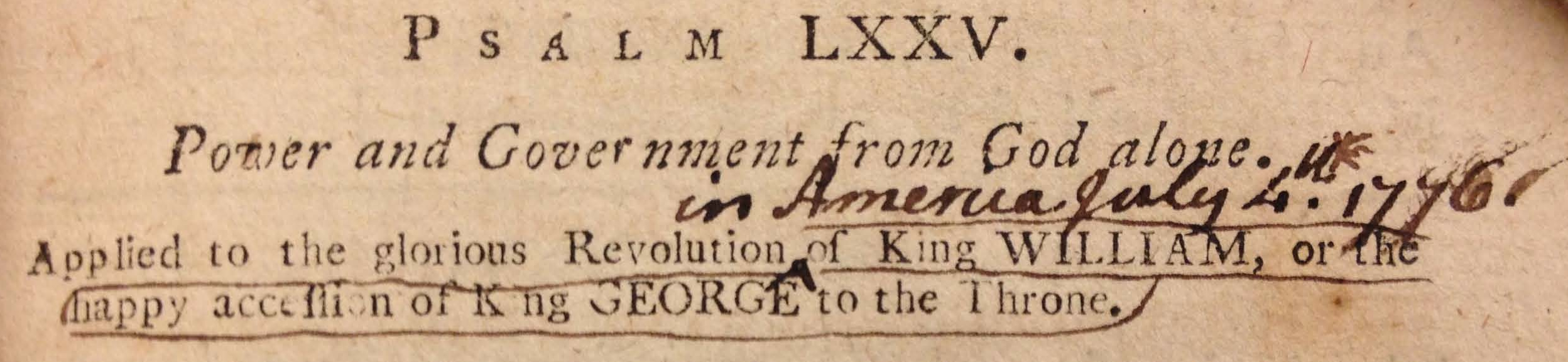 The Watkinson Library at Trinity College has an impressive collection of manuscript music from the late eighteenth century. Thanks to a grant from the Bibliographical Society of America, I spent a few weeks in June on a research road trip in New England, and Trinity was my first stop. Although I was focusing on musical commonplace books and copybooks, at the suggestion of librarian Sally Dickinson I also worked with their collection of annotated hymnals. It was while perusing these volumes that I came across something I hadn’t seen before: a hymnal in which every reference to Britain had been crossed out and replaced with the word “America” or related terms (New England, Western States, United States, etc.) As the assiduous penman noted at the bottom of one page, the entire volume had been “translated to America.”
Old-Fashioned Index Cards
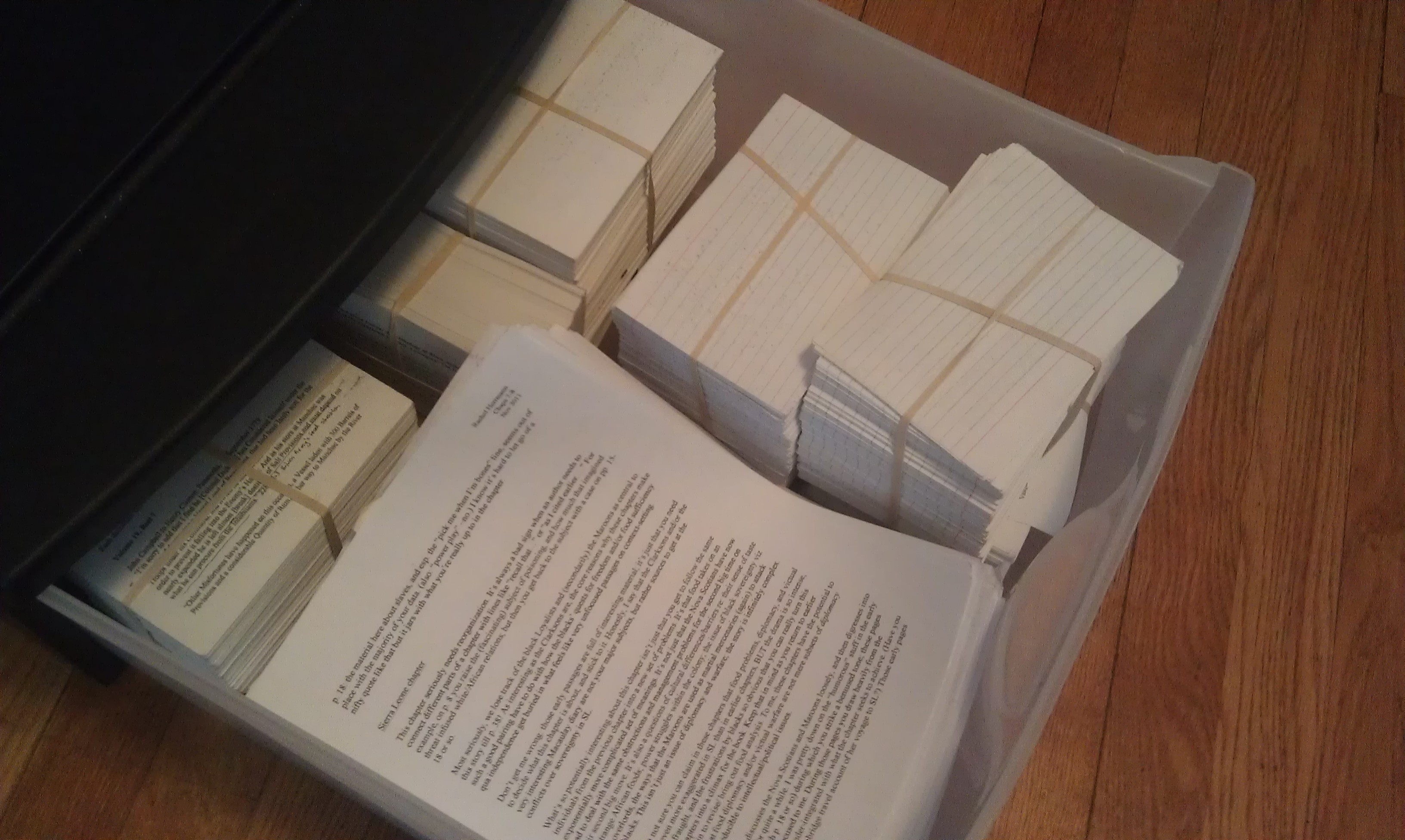
A dissertation’s worth of index cards, a draft, and comments from my adviser
When I was in Philadelphia recently to present a paper at the McNeil Center, I also enjoyed the opportunity to meet undergraduate students who were working on research papers as part of the MCEAS Undergraduate Research Workshop. I was asked to talk about my research methods—how I go about finding sources, how I organize them, and how I pull them together into (sometimes) coherent prose. In doing so, I outed myself as a very old-fashioned researcher, indeed. Continue reading
 The Junto