 Welcome to another installment of The Week in Early American History. Continue reading
Monthly Archives: July 2014
Summer Book Club, Week 4
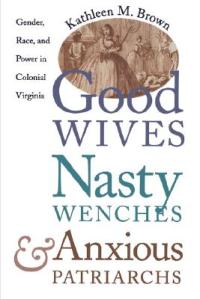 After a hiatus for Independence
 Day Week, we’re back today for chapters six and seven of Good Wives, Nasty Wenches, and Anxious Patriarchs. These chapters guide us into the eighteenth century, showing how an increasingly recognizable racial order, predicated on the authority of white householders, took shape in Virginia.
Guest Post: “George Whitefield at 300” Conference Recap
Jessica Parr received her PhD from the University of New Hampshire at Durham in 2012. Her research interests are on race and religion in the Early Modern British Atlantic. Her first book, Inventing George Whitefield: Race, Revivalism, and the Making of a Religious Icon is forthcoming from the University Press of Mississippi (2015). She currently teaches at the University of New Hampshire at Manchester. Here she recaps the recent “George Whitefield at 300” conference.
 In 1740, during George Whitefield’s first visit to New England, Connecticut minister Reverend Daniel Wadsworth wrote in his diary: “met with the famous life of Whitefield: but what is it?”[1] Wadsworth’s comments no doubt reflected both the excitement and the unease that Whitefield’s visit provoked among New England clergy, who both looked to him as a man who could renew piety and New England, but also feared his potential for exacerbating existing religious tensions. Nonetheless, it is a poignant question, and one anyone who is familiar with “the Grand Itinerant” might ask. Continue reading
SHEAR 2014 Annual Meeting Preview
 A little over a week from now (July 18-20) marks the beginning of the thirty-sixth annual meeting of the Society for Historians of the Early American Republic (SHEAR), held this year the society’s balmy hometown of Philadelphia, PA. To help get the broader Junto community excited, for what is my favorite conference of the year, I thought I’d offer a brief preview of a few of the panels and sessions I am particularly interested in this year.
I’ve highlighted below just one session from each scheduling block. This preview is just that—it does not represent all of the panels I’m interested in at this year’s conference. I have, for example, excluded all of the panels touching on the history of religion because Monica Mercado has already ably highlighted them over at Religion in American History. The wonderful thing about this year’s SHEAR meeting is the sheer number of fantastic offerings for each session block.[1] No matter your subfield—gender, slavery, religion, and economics—there are offerings sure to challenge your perceptions and shake up the historiography. You can find the full program here.
I invite our community to highlight the panels and sessions in which you are particularity interested in the comments section of this post, if I don’t mention them below. Continue reading
Digital History in the Surveillance State
 Three days ago, the Washington Post reported the results of an investigation into a large collection of files provided by Edward Snowden. Reviewing 160,000 intercepted electronic conversations and 8,000 other documents, which Snowden apparently accessed on NSA servers after that agency collected them, the Post’s reporters found that nearly half of them contained information pertaining to U.S. citizens. Overall, the article says, the sample showed that the government scooped up information on nine bystanders (as it were) for every “targeted” individual under electronic surveillance. On that basis, the reporters speculate that the NSA may have collected information on as many as 800,000 non-target individuals in 2013.
I don’t intend to comment here on the legality, ethics, or wisdom of the NSA’s programs or the Snowden leaks. But I do think this report is fascinating and important. And I think it’s worth considering from the standpoint of digital history.
How Do You Pronounce This Blog’s Name, Anyway?
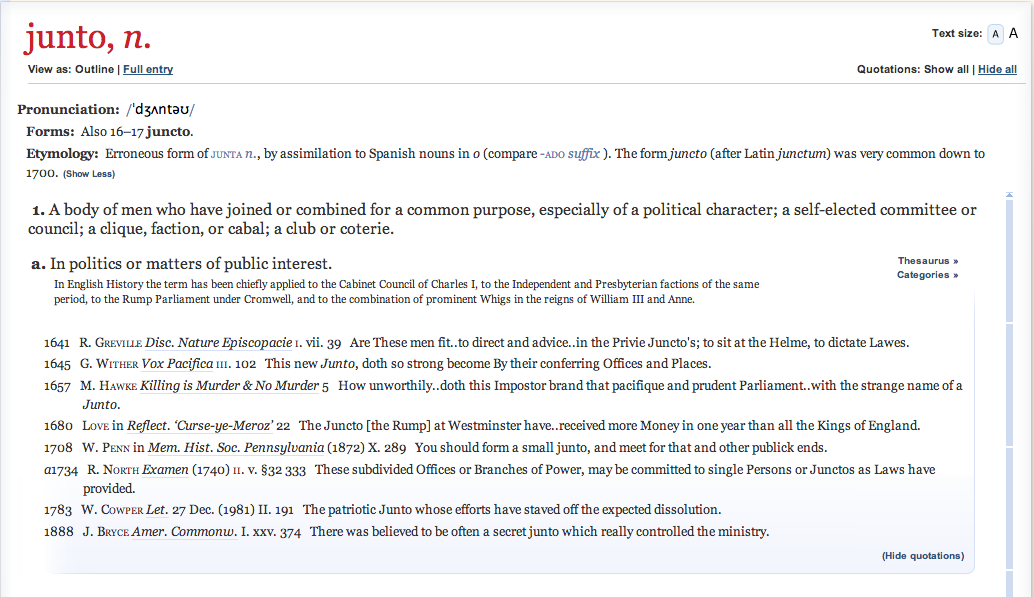 Back in 2012, when the initial ideas for this blog were first being thrown around, I suggested the name The Junto. I did so, not least because working at the Franklin Papers tends to keep Franklin on the brain. But I also suggested the name because the blog seemed to me to be analogous to the original group in that it was started by a bunch of upstarts with the intent of creating intellectual discourse amongst a supportive and engaged community. And those were the two most important initial goals of the blog. At the time, I never anticipated that there would ever be any confusion as to how to pronounce the name. That may have been a good thing since I probably would not have suggested it otherwise (“pronouncability” being pretty important when it comes to naming things, apparently). So, you might ask: “What is the correct pronunciation?” Well, that’s the thing. There doesn’t seem to be one, at least not nowadays. So, in a hopeful effort to settle the question, I decided to try to find out how people in the eighteenth century pronounced “Junto.” Continue reading
The Week in Early American History
We hope you will forgive the spottiness of TWEAH recently, but it is likely to be a regular occurrence during the summer months. Nevertheless, here are some links for you this Independence Day holiday weekend… Continue reading
The Week in the Declaration of Independence
 “Is it the Fourth?” Indeed, it is. And, along with it comes no shortage of interesting conversations about the Declaration of Independence. So here is our quick roundup… Continue reading
The First Year of Founders Online: An Interview with Kathleen Williams
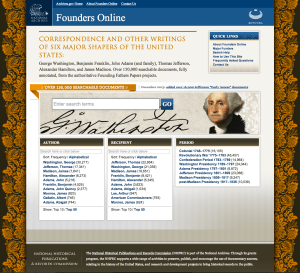 Founders Online launched just over a year ago on June 13, 2013. Today, The Junto catches up with Kathleen Williams, the Executive Director of the National Historical Publications and Records Commission (NHPRC), to get a sense of how Founders Online is being used, how much it is being used, and who is using it. We also discussed what the future may hold in store for Founders Online in terms of further website and content development. (NB: In my capacity as a Research Assistant at the Franklin Papers, I have been proofreading the Founders Online transcriptions of the Franklin volumes. I have also used the database for research, both for pieces I have written for the blog as well as my dissertation.) Continue reading
“Let a thousand MOOCs bloom”: An Interview with Peter Onuf
 Here at The Junto, we noted last semester’s flurry of history MOOCs with a combination of interest, excitement, and trepidation. Peter Onuf—the University of Virginia’s Thomas Jefferson Memorial Foundation Professor, Emeritus, and the instructor of Coursera’s recent MOOC, “The Age of Jefferson”—graciously agreed to answer some of our questions about his experience. In the transcribed interview that follows, we discussed not only the process of designing and creating his MOOC, but also his thoughts about online classes and the future of higher education in general.
 The Junto