As all of you are aware, Edmund S. Morgan’s June 1972 Journal of American History article“Slavery and Freedom: The American Paradox” was the victor of “March Madness” tournament for best journal article in American history. This victory shouldn’t have been a surprise, as such a thing is old hat for Morgan. His larger book, American Slavery, American Freedom: The Ordeal of Colonial Virginia (1975), already won for best book in 2013. The timing was perfect: just a month ago, Benjamin Carp, the Daniel M. Lyons Professor of American History at Brooklyn College, published a fantastic review essay “In Retrospect: Edmund S. Morgan and the Urgency of Good Leadership,” in Reviews in American History (see his #edmorgan100 tweets storified by our own Michael D. Hattem’s here). The OAH’s blog Process History invited Dr. Carp to write his reflections on the article (see here), and they kindly invited us to cross-post it.
 “Slavery and Freedom” is an article about Puritans, even though it doesn’t mention them at all; it’s about what happens when you try to colonize a place without them. Continue reading
 “Historians treat theory the way rattlesnakes approach small mammals. They either strike to kill or swallow whole. The latter often amounts to death by citation.”[1] David Waldstreicher’s statement on the problematic status of critical theory in Early American Studies appeared in a 2005 WMQ forum reconsidering the public sphere as a category for analysis. Must historians always view theoretical work through an antagonistic empiricism, or, just as unreflectively, swallow theory whole? Perhaps the tide is turning towards new theoretical engagements, as historians and literary scholars recognize that theories are themselves continually subject to refinement in relation to historical research. A recent conference at the McNeil Center for Early American Studies, entitled
  Last week, the entire field was saddened by the news of the passing of Drew Cayton. Born in Cincinnati in 1954, he earned his bachelor’s degree from the University of Virginia before receiving his PhD from Brown University, where he studied under Gordon Wood. Cayton went on to teach at Harvard, Wellesley, Ball State, and Miami University, before recently moving to Ohio State University, where he held the Warner Woodring Chair. He contributed to the profession in numerous ways, including serving as President of SHEAR in 2011-12 and the Ohio Academy of History in 2015. A frontier history pioneer, Cayton’s most well-known work, Frontier Republic: Ideology and Politics in the Ohio Country, 1780-1825, was published in 1989. His most recent work was Love at the Time of Revolution: Transatlantic Literary Radicalism and Historical Change, 1793-1818, published by the OIEAHC in 2013. A number of scholars responded to our call for remembrances, which we are honored to publish in memory of such a highly respected and pioneering member of our field.
  John Winthrop (1588-1649) and his son John Winthrop Jr. (1606-1676) are now known primarily as protagonists in the turbulent political history of early America. But in addition to shaping the government and theology of New England as governors of Massachusetts Bay and Connecticut (respectively), they and the rest of the Winthrop family also participated in a transatlantic and inter-generational bookish culture. Long before the Arbella sailed to Boston in 1630 to build a “city upon a hill”, generations of Winthrops began to talk about books, ways to read them and, as we will illustrate here, the difficulties and contingencies of collecting them—on both sides of the Atlantic.
  The brutality of military discipline in the British Army, which regularly sentenced enlisted soldiers to severe floggings of hundreds of lashes with the cat o’nine tails for relatively minor crimes—such as drunkenness or not wearing their uniforms properly—horrified civilian observers in Britain and America alike.
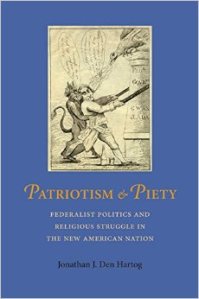 Religion was an “engine of politics” in the early American republic. Jonathan Den Hartog explains how religion energized (and then, ironically, diverted energy from) Federalist politics, and how the national vision of Federalists changed American religion. He considers northern evangelical Federalists such as John Jay (and his two sons), Caleb Strong, and Elias Boudinot, Unitarian Federalists including John Adams, and Federalists with a southern accent, Henry De Saussure and Charles Pinckney. These individuals are located, through impressive archival research, in a web of interpersonal relationships.
  The Junto