A special edition of #ColonialCouture, a Junto roundtable on fashion as history in early American life.
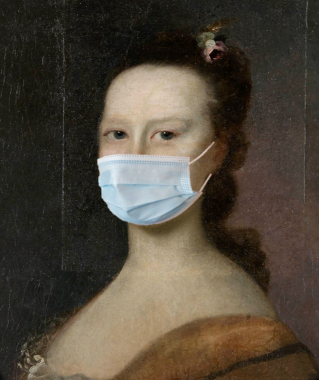
Protective face coverings have emerged as a potent, multifaceted metaphor for the Covid-19 pandemic. Despite inconsistent examples set by elected leaders and conflicting recommendations made by public health officials, unisex masks have steadily assumed a greater role in social distancing measures and become mandatory in certain settings outside the home. Options range from standard blue and white surgical masks to creative DIY improvisations and “Corona Couture.” Some museums are looking to add homemade masks to their collections as a way to document the crisis. Worn for slightly different reasons and more implicitly gendered, the masks owned by early American women and even children were no less symbolic in terms of practical use, commodification, or controversy.
 Today at The Junto, Philippe Halbert interviews Katherine Egner Gruber, who is Special Exhibition Curator at the
  As 2018 comes to a close, I can’t help but reflect on this year and its meaning for a place that has become near and dear to my heart (and in-progress dissertation): New Orleans. Founded by the French in 1718, Louisiana’s largest city has been celebrating its tricentennial for months and in a way that only New Orleans can. Ranked number one on the New York Times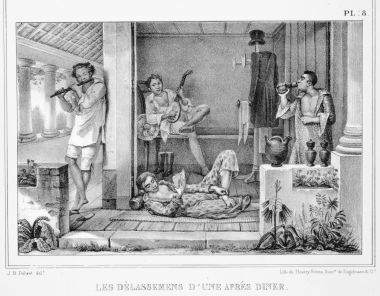
 Working on material culture, my research has taken me to some interesting, if unexpected places. Last summer, it involved waiting outside Saint John’s Church in Portsmouth, New Hampshire, founded in 1732 as the Anglican Queen’s Chapel. I quickly ran inside to snap some pictures of a baptismal font between back-to-back Sunday services. The Saint John’s font is an impressive fixture, carved from marble in a Continental European baroque style. As a ritual object used in the sacrament of baptism, the font is hardly unusual, but its story is.
  Today at The Junto, Philippe Halbert interviews Erin M. Greenwald about her exhibition,
  The Junto