Guest Post: The “Scotch War”: Scotophobia and the War of American Independence

Today’s post is a guest post from Tim Worth, a PhD candidate at the University of Southampton. His thesis examines transatlantic Scotophobia during the late eighteenth century, and how ideas of ethnicity affected British and American images of empire.
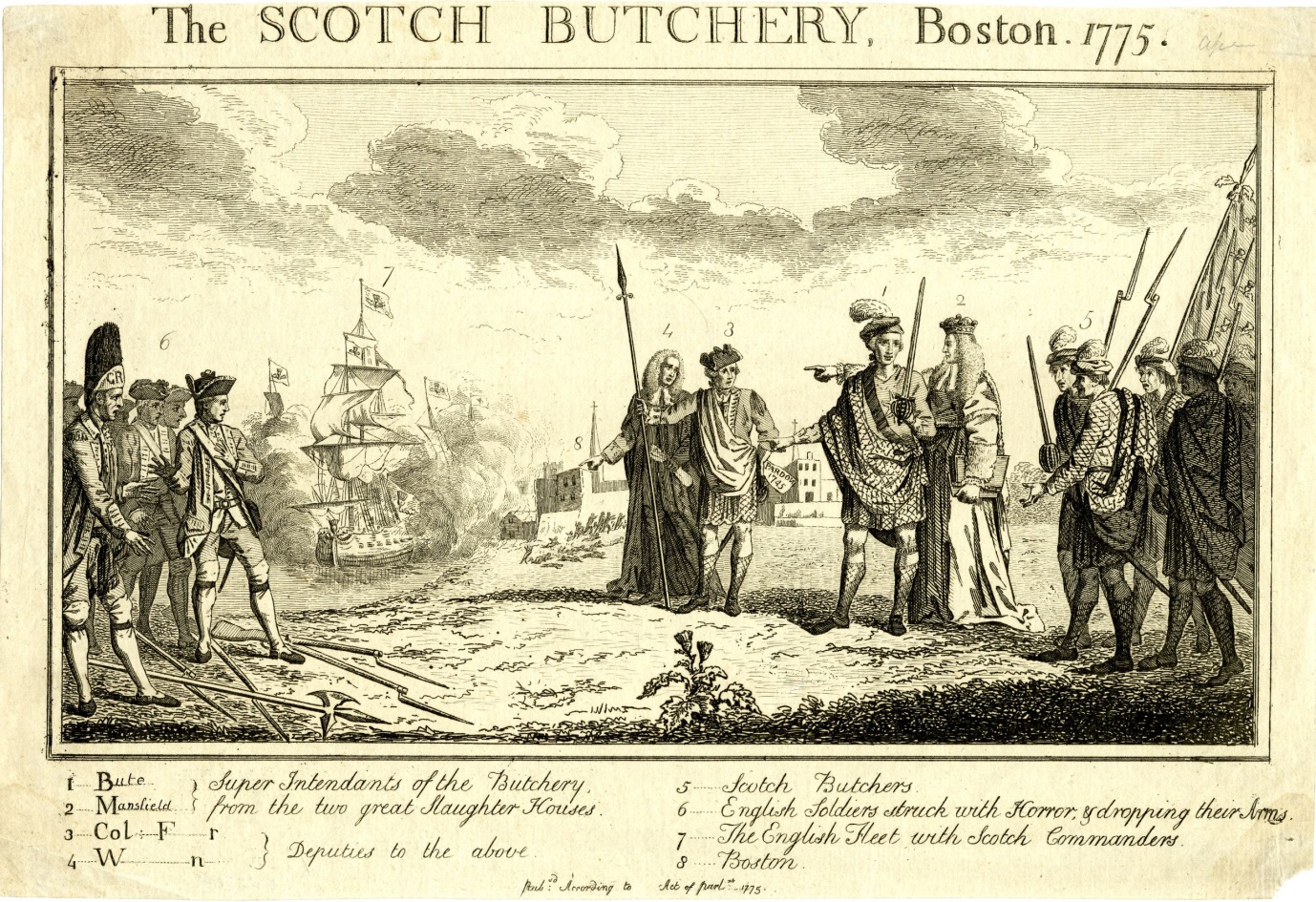
The Scotch Butchery, Boston 1775, (London, 1775).

The Scotch Butchery, Boston 1775, (London, 1775). Lord Bute and the Scotch Junto instruct Highland soldiers to slaughter the inhabitants of Boston. On the left, a group of English riflemen drop their muskets in horror. © The Trustees of the British Museum.

Over the past couple of years I’ve followed the fascinating Junto debate about whether or not we can see the War of American Independence as a civil war. Tom Cutterham and Christopher F. Minty have both put forward some excellent arguments outlining the strengths and weaknesses of this model. Whether or not we should use the term “civil war,” a great many contemporary writers often described the conflict as a tragic war fought between Britons. Today, I want to add a little more to this debate by breaking these Britons down into their component parts, and briefly examining how popular attitudes towards one of the ethnic groups we’re left with, the Scots, affected English and American ideas of the war during its early years. Continue reading

Revisiting Red Jacket, alias Cow Killer

Image from Wikimedia Commons

Image from Wikimedia Commons

Lately I’ve been thinking about names and what they mean. The Seneca orator Red Jacket had several of them. Red Jacket lived on the Buffalo Creek reservation, and according to Christopher Densmore, he was less influential than other leaders—though his name increasingly appears in council speeches in the 1780s and 1790s.[1] U.S. Indian commissioner Timothy Pickering recorded his Seneca name as “Saco-que-y-wan-tau,” translating as “Sleeper Wake up.”[2] Usually Red Jacket seems to appear in the records as Red Jacket—but I am interested in a fourth name. According to most historians Red Jacket’s alias, Cow Killer, was derogatory, meant to tease him for “his distinct disinclination to fight during the American Revolution.”[3] Continue reading

The Wandering Essay: A Lesson Plan for Teaching Writing

commas

Image by Zazzle.com

Before I even started teaching I knew that one of the most difficult parts of the job would be teaching writing. It’s not that I consider myself a great writer; I know I’m prone to tangents, and I’ve never met a dash, comma, or semi-colon I didn’t want to use. It’s just that I find writing pretty intuitive. For informal pieces like this one, I tend to write the way that I talk, and for more structured academic writing my first drafts are pretty crappy—but they get written and then ironed out in my editing process. The takeaway here is that I’ve had to think hard about how to teach writing because the process of writing isn’t really one that I had to articulate before I had students. Knowing that many of you are almost ready to collect first essay assignments, I thought I’d talk a bit today about how we teach writing to students. My Wandering Essay lesson plan is one of the meanest, most productive approaches I’ve used because it makes clear the fact that writing is a process. Here’s how you do it: Continue reading

Digital Pedagogy Roundtable: Your Links

Over the last week, Joseph Adelman, Ken Owen, Jessica Parr, and I have compiled a four part series of posts describing our attempts to incorporate digital methods into our early American history classes. As all of us are aware, however, we’re not experts–nor do we consider our posts the last word on such assignments. Continue reading

Digital Pedagogy Roundtable, Part 1: Students’ Access to Sources

This week, The Junto will feature a roundtable on digital pedagogy, in which we discuss our different approaches to using digital sources in the classroom. Today, Rachel Herrmann talks about the challenge of access. Jessica Parr, Joseph Adelman, and Ken Owen will also contribute.

A Wordle made from sources my undergraduates located for our in-class source-finding competition

A Wordle made from sources my undergraduates located for our in-class source-finding competition

Let me preface this post by saying that I’d hesitate to call myself a digital humanist; I don’t code or map or mine texts. As Lincoln Mullen pointed out a while back, however, digital practices exist on a spectrum. There are some things I do for my own research and in the classroom—tweeting, running my department’s social media accounts, using Amazon’s “Look Inside” feature to chase up a footnote so as not to use up one of my precious Interlibrary Loan requests, and of course, blogging for The Junto—that digital humanists also do. These approaches have been helpful in my teaching for three problems related to access to sources. Continue reading

Guest Post: The Payroll Union’s Paris of America

Pete David is a songwriter from Sheffield, who performs with the band, The Payroll Union. They have produced two EPs—Underfed & Underpaid and Your Obedient Servant—and have two albums: The Mule & The Elephant and their most recent, Paris of America.

Andrew Heath (@andrewdheath) is a lecturer in American History at the University of Sheffield in the UK. He spent several years in grad school in Philadelphia, where he became fascinated by the city’s nineteenth-century past.

The album cover of Paris of America.

The album cover of Paris of America.

Paris of America, a new album by the Sheffield U.K.-based band The Payroll Union, is the product of a two-year collaboration between  songwriter Pete David and historian Andrew Heath. With the help of funding from Sheffield University, Pete and the band explored the turbulent history of antebellum Philadelphia: a city in which racial, religious, and social strife earned it the title of “mob town” of the Union. Here, they reflect on the project, and the possibilities of exploring the history of the Early Republic beyond the more familiar routes of text and film.   Continue reading

Q&A: Jessica Roney, Governed by a Spirit of Opposition

RoneyYesterday, Chris Minty reviewed Jessica Choppin Roney’s book, Governed by a Spirit of Opposition: The Origins of American Political Practice in Colonial Philadelphia. Today, she speaks with The Junto about the book project and the process of turning the dissertation manuscript into a book. She received her MA at the College of William and Mary and her PhD at The Johns Hopkins University. She is currently Assistant Professor of History at Temple University in Philadelphia and is organizing a global early modern conference this November: Port Cities, 1500-1800, hosted by Temple University, the Program in Early American Economy and Society, and the McNeil Center for Early American Studies. Continue reading

Race, Riot, and Rebellion: A Bibliography

protesting-stamp-actThis morning on the other side of the Atlantic, I woke up early in preparation for a seminar on William Otter, whose History of My Own Times closes the list of our readings in my Revolutionary America class. Essentially, Otter was a brawling, violent, white man in the 1800s, living variously in New York, Pennsylvania, and Maryland. He jumped from job to job while engaging in various aggressive “sprees” against African Americans, Irishmen, and anyone else who seemed a likely candidate before becoming a burgess of Emmitsburg, Maryland.[1] And instead of getting up to prep this morning, I remained in bed, glued to the #BaltimoreUprising and #BlackLivesMatter hashtag on Twitter, as, I’m sure, were many of you during the late hours of the night. During times like these, it’s part of our jobs as historians to acknowledge that different types of violence have specific meanings that change over time. And so Juntoists have compiled a bibliography for our mutual education. Continue reading

A is for “Anthropocene”

Anthropocene wordleToday I want to pretend that I know how to read science journals, particularly a recent Nature article by scientists Simon L. Lewis and Mark A. Maslin entitled “Defining the Anthropocene.”[1] Reading a summary about the article was provocation enough to read the article itself, which in turn sparked a more extended rumination about chronology, interdisciplinarity, and scholarly divides. Continue reading