Commodification, Specialization, Mechanization

This post is the second in a two-part report on a roundtable session at this year’s Organization of American Historians annual meeting in Providence, Rhode Island, entitled, “Open Question: What’s the Relationship Between Slavery and Capitalism?” The panelists were James Oakes, Craig Wilder, Sven Beckert, and Caitlin Rosenthal. Yesterday’s post focused on Beckert’s comments, today’s looks at Rosenthal’s.
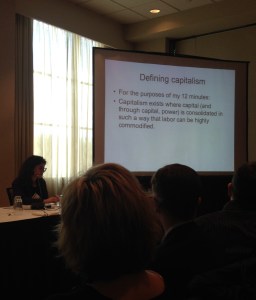
IMG_3913The new historians of capitalism have sometimes been criticised for refusing to offer a definition of their object of study. At the OAH panel, Caitlin Rosenthal (an assistant professor at the University of California, Berkeley) responded to that criticism directly. The refusal to start out with a strict definition has been, on one level, an asset to recent scholarship—freeing it from earlier dogmatic approaches. But the downside, Rosenthal said, is that it leads to misunderstandings among historians, and between historians and economists. Her tentative definition, then: “Capitalism exists where capital (and through capital, power) is consolidated in such a way that labor can be highly commodified.” Capital is at the centre, but so is labour; and what connects them is the process of commodification. Continue reading

Primitive Accumulation as Creative Destruction?

This post is the first part of a two-part report on a roundtable session at this year’s Organization of American Historians annual meeting in Providence, Rhode Island, entitled, “Open Question: What’s the Relationship Between Slavery and Capitalism?” The panelists were James Oakes, Craig Wilder, Sven Beckert, and Caitlin Rosenthal (Ed Baptist was sadly unable to be there). My first post will focus on Beckert’s comments, my second on Rosenthal’s.

As a protagonist in the debate over slavery and capitalism, Sven Beckert’s principal aim seems to be to show just how crucial violence was to the emergence and success of capitalism. This violence is not something standard, mainstream, or traditional accounts—the kind we see in economics textbooks or breezy historical surveys—are willing to acknowledge. Rather, the role of violence and slavery in the history of capitalism was erased, Beckert noted in his roundtable comments, by a “process of mystification,” an “active act of forgetting,” that took place from the late nineteenth through the twentieth centuries. Especially after the Russian Revolution and the beginning of the Cold War, he argued, American scholars and public intellectuals transformed the story of capitalism into a story of the spread of freedom. In this narrative, the nineteenth-century Civil War took on the role of a violent clearing of the decks, eliminating slavery as a remnant of the past, and opening the way for capitalist modernization. Continue reading
Sailors, States, and the Bureaucracy of Revolution

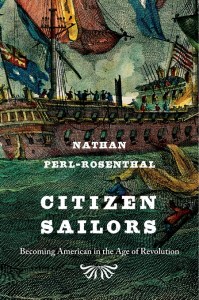
Nathan Perl-Rosenthal, Citizen Sailors: Becoming American in the Age of Revolution (Cambridge: The Belknap Press of Harvard University Press, 2015).

9780674286153-lgTransatlantic commerce was the defining feature of the eighteenth century’s imperial economy. The ocean was the conduit by which goods, labour, and capital circulated—goods that included sugar and tobacco, labour that included enslaved men and women, capital that included the remarkable oceangoing ships themselves. On transatlantic circulation hung the wealth and fate of empires, and that in turn depended upon ships and those who sailed them. Nathan Perl-Rosenthal’s new book, Citizen Sailors: Becoming American in the Age of Revolution (which Ben posted about a few weeks ago), does not tell those sailors’ story. Instead, it gives an account of the crucial relationship between sailors and states, and its remaking in the era of Revolution. As the empires and new republics of the North Atlantic world struggled to hold or wrest the reins of commerce, they had to invent new forms of power and identity—forms of power vested, like so much else we could call modern, in paper. Continue reading

Alexander Hamilton and the Inconvenient 1780s

Miranda HamiltonWhy does Hamilton, Lin-Manuel Miranda’s fantastically successful Broadway musical about the founder, skip over most of the 1780s in just one song?

The time from the victory at Yorktown to the Constitutional Convention was almost as long as the war itself, yet in the musical it merits barely a verse. Perhaps that’s not so unusual when it comes to public understanding of the founding era. But it’s worth asking what it’s all about. Eliding the 1780s reflects the way the shorthand narrative of the American Revolution goes—straight from victory in the War of Independence on to the new constitution and federal government, “non-stop.” Missing out most of the 1780s is the only way to make the revolution look like a single, coherent event. It smooths over a history that was riven with conflict and alternative possibilities, and makes it look like a straightforward path towards the federal republic that we know emerged. Continue reading

Roundtable: Academic Book Week—What’s an Academic Book Anyway?

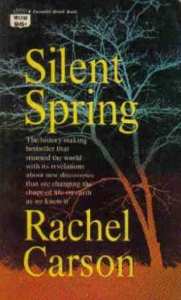
Silent SpringIs Rachel Carson’s Silent Spring an academic book? Is Mary Wollestonecraft’s Vindication of the Rights of Woman? The list of twenty nominees for “the academic book that has most changed the world,” part of the UK’s Academic Book Week, is a pretty confusing collection. Plato’s Republic is a product of the academy, sure, but is George Orwell’s 1984? In the US, we’re in the middle of University Press Week, which is a much more easily-identifiable category. We should all celebrate the important role of university presses in preserving scholarly endeavour from the rapacious maw of the market. In the face of ever-deeper cuts, they deserve our vigilant support. Continue reading

Guest Post: Correcting an Incorrect “Corrective”

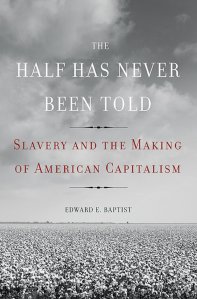
Edward E. Baptist is the author of The Half Has Never Been Told: Slavery and the Making of American Capitalism. He would like to “thank Joshua Rothman, Jefferson Cowie, Louis Hyman, and David Silbey for advice on this piece of writing, and The Junto for letting me publish in their space.”

edwardbaptist-thehalfHow was an immense increase in the “efficiency” of cotton production achieved in the nineteenth century? The question cuts to the heart of the debates over the history of U.S. slavery.
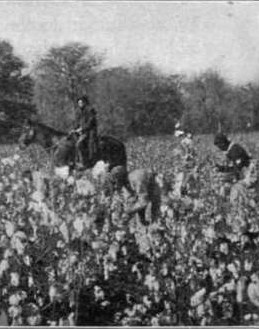
Last week, The Junto linked to sociologist John Clegg’s review in Critical Historical Studies, which considered several recent books on slavery and capitalism. This blog reported Clegg’s take on The Half Has Never Been Told as a “corrective.” Clegg attacks my argument that intense coercion drove a 400% increase in the efficiency of cotton-picking slave labor in the U.S. South between 1800 and 1860. His critiques directly build on the work of economists Alan Olmstead and Paul Rhode. In a series of essays, they asserted that efficiency actually increased because of improved seeds. In a recent issue of the Journal of Economic History, Olmstead appears somewhat displeased that I disagree with their assertions. Continue reading

Continuing the Debate on Slavery and Capitalism

Fig-6-Picking-cottonIt’s been two and a half years since the new history of capitalism marked its arrival with the full red carpet treatment in the New York Times. So it’s about time we saw some serious and constructive critiques of the project. Robin Blackburn’s lengthy review of Empire of Cotton goes some way to bringing that Bancroft-winner back down to earth, particularly by scrutinising the concept of “war capitalism.” But what I particularly want to share with Junto readers today is an article by the NYU sociologist John Clegg recently published in the Chicago-based journal, Critical Historical Studies. Continue reading

The Question of Narrative

borgesdesmazieres2Should historians embrace the art of narrative, or treat it with more suspicion? In his review of Sven Beckert’s Empire of Cotton back in July, USIH’s Kurt Newman argued that “the book-length narrative” is not “the proper form for the presentation of a historical argument.” Narrative, he wrote, involves too much selection, too many authorial choices hidden from the reader. “Most importantly,” Newman suggested, “constructing a narrative is almost always tied up with some telos or end,” a teleology that serves as expression or conduit of ideology, pulling us towards the outcome we imagine fits. Narrative, in other words, is something more than reasoned argument. It enlists desire to shape the way we think. Continue reading

Guest Post: The Constitution, Slavery, and the Problem of Agency

Today we feature a guest post by Kevin Gannon (@TheTattooedProf), Professor of History and Director of the Center for Excellence in Teaching and Learning at Grand View University in Des Moines, Iowa. His scholarship has appeared in the Journal of the Early Republic, Ohio History, and several edited volumes. He is currently writing a continental history of the Civil War and Reconstruction.

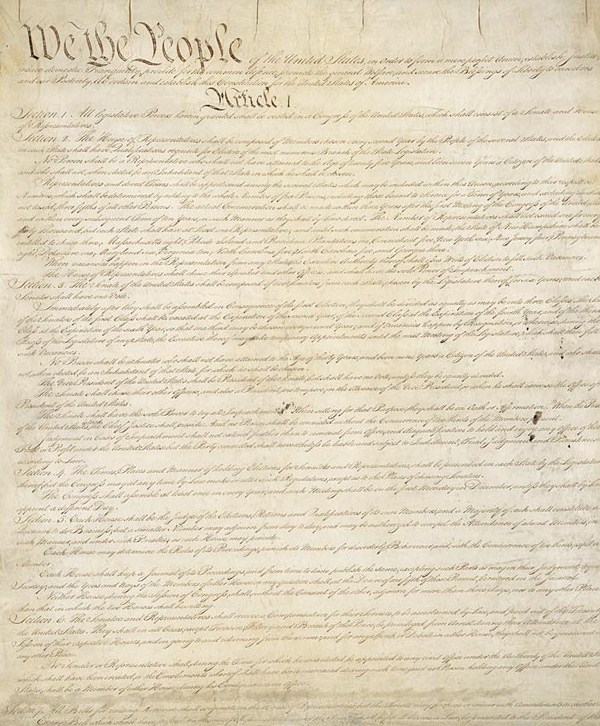
constitution_1_of_4_630Sean Wilentz’s op-ed in Wednesday’s New York Times was by turns baffling, infuriating, and sad. At its root, the essay is a narrow, technical argument trying to disguise itself as an overarching Big Answer to Important Questions. Wilentz claims “the myth that the United States was founded on racial slavery”—a myth embraced “notably among scholars and activists on the left”—is actually “one of the most destructive falsehoods in all of American history.” Continue reading

Interview: Saul Cornell and the Originalism Debate

cornell.imgSaul Cornell is a legal and constitutional historian at Fordham University, and the author of The Other Founders: Anti-Federalism and the Dissenting Tradition in America (1999) and A Well-Regulated Militia: The Founding Fathers and the Origins of Gun Control in America (2006). As an active participant in public debate over gun regulation, as well as the scholarly debate over constitutional interpretation, Cornell is a historian who does not fear to tread in dangerous political territory. Today for The Junto, he explains originalism’s complex impact, and its strange relationship to the past. Continue reading