 Depending on whom you ask, the introduction of technology into the classroom is either a blessing or a curse. The proliferation of technology has provoked some good discussions, in addition to expletives involving use (abuse?) of Powerpoint slides in lecture. For one senior (non-UNH) colleague, who shall remain nameless, the mere mention of the word “Powerpoint” is akin to a bell ring for Pavlov’s dog, though with incarnadine face and froth at the mouth the outcome rather than drooling. Continue reading
Category Archives: Academia
Creating a Public History Program
 Public history is having a bit of a renaissance right now. The data is a few years old now, but in 2008, job announcements in public history rose 27.9 percent. There was an increase the following year.[1] Most in the history profession will note 2008 not only as the year of the recession, but also as a year that saw a sharp downturn in the already-atrocious academic job market. This job market data refers to faculty jobs to train public history, but it is indicative of an increased focus by history departments to expand or introduce public history curricula.
Columbus Day video roundup
 We’ve covered Columbus Day here at the blog before. Sometimes, though, it’s hard to distill academic rage and indignation into something short, pithy, and easily conveyed to undergraduates. I tend to resort to YouTube clips when I’m feeling particularly shouty. So I’d like to issue a call: what videos do you use to teach Columbus Day (or other prickly issues)? Please include a link and a short description of the video + how you use it. Continue reading
Recap: Old Friends/New Editors: A Conversation about Early American Publishing
This post is co-written by Katy Lasdow and Eric Herschthal, contributors to The Junto and Rapporteurs for the Columbia University Seminar on Early American History and Culture.
 Earlier this month at the Columbia University Seminar on Early American History and Culture, scholars in New York City got a glimpse of the most pressing issues facing the field as seen through the eyes of the new editors of early American history’s flagship journals. Joshua Piker, the recently named editor at The William and Mary Quarterly, joined Catherine Kelly, now in charge of the Journal of the Early Republic, to discuss what concerned them most as they entered their freshman year on the job. Their concerns ranged from the challenge Atlantic history posed to what it traditionally has meant to be an early American journal, to the way technology—JSTOR, Project MUSE, even blogs like us here at The Junto—has forced academic publications to rethink their role in a more egalitarian digital world. Continue reading
Trials and Tribulations of Writing while Sleeping
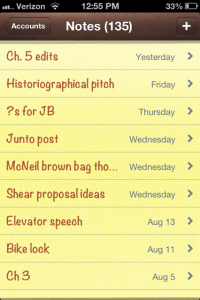 A few weeks ago, I dropped my iPhone in water. If you were wondering, those things do not float. As I pulled the phone out and dried it as best I could, all I could think about was my dissertation. I was in the throes of finishing a chapter, and I had a lot of really good ideas on that phone. In this post, I want to explain why my phone has become so important to my scholarly life. Continue reading
On Social Media Feeds for Historical Organizations and History Departments
 Turns out that after several stints running social media accounts for different institutions, I have feelings about what works and what doesn’t. What follows is a prescriptive ramble of things that historical organizations and history departments should be doing on Twitter and Facebook, with the understanding that there is a lot that I’m not covering, such as general Twitter etiquette, blogs, Tumblr, podcasts, or other social media topics we’ve already covered here. I’ll leave it to you in the comments to discuss these issues further—and to point out which additional accounts strike you as models to follow. Continue reading
The Problem with Big Books; Or, Alan Taylor’s Biggest Sin
[Headlines are supposed to draw readers, right?]
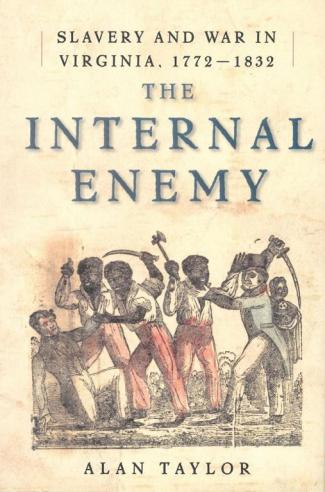 One of the first things I did after finishing my dissertation a couple of months back (other than sleeping for an entire week, of course), was reading Alan Taylor’s latest tome, An Internal Enemy: Slavery and War in Virginia, 1776-1832 (New York: W. W. Norton, 2013), which recently won the Pulitzer Prize. (One could argue that Taylor’s biggest sin, other than the one I’m about to discuss, is hogging all the major book awards.) As one would expect given Taylor’s track record, I was floored by the book’s exhaustive research and lyrical prose. I made a mental note that this would be a great book to assign to students. Now that I’m prepping for this fall, when I’ll be teaching a Jeffersonian America course, I gave the idea more serious consideration. However, I soon realized the biggest problem, which more seasoned teachers probably already know.
The book is just too big.
Herb Sloan’s Contributions to Scholarship on Jeffersonian America
 Last Tuesday, May 13, the Columbia University Seminar on Early American History and Culture and the Department of History hosted an evening in honor of Professor Herb Sloan of Barnard College. Herb, who is retiring this spring after 28 years as a member of Barnard’s history faculty, was the guest of honor at an evening commemorating both his contributions to the field of early American history, as well as a roundtable discussion on “Jeffersonian America.” Continue reading
Grade Inflation or Compression?
 Back in December, the Dean of Undergraduate Education at Harvard was quoted from a meeting of the Faculty of Arts & Sciences saying, “The median grade in Harvard College is indeed an A-. The most frequently awarded grade in Harvard College is actually a straight A.” This statistic was highly shocking to the general public (or at least the general media). Yale itself moved last year to address the problem when it turned out that 62% of grades given to undergraduates in a two-year period were A-minuses. Just a few weeks ago, the Teaching Center at Yale hosted a day-long seminar entitled, “Are All Yale Students ‘A’ Students? A Forum on Grading.” Most recently, Rebecca Schuman published a piece on grading at Slate entitled, “Confessions of a Grade Inflator.” However, rather than only seeing what has happened as the inflation of individual students’ grades, we should also see it—from the instructor’s perspective—as a compressing of the grading scale itself. Doing so reveals multiple repercussions for both students and faculty that the individualized, student-centered notion of “grade inflation” misses. We need to keep in mind that grade inflation or compression does not just benefit unworthy students; it actually has negative effects on both students and faculty, which should be the real causes for wanting to address the problem.
Commencement in Early America: Pausing at the Portal
 This is commencement season in the United States. On weekend mornings, college towns around the country are being beset by billowing clouds of begowned bachelors, trailing various family members and friends in their newly distinguished wakes. University neighborhoods are full of rented trucks and vans. Sidewalks are littered with furniture. People are swarming into auditoriums, sports stadiums, gymnasiums, or (as in the case of some of my Texas cousins) livestock arenas to hear more or less famous people dispense advice for adulthood. And to me, it’s all very, very exciting.
 The Junto