Historical trappings are extremely popular with video game designers. The Assassin’sCreed(AC) series, for example, has made a great success of combining beautiful recreations of historical scenery with the sort of conspiracy fueled story lines that propel Dan Brown novels and the Nicolas Cage headed National Treasure series to the heights of popularity.[1] The Assassin’s Creed games present a fascinating vision of historical agency, where historical change is explained through a hybrid of extreme individual agency—in the form of the game’s protagonist(s)—and the unending trans-historical battle between competing secret societies.[2] This is a very cyclical vision of history. We (through the player character, Desmond Miles and his ancestors) can battle Evil but the struggle will repeat itself time after time.
As a historian and life-long gamer I find these aspects of my beloved hobby in turns fascinating, endearing, and befuddling.[3] The question of agency—whom or what produces historical continuity and change—is one of the most contested and controversial philosophical and historiographical problems in my profession. Entire fields, such as the history of American slavery and abolition, have been riven by big-stakes arguments over such questions.[4] Few things are better at sparking heated debate (and more than a few eye-rolls) than bringing up the “agency question” in a seminar room or at a conference.
Video game designers and writers wade into this intellectual battlefield in ways that will likely surprise and frustrate most historians. I want to explore how historical agency is represented in modern gaming by looking at two recent games from Paradox Interactive—Europa Universalis IV(2013) and Crusader Kings II (2012). Both are “grand strategy games,” a genre very different from Assassin’s Creed. Born out of war and strategy board games—from the old stand-by Risk to much more complex games like Settlers of Catan—grand strategy games allow the player to take control of a nation-state, cultural group, or civilization and shape its future. To make matters more interesting, a video game allows many more facets of the human experience to be modeled than a board game does.[5]Continue reading →
The AHA recently announced the formation of an ad hoc committee to produce standard guidelines for evaluating digital scholarship. It is hoped that the guidelines will allow professional recognition of new scholarship in a way that can become codified within the tenure process. The committee is a veritable who’s who of digital humanities worthies—all with an excellent track record of traditional peer-reviewed scholarship and engagement with a variety of digital media. When this committee speaks, it will command attention.
This is an important step forward for the profession; having a rigorous set of guidelines for evaluation will serve as an important starting point for encouraging recalcitrant colleagues and administrators to take digital scholarship seriously. But there is one thing that is also notable about the committee—not to put too fine a point on it, it is rather old. All the scholars are safely tenured. Where are the voices of the new generation, of the digital natives? Continue reading →
Tomorrow at the Library Company of Philadelphia, I’ll be participating in a special edition of the McNeil Center for Early American Studies’ Friday seminar reflecting on five years of the Mellon Early American Literature and Material Texts Initiative. The Initiative began in 2009 as an effort to get early Americanists taking a material-texts approach to their research to step out of their respective fields and into a general conversation about the methods, theory, and potential of that approach. Over the course of five years, the initiative has provided funding for ten dissertation fellows to be in residency at the McNeil Center and make use of the tremendous resources of the Library Company and other area archives. In addition, the Initiative has contributed funding to conferences and sponsored a workshop each summer bringing together both junior and senior scholars to discuss their work and the trajectories of material-texts research. For Friday’s seminar, four former material-text fellows will discuss short selections of our current work and how our experiences in the Initiative have affected it. Continue reading →
Robert Whitaker is a doctoral candidate in History at the University of Texas at Austin. His dissertation, “Policing Globalization: The Imperial Origins of International Police Cooperation, 1918-1960” studies the relationship between the British Empire and international police organizations, such as Interpol. He serves as an Assistant General Editor for the journal Britain and the World, and is the creator of the YouTube series History Respawned. Bryan S. Glass teaches the history of Britain’s interactions with the World at Texas State University. He is the founding member and General Editor of The British Scholar Society and serves as an Editor of the Britain and the Worldbook series (Palgrave Macmillan). His publications include an article in the Journal of Imperial and Commonwealth History, The Scottish Nation at Empire’s End (Palgrave Macmillan, forthcoming), and a co-edited volume with John MacKenzie entitled Scotland, Empire and Decolonisation in the Twentieth Century(Manchester University Press, forthcoming).
French game company Ubisoft has turned early American history into an age of booty. Over the past two years, the company has used early American history as the backdrop for three successive and successful titles in their Assassin’s Creed franchise: Assassin’s Creed III, Assassin’s Creed III: Liberation, and Assassin’s Creed IV: Black Flag. The most recent of these titles, Black Flag, is set in the Golden Age of Piracy during the early eighteenth century, and is easily the most profitable and well received of the three. Critics and players have praised Black Flag for its gameplay, graphics, and music—or rather, sea shanties.[1] But the biggest reason why this game has garnered accolades and high sales is because of its use, or misuse, of history. More than any other Assassin’s Creed game, Black Flag plays fast and loose with the historical record. It skews away from accuracy in favor of fun at almost every turn. Yet even as Black Flag thumbs its nose at the concerns of academic history, it nevertheless succeeds, perhaps better than any previous title in the series, in giving players a sensibility of the age. Continue reading →
Christopher F. Minty (University of Stirling) recently completed his dissertation on the social and cultural origins of Loyalism in New York during the imperial crisis. He is the recipient of numerous fellowships, including the British Library, the Huntington Library, the David Library of the American Revolution, Colonial Williamsburg Foundation, and Houghton Library at Harvard University. This is his second guest post for The Junto.
In the years after the American victory at Yorktown, a series of debates took place over questions of citizenship and international law. Who counted as an American citizen, and what did that mean? What did the new American republics, and their confederation, owe to those who fell outside that category? In an earlier post, I discussed these matters in regard to one group of outsiders—suspected loyalists. Here I want to continue the theme as it touches a different group—Native Americans. Continue reading →
With Christmas right around the corner, we are re-posting this piece from three years ago. All of us at The Junto would like to wish happy holidays to all our readers.
As an historian of early America, I suspect I am not alone in sighing a little bit to myself when hearing the often heated rhetoric about the “War on Christmas” emanating from right-wing and evangelical media outlets at this time of the year. That, of course, is because the real war on Christmas was not waged by 21st-century godless, liberal secular humanists and the ACLU but by 17th-century New England Puritans, particularly the clergy.
Saturnalia was a pagan Roman festival held annually from December 17-25. Its customary celebrations were both chaotic and violent and, hence, were popular amongst lower-class Romans. In the fourth century, as the Catholic Church sought to bring the pagan masses into the Christian fold, the Church adopted the final day of the festival as Jesus’s birthday, which the New Testament does not indicate and on which, until this time, there had been no widespread consensus. The Church effectively killed two birds with one stone. Throughout the centuries, the most violent aspects of the celebration (which, allegedly, may have included human sacrifices) fell away, but the customs of near-lawless revelry persisted, and indeed defined the celebrations in the early modern period.
At the start of the early modern period, the holiday was not yet the priority it has become, as Easter dominated the Catholic calendar. But the Reformation had a significant impact on the perception of Christmas, both positively and negatively. The holiday celebration customs were continued by the Church of England. The often uninhibited revelry of the holiday (which Puritans derisively referred to as “Foolstide”) appealed to the English lower classes while the gentry celebrated with “eating and drinking, [and] banqueting and feasting.”
In addition there was a distinct class aspect to one of the customs, in which the poorest man in the town was named “The Lord of Misrule” and treated like a gentleman.[1] Another custom, known as “wassailling” involved lower-class persons going to the homes of wealthy individuals and “asking” for food and drink, which they would then use to toast that individual. Due to the penchant for disorder, immodesty, gluttony, and the (temporary) breakdown of the social order, it should come as no surprise that in the late sixteenth and early seventeenth centuries, English dissenters began to take a very dim view of the holiday. Indeed, the hotter the Protestant, the stronger the aversion to Christmas. But their opposition to Christmas was not just due to the overtly social nature of its celebration. Puritan faith derived wholly from scripture, and, in 1645 and again in 1647, the Long Parliament declared the abolition of all holy days except the Sabbath, which was the only day described as such in the Bible.[2]
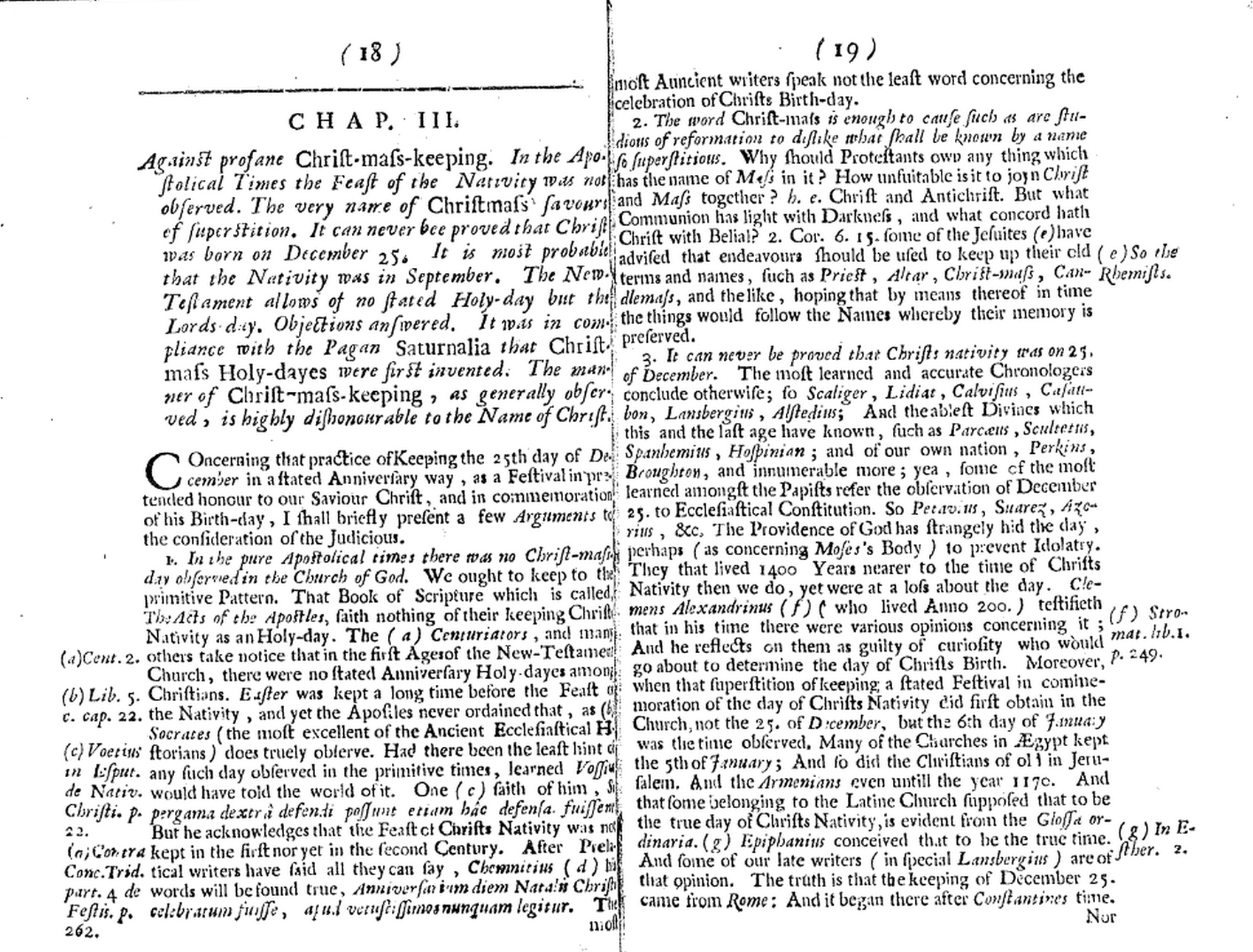
In the pure Apostolical times there was no Christ-mass day observed in the Church of God. We ought to keep the primitive Pattern. That Book of Scripture which is called The Acts of Apostles saith nothing of their keeping Christ’s Nativity as an Holy-day.
[. . .]
Why should Protestants own any thing which has the name of Mass in it? How unsuitable is it to join Christ and Mass together? [. . .] It can never be proved that Christ’s nativity was on 25 of December.
[. . .]
[They] who first of all observed the Feast of Christ’s Nativity in the latter end of December, did it not as thinking that Christ was born in that Month, but because the Heathens’ Saturnalia was at that time kept in Rome, and they were willing to have those Pagan Holidays metamorphosed into Christian ones.
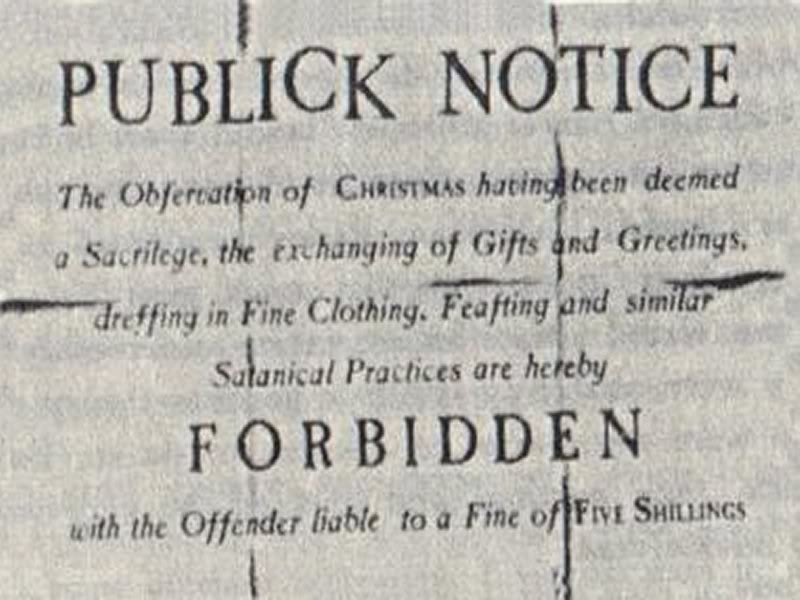
By mid-century, the Puritan “City on a Hill” was already losing its spiritual homogeneity and the combination of new settlers and a new generation less committed to Puritan strictures forced the Massachusetts General Court to take action. On May 11, 1659, the following was entered into the General Court’s records:[4]
For preventing disorders, arising in several places within this jurisdiction by reason of some still observing such festivals as were superstitiously kept in other communities, to the great dishonor of God and offense of others: it is therefore ordered by this court and the authority thereof that whosoever shall be found observing any such day as Christmas or the like, either by forbearing of labor, feasting, or any other way, upon any such account as aforesaid, every such person so offending shall pay for every such offence five shilling as a fine to the county.
Mather, “A Testimony…” (click to see full-size page)
Despite being told to repeal the “penalty for keeping Christmas” as early as May of 1665 for its “being directly against the lawe of England,” the law was not stricken until 1681, followed by renewed pressure from Charles II.[5] But even though the legal war was over, the cultural war on Christmas continued. In 1686, the unpopular royal governor of the new Dominion of New England, Sir Edmund Andros, required an armed escort at a Christmas service he sponsored (somewhat brazenly) in Boston. Indeed, Christmas was not celebrated widely in New England through the eighteenth century, and, when it was, it was done privately. All this is not to imply that Christmas was celebrated broadly outside of New England. Even after the Revolution, the Congress was known to meet on Christmas Day, if they were in session. Throughout the nineteenth century, as well, there are numerous reports from all over the United States attesting to the lack Christmas observance, particularly by various Protestant and German Pietist sects.
A few days ago, Bill O’Reilly claimed that—thanks to him and Fox News—the “War on Christmas” had been won and Christmas had been saved for all the true Americans out there wishing to celebrate the “traditional American Christmas.” However, the history shows that waging a “war on Christmas” is one of the very oldest of all American traditions and is a far more American tradition than the current twentieth-century, commercial capitalist version of Christmas that Bill O’Reilly claims to have saved.
____________________
[1] This tradition had its roots in a Saturnalian custom of Masters exchanging roles with their servants.
[2] If there could be said to have been a war “over” Christmas, it would have been in the 1640s and 1650s as Oliver Cromwell and Parliament tried to enforce their ban on Christmas by attempting to stop public celebrations by Anglicans (and the few remaining Catholics) and force shop keepers to remain open. In many localities, the result was fighting in the street between the authorities and those intent on celebrating the holiday in its traditional manner. For more on the English context, see Chris Durston, “The Lords of Misrule: The Puritan War on Christmas, 1642-60” History Today 35, no. 12 (1985).
For early Americanists, fall is conference-planning season. Proposals for the Omohundro Institute Conference were due in mid-September, SHEAR is accepting proposals until December 1, and a bevy of other conferences have posted CFPs in recent months. Watching this flurry of activity has led me to think about the intellectual goals that structure the formation of conference panels.
Of course, the conference panels we form—and whom we invite to participate in them—are partly functions of pragmatism. Each of us wants to find our way onto the program of our desired meeting, and mobilizing our networks is one way to do this. We scramble to find friends, colleagues, friends-of-friends, and acquaintances from research trips and prior conferences to join us on our panels. But if one of the goals of conferences is to enter into scholarly conversations, rather than simply to share our work with academic audiences, then it is essential to think about the kinds of questions our panels are asking and answering. Continue reading →
Thanks to the Comte de Buffon’s comprehensive Natural History, every European in the eighteenth century knew that the American environment was conducive only to degeneration. Still, Buffon admitted, “though Nature has reduced all the quadropeds of the new world, yet she has preferred the size of reptiles, and enlarged that of insects.” As his Dutch colleague Cornelis de Pauw put it, giant insects and venomous snakes “so unhappily distinguish this hemisphere” from the more hospitable side of the Atlantic.[1] Leaving aside insects for the moment, reptiles—and especially serpents—have always had a powerful symbolic valence. In the American context, the ambivalent use of the reptile shows up some of the complex relationship between the colonists’ natural world and their political imagination.
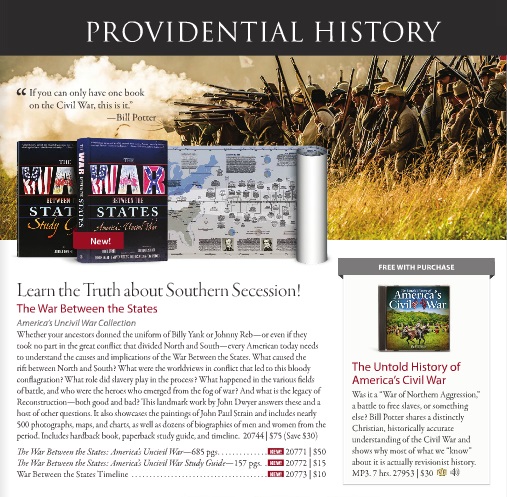
A recent news story has me thinking about the weird enduring appeal of the Lost Cause. It seems to me that this news story about a contemporary religious organization might lead us into an interesting case study. Why, at this late date, do so many Americans still want to see the antebellum South as a tragically vanished world of nobility and grace?
Most early Americanists are familiar with David Barton, a conservative activist who argues that the United States was founded as a Christian nation. He’s been mentionedhereseveral times as the most visible proponent of a view that’s common among members of the “Religious Right.”[1] What’s less widely understood is how often his Christian-founding ideology overlaps with a claim advanced by a few other evangelical conservatives: that the Confederacy—and antebellum southern culture, if not slavery itself—are also part of “America’s Godly heritage.”[2] In these circles, in other words, the Founding is sometimes wrapped up with the Old South.


 Tomorrow at the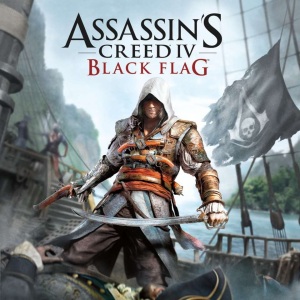



 For early Americanists, fall is conference-planning season. Proposals for the
 The Junto

