 In the first episode of HBO’s John Adams miniseries there’s a memorable scene (NB: it includes nudity) in which Adams is present at the tarring and feathering of a customs officer at Boston harbour. The purpose of the scene was to frame Adams as an outsider whose firm principles prevent him from ever being an organic leader of the American people—a theme that runs throughout the series. But it also does something else, which is to acknowledge early on that the American Revolution was an affair of violence. In a particularly poignant moment of the scene (2.02-2.07 in the clip), the director even chose to portray slaves in chains, looking on silently at the anger of the American mob. That is, he chose to remind us that violence in colonial and revolutionary America wasn’t just momentary and spectacular, but also pervasive and structural.[1] Continue reading
Category Archives: Opinion
A Rumination on “Perhaps”: Demos, Editing, and First Book Projects
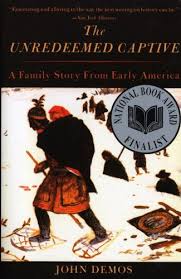 Confession: I hated John Demos’s The Unredeemed Captive when I read it in graduate school. So much so that whenever my future roommate and I became frustrated by the vagaries of our PhD experience, we’d lapse into extended wailing cries of “EUNICE!” that stretched across apartments, parking lots, and doubtless a library lobby or two. I’m not sure why it seemed so funny to us, but then, comprehensive exams do strange things to graduate students’ psyches. Continue reading
Is Blogging Scholarship? Reflections on the OAH Panel
 On Sunday, at the 2014 OAH Annual Meeting, I was part of a roundtable discussion entitled “Is Blogging Scholarship?” Several other participants have posted their thoughts on the subject; there was also a great deal of live-tweeting, and our own Joe Adelman has also joined (and developed!) the conversation. The discussion itself was fantastic, and was videotaped for later broadcasting. But in reflecting on the panel, I’ve found there are some points I wish to re-emphasize, and some problems I have with the way the entire roundtable was framed. Continue reading
Sinews of Power and Those Power Forgot
A Call to the Most Bland and Boring Pieces of Paper You’ve Ever Skipped Over in the Archives
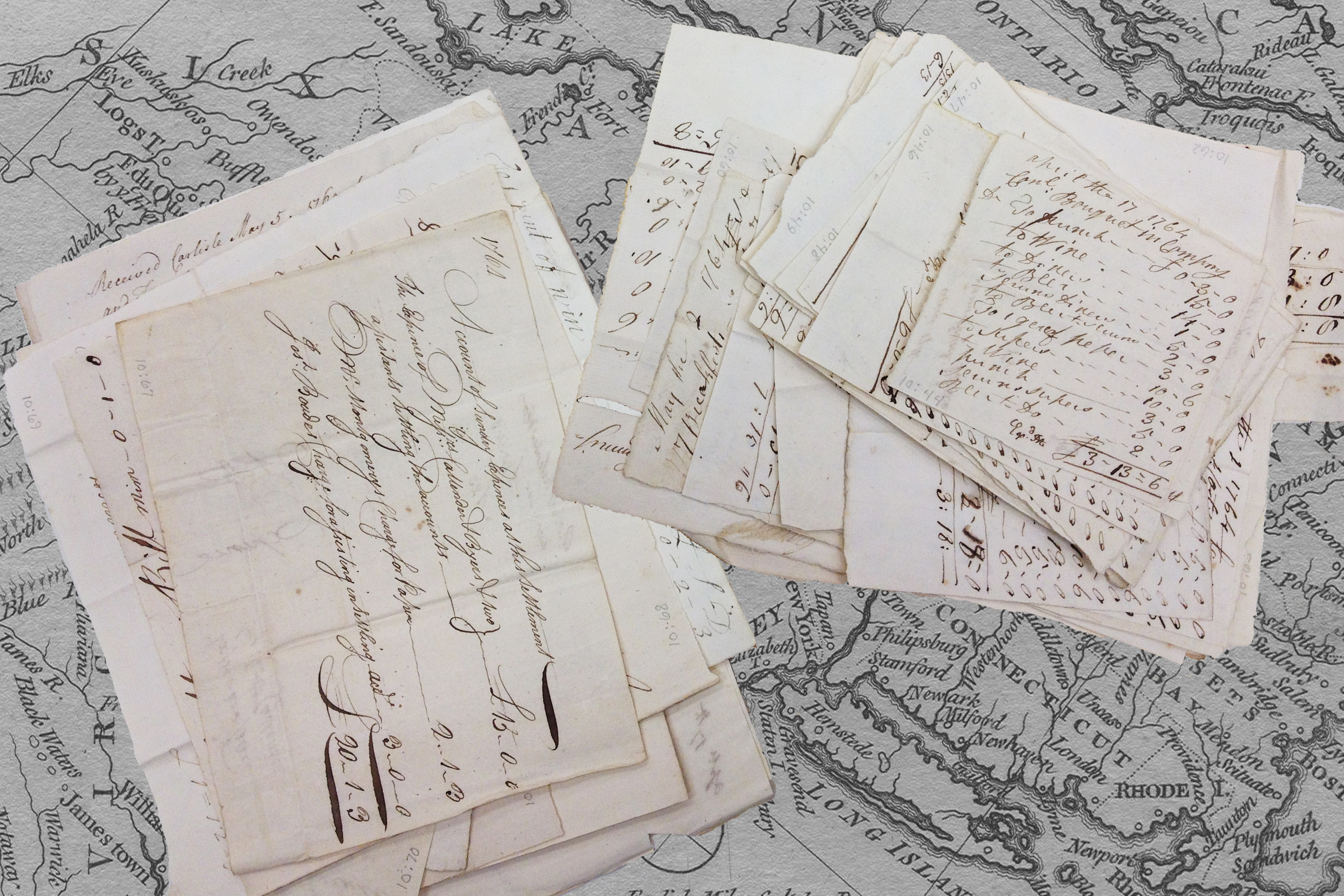
Vouchers! Receipts! Bills of exchange!
The paperwork of empire, particularly that of credit and finance, is probably not what gets most of us up in the morning. In the archives, we skip over the dull sections of the finding aids—warrants, no thanks!—and instead dive into correspondence and maps and bound volumes and clippings. The more adventurous of us might even call up account books—but those individual receipts? They’re lucky if we ever take them out of the box.
And why would we? Unless we live in a world of down-and-dirty finance or economics or material culture, they seem not only besides the point, but, even more, incredibly hollow. What do we get from reading a quick statement that someone was eventually paid for delivering a barrel of pickled cabbage in 1760? Especially when we can read in frantic detail the correspondence about how that barrel fell into the Mohawk River, burst open, got hauled back onto a bateau, arrived at Fort Stanwix, was re-opened, reeked, was declared unfit for consumption, continued to reek, was declared fit for consumption, reeked some more, ordered northward to Oswego, reeked still, and finally was delivered to a garrison comprised mostly of Germans who (our correspondents assumed) would think they’d been gifted sauerkraut.[1]
It’s the correspondence, we might argue, that gives us actors and action. In it, even a barrel—brown, wooden, boring—becomes something dynamic.
But who delivered that barrel? How long did it take him? Where did he begin his trip? Was he a merchant contractor, a militia man, a professional sled driver? And what did he get out of a journey, in the dead of winter, through the type of paralyzing cold you can only feel in upstate New York, with barrels of spoiled pickled cabbage?
Exceedingly important questions like these suddenly make the boring, bland, bureaucratic paperwork appear just a little (a very little?) more interesting. Continue reading
Was the American Revolution a Civil War?
 “Every great revolution is a civil war,” as David Armitage has recently remarked. That insight could change the way we think about the American Revolution. Contemporaries understood it that way—or at least, they did at first. David Ramsay, the first patriot historian of the war, held that the Revolution was “originally a civil war in the estimation of both parties.” Mercy Otis Warren wrote that the fires of civil war were kindled as early as the Boston massacre. But in the narratives of these historians, the moment the United States declared independence was the moment the conflict stopped being a civil war. It was no longer being fought within a single imperial polity. Now it was a war between two nations.[1] Continue reading
The Kitten in the Bookcase

Our new kitten, Rue, sitting on top of a shelf in the “Slavery and Freedom” section of my library. This post was totally not just an excuse to use this photo.[1]
A few months ago my partner and I moved to a new apartment, for the first time since I began living in New York full-time. The best part of moving to me, for purely selfish reasons, was it created an opportunity to fully reorganize my library for the first time in three years. Our old apartment was much smaller than our current place which left my ever-growing doctoral candidate’s library relegated to one and a half bookshelves. This led to all kinds of organizational chaos and housecleaning headaches – with books tucked away in closets, stacked on desks, piled in corners. Many times while writing I found myself looking for a book for a reference or citation say, for example, my copy of Joanne Freeman’s Affairs of Honor (which always seems to vanish) and I knew, for the life of me, that I had the book somewhere in the apartment, but had no way to even begin to find it without tearing the place apart. At the new apartment I have, thanks to my partner’s beneficence, the space to fully store my library in real bookcases and in some sort of proper organizational scheme.
Whither the 18th Century?
 Teaching the first half of the American history survey has become a more complicated job over the last few decades. The reason is quite simple—the purview of early American historians has broadened significantly in the same period. A narrative from Jamestown to Independence to Civil War is now a narrative that begins with (or even before) the Columbian Exchange. A geographical focus that formerly considered the “thirteen colonies” almost in isolation now extends northwards to Canada, westwards to the Mississippi, southwards to the Caribbean, and across the ocean to Europe and Africa. A predominantly white, male, Protestant cast of characters has welcomed women, people of color, Native Americans, and others to its merry band.
All of this is a good thing. But it runs up against a critical problem—the amount of time in a semester has not extended at all. To take account of newer historical approaches therefore requires critical editing of syllabi and a rethinking of approaches. That means there will be, for want of a better term, “winners” and “losers” in terms of the material covered in the survey course. My contention is that the 18th century is the main loser from these changes—and I wonder, at times, what the implication is for our students’ understanding of key currents of American history. Continue reading
What The Oatmeal Missed
NB: This post was originally published in 2013.
 When did you realize Christopher Columbus was a jerk?[1]
I’m not sure if I actually received the “traditional,” Samuel Eliot Morrison and Daniel Boorstin-inflected education on Columbus, during my child and young adulthood.[2] I remember that my high school history course (c. the early 2000s) sped through Columbus and discussed a bit about his bad human rights record. My excellent college-level history courses, of course, provided the standard explaination, found in virtually every modern textbook of repute, of the Columbian Exchange unleashed by early European exploration and conquests in the Americas.[3] I imbibed, during my childhood, the general story about Columbus in American culture—that “he sailed the ocean blue in 1492” and “discovered” America—but, if there were any lies my teachers told me, it certainly wasn’t about the earliest encounters between Native Americans and Europeans in the Caribbean.[4]
Howard & Me
Howard Zinn’s A People’s History of the United States changed my life.[1]
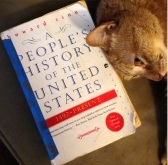
My personal copy of the 2003 edition of A People History of the United States. Also featured: my cat Marshall.
I grew up in very historically minded family. My recollections of my boyhood and tween years are filled with sweaty summer memories of traipsing with my mother and sister through every Revolutionary and Civil War battlefield between the mid-Atlantic and Upper South—from Gettysburg to Yorktown.[2] We regularly took the Orange Line into Washington to go to the National Museum of American History. The History Channel, when we had cable, was a regular fixture on our television.[3] All of this history education was very traditional—all Presidents, bloodshed, and American Exceptionalism.[4] My understanding of American history only became more traditional once I entered a conservative Catholic high school.
The Plains of Abraham and Annus Mirabilis
Or, how I came to realize my early America might not be so quintessentially American. 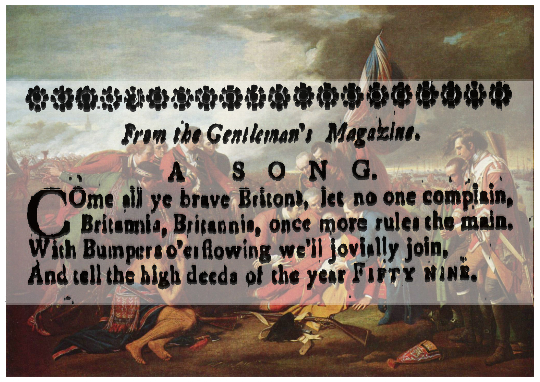
According to my calendar—everyone has alerts set to eighteenth-century military actions, right?—today is the 254th anniversary of the French surrender of Quebec. Forget Constitution Day, this is the hottest event of your week.
 The Junto