 A relatively quiet week here; with the semester now underway everywhere, it’s probably not such a bad thing that we have fewer links to share. In any case, a little Revolution, an unidentified diary, and a forgotten war … on to the links!
The NNPH: Odds, Ends, and Some Concluding Statements
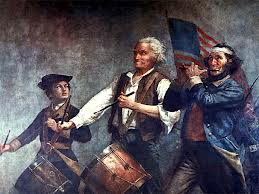
Political history goes marching on.
Unfortunately, we were unable to post the final scheduled post for the roundtable, which was set to be on race. So instead of someone trying to scrounge up a full post last-minute on this important topic, a few of us decided to put up some brief concluding thoughts on various topics related to the New New Political History. We ask that these be read as more informal than the previous three posts, and more as a touchstone for possible discussion. If things go right, we should have a response to the roundtable from Andrew Robertson sometime soon.
Besides engaging with any points in this or other posts in the roundtable, please feel free to bring up any other issues that we didn’t address related to the NNPH. Continue reading
More Public than Spherical: The NNPH and the “Public Sphere”
 Historians of early America often stereotype each other as being adverse to the use of theory. However, a closer look at the historiography of early America over the last century does not bear out that claim. In the first decades of the twentieth century, Progressives derived their materialist conception of history from Marx.[1] The Progressive interpretation held for decades until the 1960s when a group of historians based at Harvard University displaced it with an interpretation influenced by the sociological theories of anthropologist, Clifford Geertz.[2] Even though postmodernism and postcolonialism, as theories, never took a strong hold on the field, there have been early American historians who have sought to incorporate, in a general sense, their broader modes of inquiry.[3] The historiography of early America has hardly been devoid of theory over the last one hundred years.
Nevertheless, a deeper look into each of these examples shows us that early Americanists’ relationship with theory has been anything but obsequious. Perhaps, it is best defined as casual or, better yet, utilitarian. The Progressives appropriated the generalities of Marx’s historical materialism without embracing either his sociological analysis or his broader dialectic. Similarly, the ideological historians of the 1960s and 1970s used Geertz’s definition of ideology as the mediation of experience into the structure of consciousness without attempting to apply the rest of his intricately complex theory regarding cultural systems. Following in that tradition, early Americanists over the last twenty years, particularly those associated with the New New Political History, have loosely appropriated the Habermasian concepts of the “public sphere” and “civil society” while casting aside both small but fundamental details and the much larger particulars of Habermas’s argument.[4] Continue reading
Politically Incorrect?
I consider myself a child of the ‘new new political history’. When I first started in graduate school, books like Simon Newman’s Parades and the Politics of the Street and David Waldstreicher’s In The Midst of Perpetual Fetes helped a constitutional geek recognize the necessity of taking a broad definition not just of political activity, but also of political actors. Beyond the Founders was a wonderful introduction to the possibilities of political history – the way in which a whole host of diverse experiences influenced and shaped political culture during the early republic. Their portrayal of early American political culture was a welcome change from previous histories focusing excessively on elites (and thus tending to promote ideology ahead of political action), or social histories whose model of class consciousness seemed a bit too heavily grafted on to a period in which some (if by no means all) elite political leaders possessed a real claim to widespread popularity.
Of course, the plea to get historians to move ‘Beyond the Founders’ hasn’t been a wholesale success. While Chris Beneke may have suggested that the plethora of books about ‘Founders’ would inevitably slow down, even some Beyond the Founders contributors themselves contributed essays to Alfred Young, Ray Raphael and Gary Nash’s recent Revolutionary Founders. In both popular culture and in academic circles, the trope of ‘founders’ or ‘framers’ or a ‘revolutionary generation’ still looms large. The question I want to explore in this blog post, then, is this: If the NNPH promised to provide a history that synthesized political narratives with social and cultural history, why do we seem to find it so hard to move beyond the founders? My suggestion will be this: for all that the NNPH revitalized political history after the ‘social turn’, much of it was strangely detached from high politics. Continue reading
“There was a great argument yesterday on female excellence”: Gender & the Newest Political history
One of the most striking features of the “newest political histories” has been their careful attention to questions of gender. Four essays (for example) in Beyond the Founders, the capstone-cum-manifesto of this particular historiographical moment, deal directly with the political nature of gender identities in the early American republic.[1] The privileged place of gender in these histories makes a great deal of sense–if the goal of the “newest political histories” is to broaden cast of characters in political history and explore the intersection of “cultural” and “ordinary” and “traditional” politics then questions of masculinity, femininity, and sexuality should be central. Gender, along with race, was a key way to demarcate between who was in and who was out of respectable politics in the new nation.
The most productive, and perhaps influential, use of gender as an interpretive lens has been in the political history of women. Many of the earliest works of what could be called the “newest political history,” and those which best exemplify the movement, are histories of women and politics.[2] This generation of historians has shown that women were clear actors in early national politics and print culture–through newspapers, the theater, parades, books, and the salon. Not only were women a direct participant in politics “out of doors” and in print, femininity was deeply politicized in the early national period. In the highly charged politics of the early republic, much was up for grabs–a great deal of prestige and power would be gained (or lost) depending on where the line of respectable political behavior of men and women was drawn. Continue reading
The New, New Political History: A Roundtable (Introduction)
This will hopefully be the first of many roundtables hosted by The Junto, in which a bunch of young whipper-snappers take aim at various topics of early American history, with the occasional response from seasoned scholars to set us straight. This particular roundtable, which will hopefully set a pattern for others to follow, includes contributions every day this week, each on a different topic related to the broader theme, and then a conclusion/response next Monday. We hope these roundtables, starting with this one on the current state of political history, will start a fruitful discussion both on the blog and elsewhere.

In 2005, Chris Beneke published an essay in Reviews in American History titled “The New, New Political History.”[1] This label did not originate with him—indeed, one of the chapters in the book he was reviewing used the same description[2]—but it was meant to capture the arguably fresh take on early American politics. The editors of Beyond the Founders, Beneke wrote, “enter a nearly decade-long discussion on the direction of political history.”[3] Was the field thriving or faltering? Well, he reasoned, it depended on how you defined the field. And after looking at this manifesto-volume, Beneke concluded that the movement was diverse, scattered, and unsystematic, yet promising. In the face of the ever-constant “founders chic,” a continuation of America’s fascination with a small group of people who allegedly embodied America’s pride and glory, this historical movement sought to widen the scope and centralize the peripheries. Sometimes, for academics, the Joseph Ellises and David McCulloughs of the world are not quite enough. Continue reading
The Week in Early American History
Good morning, and welcome to another edition of The Week in Early American History. Lots going on this week, so let’s get straight to the links.
The Abolitionists: A Recap
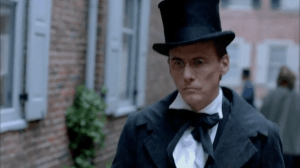 Over the last three weeks, Jonathan Wilson and Ken Owen have reviewed the PBS documentary series The Abolitionists. Their reviews of part 1, part 2, and part 3 are already available for you to read. In this final post, Wilson and Owen will discuss the series as a whole, focusing especially on its value for history professors in the classroom.
Ken: Jonathan, I thought that we might start this discussion by looking at the producers’ public statements on what they were attempting with the series. For reference, there is a video entitled ‘Why We Made The Abolitionists‘, and an article ‘From The Executive Producer‘. For me, the most striking statement of the video is the opening assertion that no transformative moment in American history ‘stems from the actions of ordinary Americans as much as the abolitionists’. The producers then say that the five characters that they chose were deliberately intended to invoke different strands of the abolitionist movement.
The Abolitionists Go to War: Part 3
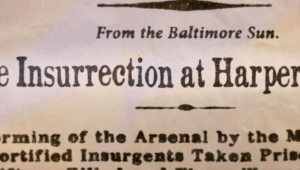 The final episode of The Abolitionists aired this week on PBS. The entire three-hour documentary is now available online here (Part 3 begins at the 1:40 mark). A full transcript is also available. Kenneth Owen and Jonathan Wilson previously discussed the first two episodes for The Junto. Today, we discuss the final hour.
Jonathan Wilson:
We’ve been fairly hard on The Abolitionists thus far, so I’m happy to say I thought the final chapter of the film is the strongest, both historiographically and dramatically. This episode reflects recent scholarship on slave rebellions, and on John Brown in particular, by meditating in a fairly sophisticated way on the uses and languages of violence.
A Stack of Bibles
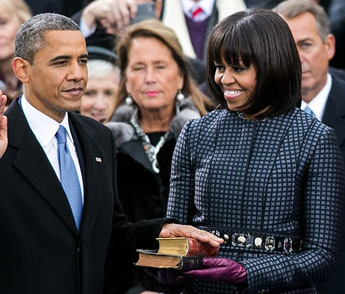
As has been widely reported, on Monday President Obama swore on a stack of bibles to uphold the Constitution. On one hand, maybe doubling-up on the sacred iconography will reassure those on the right who doubt the President’s sincerity, but the primary purpose was to honor two periods of American history simultaneously. This year marks the 150th anniversary of the Emancipation Proclamation and the 50th anniversary of the March on Washington, and the bibles were direct material links to those eras: one was the bible on which Abraham Lincoln took the oath of office in 1861, and the other belonged to Dr. Martin Luther King, Jr.
United in this one event, they are very different books. The Lincoln bible has, for all intents and purposes, never been used. Continue reading

