Sanitizing History

For the last few years, there has been a recurring news item in early January that sets my historical rage going. The repeated refusal of the Baseball Writers Association of America to elect Mark McGwire and others suspected of steroid use in the 1990s and early 2000s was bad enough. This year tipped me over the edge; the idea that neither Barry Bonds nor Roger Clemens deserve a place in the Hall of Fame is nothing short of preposterous. For better or worse, McGwire, Sosa, Clemens, and Bonds defined an era in which baseball regained its popularity after a self-destructive strike in 1994. For the hallowed halls of Cooperstown to pretend they never really existed is willfully sticking heads in the sand.

Of course, the sanitizing of history is not limited to the game of baseball. Every year, the NCAA comes down with ‘sanctions’ on college sports programs for a series of violations, whether academic, financial, or moral. Most typically, those programs are asked to ‘vacate’ their wins – doing nothing to actually award wins to the losers. And the sorry mess of the Lance Armstrong saga reflects a similar tale – those consulting the record books will simply be told that no-one won the Tour de France between 1999 and 2005, as if the race had never been run. At least the ‘vacation’ of title or a blank space in the annals encourages the casual observer to do some further reading on the circumstances. At root, though, it is a cop-out – if the record books don’t give us the nice morality tale that we’d like to see, we just press the delete button and hope that no-one comes to notice. Continue reading

Where Have You Gone, Gordon Wood?

Gordon S. WoodWood and Obama is perhaps the most prominent of the many Bernard Bailyn-trained historians to emerge from Harvard in the 1960s and 1970s, including Richard Bushman, Michael Kammen, Michael Zuckerman, Lois Carr, James Henretta, Pauline Maier, Mary Beth Norton, and many others. In the late 1960s, Wood’s dissertation-turned-first-book, The Creation of the American Republic, 1776-1787, had arguably as large an impact on the field as his mentor’s Ideological Origins of the American Revolution did a few years before, both helping to usher in the heady days of the “republican synthesis.” This is all to say that Wood had earned himself a prominent spot in the field of early American history from pretty much the very start of his career. However, subsequent generations of early Americanists have grown increasingly hostile to not only Wood’s work but to the man himself. This leads to the question: Why is it acceptable (or even praiseworthy) behavior among early Americanists to treat one of the most important historians in the field in the last century disrespectfully? In this piece, I’d like to talk about Gordon Wood’s career trajectory, suggest that other historians’ reactions to him reflect not only Wood but on historians themselves, and ask whether that might give us even a fleeting insight into generational differences between early Americanists. Continue reading

The Week in Early American History

TWEAHGood morning and Happy Inauguration Day! Since in early America the inaugural was a March event, no links to that event today, but plenty to keep you occupied until noon based on the collective wisdom of the Junto.

Continue reading

Early America, with a Brooklyn Accent

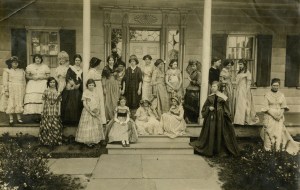
Historic reenactors at Lefferts House, Prospect Park (1938)

Last week, we asked how digital projects are transforming our study of early American life and culture. Here’s the first in a series of interviews with historians who tell us what worked, how digital tools shaped the narrative, and where they want to go next on the digital frontier. This week, we asked the Brooklyn Historical Society for a peek at the making of a special digital exhibit on the Lefferts family of New York. As Breuckelen becomes Brooklyn, readers can link to local sites where the Lefferts family lived and worked, including the Lefferts Historic Homestead in Prospect Park (shown here: Historical re-enactors gathering on the front steps in 1938). The Leffertses were influential landowners, politicians, historians, financiers—and also one of the county’s biggest slaveholding families. Their letters, farm accounts, and recipe books offer a new and very personal window on New York’s development.Our thanks to Jacob Nadal, the Director of Library and Archives, and Julie Golia, Public Historian and Curator, who kindly took our questions on bringing nearly four centuries of Brooklyn to digital life. Continue reading

The Abolitionists Ride Again: Part 2

Douglass at antislavery meetingLast week, The Junto brought you a pair of responses to Part 1 of PBS’s new American Experience documentary on The Abolitionists. Kenneth Owen and Jonathan Wilson were cautiously critical of the first episode–particularly its treatment of religious belief and the activities of less famous abolitionists. Today, they weigh in again with brief responses to the second episode, which aired Tuesday night. (It is still available to watch online; skip ahead to Chapter 8 or the 50:40 mark.) Continue reading

Edutainment and the Boston Tea Party

In recent years, the museum world has become inundated with edutainment sites and exhibits that hope to entice younger, more tech-savvy visitors, as well as people who do not tend to frequent museums, with all the bells and whistles of electronics and media. Videos, audio recordings, touch screens, and smart phone apps attempt to make history relevant to modern-day audiences by drawing them in with high-resolution graphics and multi-sensory experiences. At a time when funding for cultural institutions often takes a back seat, and when technology is everywhere and impossible to ignore, this push to increase revenue, visitation, and visitor interaction is unavoidable and understandable.

I recently ventured to the Boston Tea Party MuseumHistoric Tours of America’s updated and expanded building (to the tune of $28 million) along the Boston waterfront, and one of the most extreme examples of edutainment that I’ve seen. My visit got me thinking about the ways in which history museums use technology and media to attract visitors, and the ways in which this technology can both clarify and obscure the historical information that is presented to the public. After touring the Boston Tea Party Museum I couldn’t help but wonder, when does a museum stop being a museum and become something else entirely?  Continue reading

Primary Sources in the Classroom: Politics and Pedagogy

This is my first “real” blog post for The Junto, though I’ve been a spectral presence each Sunday with a gathering of links on early American history (which the past month or so has revolved a great deal around Lincoln and Django Unchained). One of my aspirations in agreeing to contribute, and one of my hopes for a developing conversation, centered on the opportunity to discuss teaching early American history, from the 100-level survey to upper-level courses. So I offered for this post to write something about teaching primary sources, without at the time knowing quite what I would say.

Then, last week, the National Association of Scholars released a report assailing colleges in Texas (the flagships – UT-Austin and A&M) for teaching too much “race, class, and gender,” and not enough political, diplomatic, and economic history. I wrote about a few of the report’s shortcomings at Publick Occurrences 2.0 on Friday. You can read the substance over there, but as I was writing I realized that I want to extend my thoughts to think more deeply about what we do in the classroom. Continue reading

Young Men of the Revolution

The intelligent American of today may know a great deal about his history, but the chances are that he feels none too secure about the Founding Fathers and the framing and ratification of the Federal Constitution. He is no longer certain what the “enlightened” version of that story is, or even whether there is one. This is because, in the century and three quarters since the Constitution was written, our best thinking on that subject has gone through two dramatically different phases and at this moment is about to enter a third.

As well as a continuation of my earlier thoughts on elites, this post is a tribute to a classic article: Stanley Elkins and Eric McKitrick’s “The Founding Fathers: Young Men of the Revolution,” in the Political Science Quarterly 76, no. 2 (June 1961). When I opened the article to reread it in order to write this post, I was struck by the vigour and assurance of that opening paragraph. It’s writing that hasn’t dated so much as aged, beautifully. Continue reading

The Week in Early American History

TWEAH2Happy New Year! We took last week off while so many of us were in New Orleans for AHA, so the set of links covers just a bit more than the past seven days. From here on we should be back to our regular schedule every Sunday morning.

Continue reading

Brave New World: Digital Early America

As settlers and explorers, early Americans navigated intricate webs of trade, created dynamic intellectual networks, and (often, thankfully) left us a paper trail of discoveries great and small. Presented with that past in the archive or on the screen, historians increasingly turn to digital resources for a new arc of insight. Thanks to digitized books and manuscripts, online reference tools like Google Books, amplified search methods, new digital libraries, and GIS mapping, there are plenty of opportunities for new research. We can follow foreign consuls, read a Southern man of letters, watch a Brooklyn family put down roots, or hear a podcast about Native American family life in Virginia. That’s just a small sample of the many digital projects transforming what we know of American history. The wave of new media has benefitted professional training, too. For digital scholars of all stages, there’s a welcoming set of training opportunities like THATCamps, summer institutes, and winter training sessions. Continue reading