The Abolitionists in Primetime: Two Responses

The Abolitionists on PBSThis week, PBS’s American Experience aired the first episode of The Abolitionists, a new three-part documentary. If you missed it, you can still watch it online. It is written and directed by Rob Rapley. The next two episodes will air on January 15 and 22.

The film profiles Frederick Douglass, William Lloyd Garrison, Harriet Beecher Stowe, John Brown, and Angelina Grimké. Part I covers the 1820s and 1830s, fitting it comfortably into The Junto’s portfolio. Kenneth Owen, an Assistant Professor of History at the University of Illinois at Springfield, and Jonathan Wilson, a PhD candidate at Syracuse University, have a review.

Continue reading

The Plantation as Crime Scene: Quentin Tarantino’s “Django Unchained”

Between this and Abraham Lincoln, Vampire Hunter, it's been a banner year for antebellum shades.

Between this and Abraham Lincoln, Vampire Hunter, it’s been a banner year for antebellum shades.

“It’s a flesh for cash business—just like slavery.” So the German bounty hunter Dr. Schultz describes his profession to the ex-slave title character near the beginning of Quentin Tarantino’s Django Unchained. It’s an apt introduction to the film’s broader portrait of American slavery — a rendering that emphasizes the tortured flesh, the sordid cash, and the gruesome business of bondage at every turn. In this regard, Django Unchained fits comfortably within the familiar canon of Tarantino crime films, which have nearly always probed the intersection between the brutally physical and the cynically transactional.

The old gang’s all here: the vicious mob boss, the wisecracking assassin, the tight-lipped, vengeance-minded hero. So why should anyone, let alone early American historians, bother to consider the historical perspective of a film that in many ways is just Reservoir Dogs with snazzier waistcoats and more primitive sunglasses? Continue reading

The AHA and the Future of the Profession

This past weekend, historians from all over the country invaded the Big Easy for the American Historical Association’s 2013 Annual Meeting. Thanks to Twitter, those of us unfortunate enough to not be in attendance were kept abreast of the discussions occurring regarding the state of the field. Most notably, the traditional AHA Presidential Address by outgoing President William Cronon has sparked much debate among historians as well as articles in the New York Times and the Chronicle of Higher Education. Before that, Cronon oversaw a panel entitled “The Public Practice of History in and for a Digital Age,” which explored academic historians’ failures to reach the general public and the profession itself failing to sufficiently adapt to the rise of digital technology. Changes to the profession discussed included a renewed focus on storytelling and narrative to better engage the general reader in academic history, weighing digital history equally with print history (when of equal value), and rethinking the monograph as the standard mode of delivery of academic historians’ work. Due to my lack of attendance, I am indebted to the excellent Twitter and blog coverage of these events by John FeaLincoln Mullen, and others, as well as the History News Network‘s video recording of Cronon’s address (see below). Continue reading

Shall We Listen to That Again?

I’m working on my syllabus for next semester. This is a new class at a relatively new job, and I have spent approximately 1,000 hours agonizing over the structure of the class and the difficulty of the readings, tweaking the language of the course description, and trying to find the most fair and opportune balance for the assignments. But mostly, making this syllabus has made me reconsider the role of listening in the classroom. Listening to music, that is.

Since I teach at an elite conservatory where all of the students are training to be (or already are) professional performers, we listen to music in every class meeting. This particular course, on representations of the “exotic” in western music from c. 1600 to today, features approximately 30 pieces of music. I treat these pieces like primary sources. The students are expected to listen to the assigned piece in advance, and in class we listen to excerpts in order to ground our discussion. I introduce other musical examples to illustrate points or guide the discussion in new directions. Sometimes the students draw on their own experiences as performers, making connections between the course materials and music they’ve encountered elsewhere. Continue reading

American Revolution: The Game

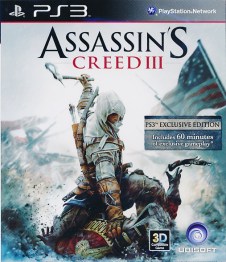
Assassin's Creed IIIWarning: Please be advised that there are a few spoilers in terms of the game’s storyline in the fourth paragraph of this post.

This is a strange topic for me to be writing on, i.e., a video game. After all, I am not what some younger Juntoists might call “a gamer.” But when I saw the trailers for Assassin’s Creed III last summer I found my anticipation for the game growing. Assassin’s Creed III is a historical fiction-based game in which the main character—a half-English, half-Mohawk warrior called Connor—finds himself at the center of many of the most important events of the American Revolution. Let me start with a little background on the game.

Continue reading

#AHA2013 Open Comment Thread

Some of us here at The Junto are headed to the American Historical Association’s annual meeting in New Orleans today. We thought about doing one post, but then we thought it’d be fun to hear your AHA impressions, too. So we’re making this an open comment thread.
Do you want to plug your paper? Are you a first-time AHA attendee? Did you hear about something new afoot in the world of early America? More broadly, did you find any thought-provoking panels on teaching, publishing, or digital history?

Think of this thread as a place to post preliminary thoughts on the conference. We’d love to hear about your experiences in New Orleans.

Then, Thenceforward, and Forever Free

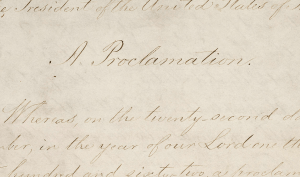
emancipationproclamationWe can’t let 2013 begin without marking the 150th anniversary of the Emancipation Proclamation, which Abraham Lincoln issued on January 1, 1863.

Harold Holzer describes the anxiety many Americans felt on that day as they waited for confirmation of the act. Allen Guelzo weighs Lincoln’s legal options. Annette Gordon-Reed discusses the document’s significance. Eric Foner discusses what it did–and did not do. Continue reading

The Week in Early American History

TWEAHHappy New Year! A brief post today, and then the Junto will take a few days to observe the transition from 2012 to 2013 (before most of the members head to New Orleans for the AHA conference). Enjoy these reads!

Continue reading

About a Book

allen_bible_tp

Ceci n’est pas une book.

She was encased in stolen books, buried in them as if in dirt. The thought of the countless hundreds of thousands of names that surrounded her, vainly scrawled in top right-hand corners – the weight of all that ignored ink, the endless proclamations that this is mine this is mine, every one of them snubbed simply and imperiously….The ease with which those little commands were broken.

She felt as if all around her, morose ghosts were milling, unable to accept that the volumes were no longer theirs.

China Miéville, The Scar

So, on the heels of Christopher’s eloquent framing of the questions of historical distance, a material-texts take on the joys of negotiating that distance by using dead people’s books: Continue reading

Narrative History and the Collapsing of Historical Distance

Among the highlights of my Christmas was receiving Catherine Brekus’s recently-released volume, Sarah Osborn’s World: The Rise of Evangelical Christianity in Early America, a fascinating account of an eighteenth-century evangelical woman whose life experiences intersected with, and speak to, several importance events and themes from the period. At the time of writing, I’m about half-way through and can’t recommend it enough. At a future date, I’ll try and post a more formal review (or at least lengthier thoughts) of the book, but wanted to briefly reflect here on something Brekus briefly discusses in her preface. “Reading Sarah’s reflections on her life,” Brekus explains, “reminds us of how far away the past is—but also how close.” Solidly grounding her subject’s experiences in its eighteenth-century context, she continues: Continue reading