 Sometime in the 1990s, NBC decided to promote its usual lineup of summer reruns with the tag line, “if you haven’t seen it, it’s new to you!” I’ve thought about that line occasionally since I started grad school, and came to it again this week as I’m working on syllabi (including, yes, a belated book order) for the fall semester. The problem I’m facing is a familiar one: how to balance the desire to engage in discussions of the newest work on a given topic—in this case the American Revolution—with the fact that they haven’t yet encountered some of the classic arguments.
Ballin’ Ben Franklin, Father Knickerbocker, and Lucky the Leprechaun: Representations of Early American History in NBA Team Logos
 Big news out of Philadelphia earlier this week, as the city’s NBA team, the 76ers, introduced an “updated brand identity.”[1] For now, the team has released the new logo set, though updated uniforms are also reportedly in the works. That new logo set amounts mostly to slight revisions of existing logos, but also includes a secondary logo featuring a bespectacled Benjamin Franklin donning a blue jacket emblazoned with “76,” red culottes so as to expose knee high and team colored-striped socks, and blue sneakers. Suffice it to say that my excitement about my prospective move to Philadelphia this fall just increased ten-fold. Continue reading
Natural Histories

See the world through Hannah Winthrop’s eyes. Your gaze dips down into the high-polished tea table and shears past John Singleton Copley’s brush, into summer 1773. Shown here serenely grasping a nectarine branch, Hannah likely knew that her world—what she called the “same little peaceful circle”—was spinning into a new revolution. Continue reading
Guest Post: African Americans, Mobility, and the Law
Today’s guest poster is Robert Gamble, Visiting Assistant Professor of History at the University of Kansas. He is currently at work on a manuscript entitled “The Civic Economy: Regulating Urban Space and Capitalism in the Early American Republic,” and has written a chapter on secondhand goods for Capitalism by Gaslight: Illuminating the Economy of Nineteenth-Century America (Brian Luskey and Wendy Woloson, eds.).
 The death of Freddie Gray three weeks ago and the ensuing protests prompted many people to seek richer historical context for what happened. Consider that Seth Rockman’s twelve-year-old Common-place essay on rioting in early Baltimore had garnered some one million re-tweets by last Tuesday afternoon, according to his estimate. Justly concerned about half-baked historical parallels, Rockman doubts “the 1830s is [the] most useful context for now.” Certainly, there are more recent sources and contexts to consider: the real estate and lending practices that fortified segregation, reeling public school systems, eroding city tax bases, deindustrialization and the exportation of jobs, transit systems that bypass largely black neighborhoods, a deteriorating housing stock encased in lead paint, the mutual distrust sown by the War on Drugs, militarization of the police, and so on. Baltimore’s bank riot of 1835, though a nice lesson in shifting attitudes toward capitalism and urban order, does little to make the issues of 2015 any more coherent.
Q&A: Abigail Swingen, Competing Visions of Empire
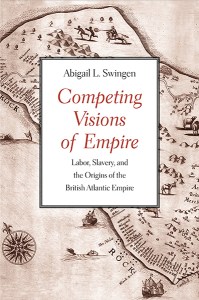 Abigail Swingen is an Assistant Professor of History at Texas Tech University (Lubbock, TX). She received her Ph.D. in History from the University of Chicago. She specializes in the Early Modern British Atlantic Political Economy. Competing Visions of Empire is her first book and was reviewed here yesterday. The following is part of our (relatively) new tradition of reviewing a book and then offering a Q & A with the author the following day. [NB: You can find my review from yesterday here.] Continue reading
Review: Abigail Swingen, Competing Visions of Empire
Abigail L. Swingen, Competing Visions of Empire: Labor, Slavery, and the Origins of the British Atlantic Empire (New Haven: Yale University Press, 2015).
There have been some fantastic new contributions of late that explore connections between slavery, economics, and empire. In his 2008 analysis of the American political economy, economic historian Gavin Wright concluded that the dependence on slave labor came not because of any institutional efficiency on the part of plantations, but rather, that no other form of coerced labor could have been made to meet the labor demands. Sven Beckart’s Bancroft Prize-winning book, Empire of Cotton, analyzes connections between cotton, and the slave labor behind it, and the rise of modern capitalism. Ed Baptist’s book, The Half Has Never Been Told, explores slavery’s role in the making of American capitalism.
The King’s Arms?
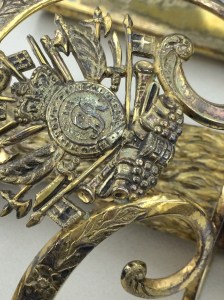 Paper soldiers on the march, and tin men tilting at swordpoint: these were the first battle ranks that Grenville Howland Norcross, aged 11 in Civil War Boston, led to glory. Between phantom invasions and replays of Antietam with “relics” received as gifts, Norcross gobbled up the military heroics popularized by the era’s dime novels. In a childhood diary that illustrates how “lowbrow” literature grabbed the imagination of a warsick homefront, Norcross chronicled his progress through the antics of Kate Sharp, Old Hal Williams, and Crazy Dan. By 1875, Norcross had outgrown his toy battalions, graduated Harvard, and stepped into a law career. An avid autograph collector, from his Commonwealth Avenue perch Norcross nurtured the city’s flourishing history culture, taking a leading role at the New England Historic and Genealogical Society, the American Antiquarian Society, and the Bostonian Society. He rose to serve as Cabinet-Keeper for the Massachusetts Historical Society, supervising the intake and cataloguing of major collections including, by April 1920, the library of historian Henry Adams. At the Society’s next meeting, held in the midafternoon of 10 June, Grenville Norcross reported on the Cabinet’s newest curiosity, which has proven a royal mystery ever since:
The Week in Early American History

Welcome to another The Week in Early American History! Baltimore continues to feature heavily, but we’ve also got some Founding Fathers’ poetry and ridiculous styles of conference questions for your amusement. And now, the links! Continue reading
Race, Riot, and Rebellion: A Bibliography
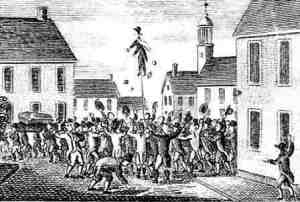 This morning on the other side of the Atlantic, I woke up early in preparation for a seminar on William Otter, whose History of My Own Times closes the list of our readings in my Revolutionary America class. Essentially, Otter was a brawling, violent, white man in the 1800s, living variously in New York, Pennsylvania, and Maryland. He jumped from job to job while engaging in various aggressive “sprees” against African Americans, Irishmen, and anyone else who seemed a likely candidate before becoming a burgess of Emmitsburg, Maryland.[1] And instead of getting up to prep this morning, I remained in bed, glued to the #BaltimoreUprising and #BlackLivesMatter hashtag on Twitter, as, I’m sure, were many of you during the late hours of the night. During times like these, it’s part of our jobs as historians to acknowledge that different types of violence have specific meanings that change over time. And so Juntoists have compiled a bibliography for our mutual education. Continue reading
A is for “Anthropocene”
 Today I want to pretend that I know how to read science journals, particularly a recent Nature article by scientists Simon L. Lewis and Mark A. Maslin entitled “Defining the Anthropocene.”[1] Reading a summary about the article was provocation enough to read the article itself, which in turn sparked a more extended rumination about chronology, interdisciplinarity, and scholarly divides. Continue reading
 The Junto