 Depending on whom you ask, the introduction of technology into the classroom is either a blessing or a curse. The proliferation of technology has provoked some good discussions, in addition to expletives involving use (abuse?) of Powerpoint slides in lecture. For one senior (non-UNH) colleague, who shall remain nameless, the mere mention of the word “Powerpoint” is akin to a bell ring for Pavlov’s dog, though with incarnadine face and froth at the mouth the outcome rather than drooling. Continue reading
Guest Post: “Fear in the Revolutionary Americas” Conference Recap
Elizabeth M. Covart is an early American historian, writer, and podcaster. Presently she is working on her first book manuscript about cultural community creation in Albany, New York, 1614-1830. Liz also writes a practical blog about history and how to make it more accessible at Uncommonplacebook.com and her new podcast, “Ben Franklin’s World: A Podcast About Early American History,” seeks to bring the work of academic and public historians to history lovers everywhere.
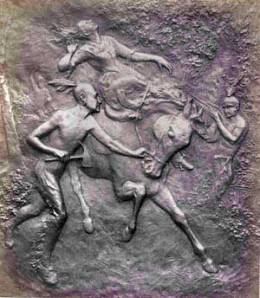 October 31, 2014. On the most fearsome day of the year, Tufts University convened “Fear in the Revolutionary Americas, 1776-1865,” a one-day conference designed to explore the question: What role did fear play in the revolutions that occurred in North and South America between 1776 and 1865? Continue reading
The JuntoCast, Episode 13: Education in Early America
 We’re happy to bring you the thirteenth episode of “The JuntoCast.” Continue reading
Economic Growth and the Historicity of Capitalism
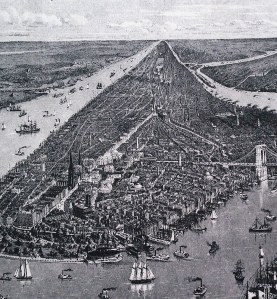 One of the central characteristics of the new history of capitalism has been its tendency to defer the question of just what “capitalism” is. The project’s enquiry starts with the question, not with a predetermined answer. But in order to know where to look, historians have to start with some idea about what makes a place and a time capitalist. As Tim Shenk points out in a recent article in The New Republic, the clue around which they converge is economic growth. Continue reading
Guest Post: Megan Brett on the Papers of the War Department, 1784-1800
Today’s guest poster is Megan R. Brett. Brett is a doctoral student in History at George Mason University where her dissertation will focus on the challenges faced by early American diplomatic families stationed overseas. She is also a Digital History Associate at the Roy Rosenzweig Center for History and New Media.
 The Papers of the War Department, 1784-1800, is a rich resource, not only for its content but also as a community transcription project. Only a small percentage of the transcribers identify as educators or academics; what draws people to volunteer their time deciphering 18th century handwriting? Continue reading
Creating a Public History Program
 Public history is having a bit of a renaissance right now. The data is a few years old now, but in 2008, job announcements in public history rose 27.9 percent. There was an increase the following year.[1] Most in the history profession will note 2008 not only as the year of the recession, but also as a year that saw a sharp downturn in the already-atrocious academic job market. This job market data refers to faculty jobs to train public history, but it is indicative of an increased focus by history departments to expand or introduce public history curricula.
J. Franklin Jameson Superstar
 It is not often that historiographical essays have a hero. But, in Al Young’s essay, “American Historians Confront ‘The Transforming Hand of Revolution’,” it’s hard not to see J. Franklin Jameson that way. Jameson was a New Englander by birth and character who helped found the American Historical Association in 1884. Never a prolific historian (or teacher, for that matter), Jameson’s greatest impact—beyond the important structural role he played in the emergence of History as a modern academic and professional discipline in the United States—came in the form of a small collection of four lectures originally written in 1895 but published largely in the form they were given at Princeton 30 years later. That small book, The American Revolution Considered as a Social Movement, is not just the starting point for Young’s assessment of the historiography of the American Revolution in the twentieth century, it is quite literally its genesis. Continue reading
The Masquerade
 I’ve admired Alfred Young’s wonderful, if unwieldy, Masquerade: The Life and Times of Deborah Sampson, Continental Soldier (New York: Knopf, 2004) since I first encountered the book in an undergraduate classroom a decade ago. Young’s biography of Sampson, which covers the life, career, and memory of this remarkable woman who “passed” as a man in the Continental Army for seventeen months, shares much in common with its intellectual sibling, The Shoemaker and the Tea Party—the detective-like level of historical research, the concern with the constantly shifting nature of memory, the drive to capture the life of a common person who left an uncommon historical legacy. New concerns, such as the performative and unstable nature of gender, emerge in Masquerade as well. My most striking impression from this latest reread, however, is just how much the book is about the limits of the American Revolution. Continue reading
George Robert Twelves Hewes and the Politics of Historical Pedagogy
How does an ordinary person win a place in history?
 Such is the line that Alfred Young opened his classic The Shoemaker and the Tea Party: Memory and the American Revolution (Boston: Beacon Press, 1999). In a way, the phrase captures much of his overall scholarship. Other contributions to this roundtable have/will cover(ed) how he did this in his influential books, essays, and edited collection. In my post, I want to focus on how he translated his approach into a work that is probably read more than any of his other books. Indeed, Shoemaker and the Tea Party is a popular book in the classroom, both undergrad and graduate, since it tells a fascinating tale with an important message. Continue reading
Empire/State
 In 1967, Alfred F. Young transformed his Northwestern doctoral dissertation into a dense saga of New York’s Revolutionary power players and their roiling class wars, entitled The Democratic Republicans of New York: The Origins, 1763-1797 (Chapel Hill: Published for the Institute of Early American History and Culture at Williamsburg, Va., by the University of North Carolina Press). Young’s work, in many ways, spoke both to the colonial past that he studied and to the America of President Lyndon Johnson, a nation beset by party strife over civil rights, the Vietnam War, and a range of social issues. And, tucked away near the volume’s end, Young shared a few bright-lines of inquiry for any student of political history—no matter that his focus here is firmly fixed on New York State. “I have been interested in politics as it is organized by the leaders,” Young writes, “how it appears up front to the voters, how it all turns out in the elections, and what the elected do with political power” (596). Continue reading
 The Junto