 On to this week’s links…
Learning While Distracted

I don’t know about you, but my Twitter and Facebook feeds are overflowing with updates on how many schools, universities, and day care centers are closed today as the latest round of winter weather works its way up the East Coast. But some are open, with professors in the classroom trying to make headway on syllabi that are rapidly becoming useless as guides.
These Aren’t the Docs You’re Looking For
Rachel Herrmann concludes our roundtable on James Merrell’s article, “‘Exactly as they appear’: Another Look at the Notes of a 1766 Treason Trial in Poughkeepsie, New York, with Some Musings on the Documentary Foundations of Early American History” from the most recent issue of Early American Studies.

You know the feeling: that moment when, in the midst of crafting a sentence, you realize that the notes you made in the archive are…incomplete. I’m a transcriber, and not one to take digital photographs. I just know myself well enough to recognize the fact that transcribed words are more useful for my writing than image after image of manuscript pages that I will procrastinate from analyzing. This preference, however, means that I’ve encountered more than a few errors in my transcriptions of manuscript sources and secondary works alike. I catch my mistakes from the latter when I’m proofing a piece of writing before I submit it; I’ll go back to the book or article, read it and my quotes side by side, and discover that I’ve left out a “the,” or transposed two words, or typed part of the same sentence twice. Preventing all of my blunders on manuscript transcriptions is another matter entirely, and it is to manuscript research that I’d like to turn in my response to James Merrell’s article in Early American Studies. Continue reading
A Long Time Ago in an Archive Far, Far Away
Michael D. Hattem continues our roundtable on James Merrell’s article, “‘Exactly as they appear’: Another Look at the Notes of a 1766 Treason Trial in Poughkeepsie, New York, with Some Musings on the Documentary Foundations of Early American History” from the most recent issue of Early American Studies.
Some of our (very) regular readers will know that I have a penchant for occasionally adopting a bit of the role of contrarian. For me, it serves as a way to shake myself into thinking differently about something, and I would hope it does the same for the reader. For this roundtable, it could have been quite easy to sing the praises of Dr. Merrell’s excellent article, and go on a 500-word rant about why historians should always seek out the manuscript sources over older published collections. However, I think my slot in this roundtable is an excellent opportunity to try to approach the article differently, one that attempts to historicize its meta-argument from a documentary editing perspective. Continue reading
Roundtable: James Merrell’s “Exactly as they appear” and Published Editions of Manuscript Sources
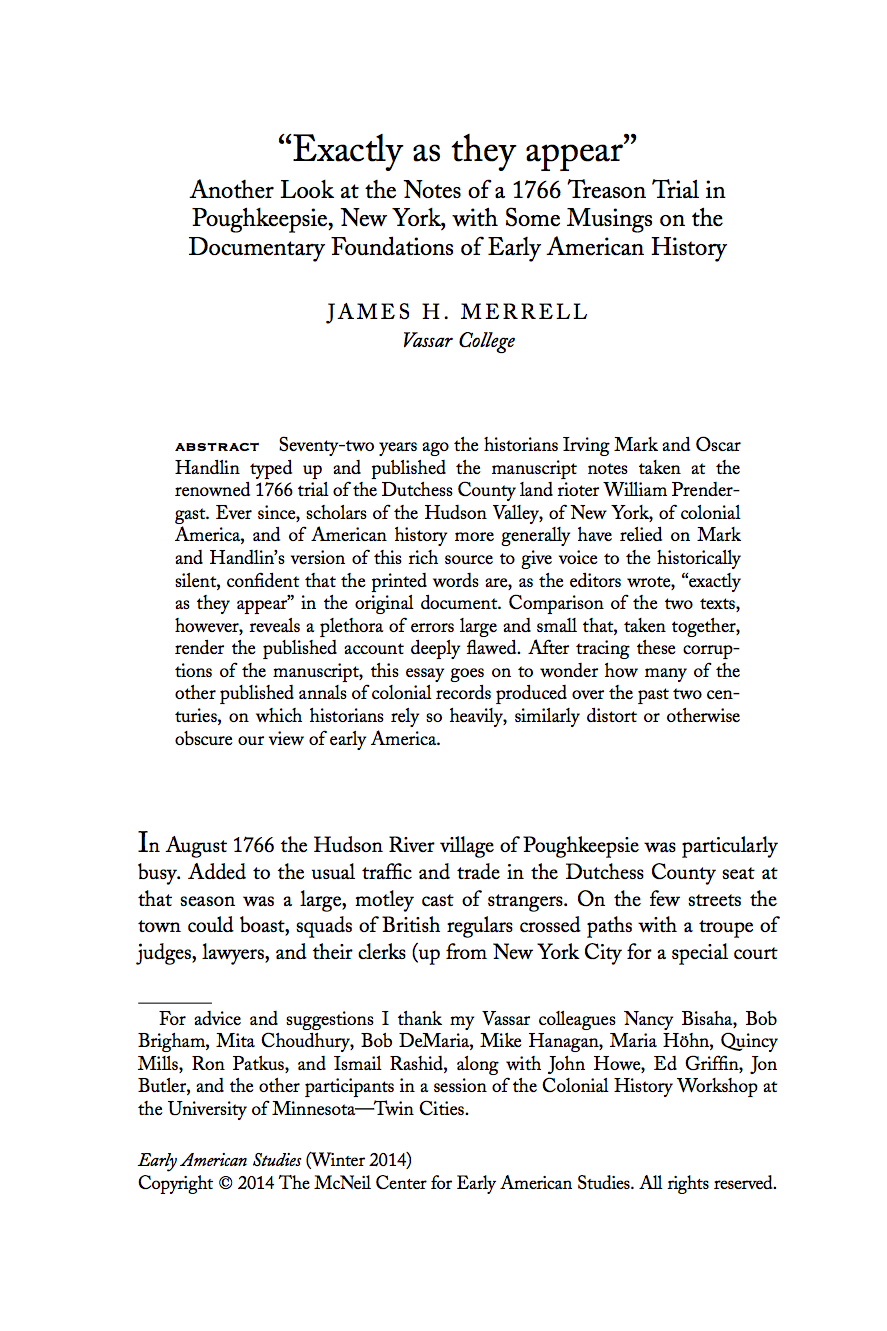 Many of us have been there. Sitting in front of our computers, we fret over how we will find the time and funding to examine important manuscript sources at faraway archives. And then, a few keystrokes later, we find that those sources are available in published form. Relief floods over us, replacing anxiety. But should we really be so relieved?
James H. Merrell’s recent article in Early American Studies asks exactly this question. Entitled “‘Exactly as they appear’: Another Look at the Notes of a 1766 Treason Trial in Poughkeepsie, New York, with Some Musings on the Documentary Foundations of Early American History,” it suggests that we should not be so quick to assume that published versions of manuscript sources faithfully reproduce the originals. [1]
The Week in Early American History
 Good morning and welcome to another Week in Early American History. I’m your host, Tom Cutterham. Continue reading
The Generation Game
 The AHA recently announced the formation of an ad hoc committee to produce standard guidelines for evaluating digital scholarship. It is hoped that the guidelines will allow professional recognition of new scholarship in a way that can become codified within the tenure process. The committee is a veritable who’s who of digital humanities worthies—all with an excellent track record of traditional peer-reviewed scholarship and engagement with a variety of digital media. When this committee speaks, it will command attention.
This is an important step forward for the profession; having a rigorous set of guidelines for evaluation will serve as an important starting point for encouraging recalcitrant colleagues and administrators to take digital scholarship seriously. But there is one thing that is also notable about the committee—not to put too fine a point on it, it is rather old. All the scholars are safely tenured. Where are the voices of the new generation, of the digital natives? Continue reading
Are We All Book Historians Now?
 Tomorrow at the Library Company of Philadelphia, I’ll be participating in a special edition of the McNeil Center for Early American Studies’ Friday seminar reflecting on five years of the Mellon Early American Literature and Material Texts Initiative. The Initiative began in 2009 as an effort to get early Americanists taking a material-texts approach to their research to step out of their respective fields and into a general conversation about the methods, theory, and potential of that approach. Over the course of five years, the initiative has provided funding for ten dissertation fellows to be in residency at the McNeil Center and make use of the tremendous resources of the Library Company and other area archives. In addition, the Initiative has contributed funding to conferences and sponsored a workshop each summer bringing together both junior and senior scholars to discuss their work and the trajectories of material-texts research. For Friday’s seminar, four former material-text fellows will discuss short selections of our current work and how our experiences in the Initiative have affected it. Continue reading
Guest Post: “X” Marks the History: Plundering the Past in Assassin’s Creed IV
Robert Whitaker is a doctoral candidate in History at the University of Texas at Austin. His dissertation, “Policing Globalization: The Imperial Origins of International Police Cooperation, 1918-1960” studies the relationship between the British Empire and international police organizations, such as Interpol. He serves as an Assistant General Editor for the journal Britain and the World, and is the creator of the YouTube series History Respawned. Bryan S. Glass teaches the history of Britain’s interactions with the World at Texas State University. He is the founding member and General Editor of The British Scholar Society and serves as an Editor of the Britain and the World book series (Palgrave Macmillan). His publications include an article in the Journal of Imperial and Commonwealth History, The Scottish Nation at Empire’s End (Palgrave Macmillan, forthcoming), and a co-edited volume with John MacKenzie entitled Scotland, Empire and Decolonisation in the Twentieth Century (Manchester University Press, forthcoming).
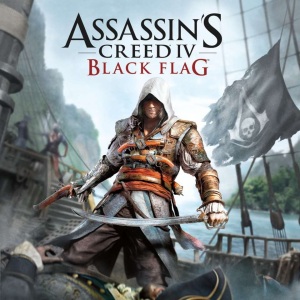
French game company Ubisoft has turned early American history into an age of booty. Over the past two years, the company has used early American history as the backdrop for three successive and successful titles in their Assassin’s Creed franchise: Assassin’s Creed III, Assassin’s Creed III: Liberation, and Assassin’s Creed IV: Black Flag. The most recent of these titles, Black Flag, is set in the Golden Age of Piracy during the early eighteenth century, and is easily the most profitable and well received of the three. Critics and players have praised Black Flag for its gameplay, graphics, and music—or rather, sea shanties.[1] But the biggest reason why this game has garnered accolades and high sales is because of its use, or misuse, of history. More than any other Assassin’s Creed game, Black Flag plays fast and loose with the historical record. It skews away from accuracy in favor of fun at almost every turn. Yet even as Black Flag thumbs its nose at the concerns of academic history, it nevertheless succeeds, perhaps better than any previous title in the series, in giving players a sensibility of the age. Continue reading
Introducing The History Carousel: Bringing the Past Full-Circle with the Present
 We at The Junto are very excited to announce the birth of a new podcast. “The History Carousel” will connect the past with the present, and will feature a rotating cast of Junto members and guests. It’s part of our equally-new podcast network, which is going to allow for all sorts of podcasting shenanigans—many thanks to Michael Hattem for helping to set it up. Continue reading
 The Junto