The Week in Early American History

TWEAHO March! You herald spring and blooms and sun!
But lest you fear a change too swift to speak,
I now present our tidings of the week. Continue reading

Just How Free Was Religious Life in the Early American Republic?

Religious liberty, perhaps, is the key legacy of the Revolutionary generation. The new United States was a society where slavery was a growing economic force, gender inequality was becoming entrenched, and the new nation’s expansion relied on the exploitation and expropriation of Native Americans. If there was one freedom, however, on the march in the early republic it was religious freedom. The progress of religious freedom in the United States was also the progress of religion itself. “[T]he number, the industry, and the morality of the priesthood and the devotion of the people have been manifestly increased by the total separation of the Church from the state” noted James Madison, that famous advocate of religious liberty, in an 1819 letter.[1] Religious freedom, then, is the American freedom. This has been the animating assumption behind most scholarship on the religious development of late eighteenth and early nineteenth centuries. Continue reading

The JuntoCast, Episode 9: The Early American Presidency

The JuntoCastIn honor of President’s Day, this month’s episode features Ken Owen, Michael Hattem, and Roy Rogers discussing issues related to the development of the Presidency in the early republic, including the initial defining of the office by Federalists and John Adams’ and Thomas Jefferson’s challenges in navigating that office, as well as the role of the Presidency in public memory. Continue reading

The Great Writing and Editing Extravaganza of 2013

Writing extravaganzaThat moment in the semester had arrived. You know the one: the point at which, having received their grades from the first assignment of the term, students were beginning to panic about their final writing tasks. Even though I, as a historian, write quite a bit, I sometimes find it hard to teach writing because it’s difficult to articulate the rules I inherently know. I also think that it can be tricky to teach in an engaging way. Because I can be a competitive person, I decided to teach my first-year students about writing through a contest of sorts. Continue reading

The Week in Early American History

TWEAHWelcome to your weekly roundup of early American history headlines. Now that you’ve aced your presidential history knowledge,  and reviewed this reading list of their lives, it’s on to the links! Continue reading

On Undergraduate Writing

I am currently in the midst of grading midterms and the process, as well as a recent piece by Marc Bousquet at CHE, has gotten me thinking about undergraduate writing and the debate of its value kicked off by Rebecca Schuman’s piece, “The End of the College Essay,” in Slate back in December. I want to use my post today to lay out some thoughts I have been having about undergraduate writing in lieu of the debate these articles have occasioned. Continue reading

Sinews of Power and Those Power Forgot

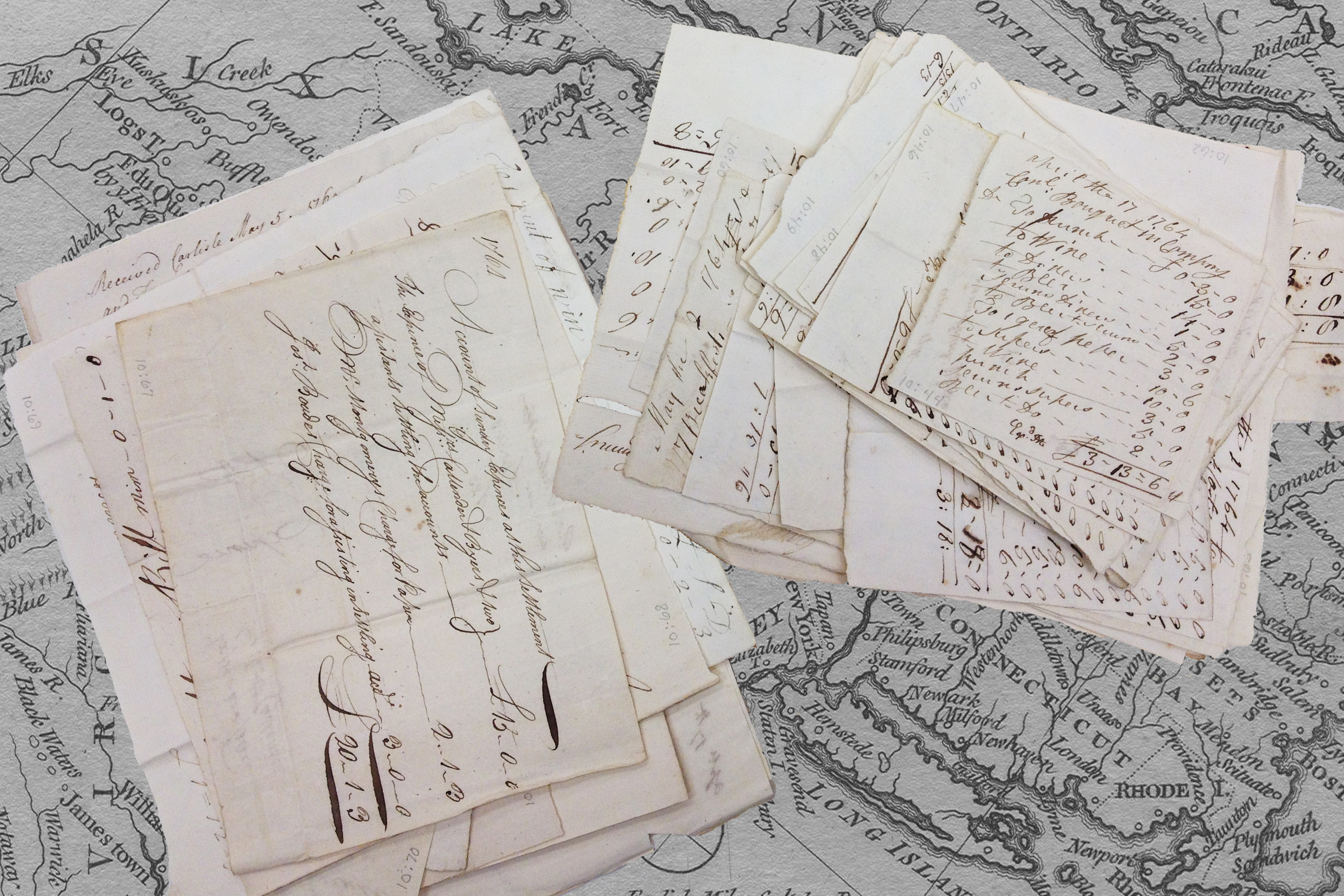
A Call to the Most Bland and Boring Pieces of Paper You’ve Ever Skipped Over in the Archives

VouchersReceipts

Vouchers! Receipts! Bills of exchange!

The paperwork of empire, particularly that of credit and finance, is probably not what gets most of us up in the morning. In the archives, we skip over the dull sections of the finding aids—warrants, no thanks!—and instead dive into correspondence and maps and bound volumes and clippings. The more adventurous of us might even call up account books—but those individual receipts? They’re lucky if we ever take them out of the box.

And why would we? Unless we live in a world of down-and-dirty finance or economics or material culture, they seem not only besides the point, but, even more, incredibly hollow. What do we get from reading a quick statement that someone was eventually paid for delivering a barrel of pickled cabbage in 1760? Especially when we can read in frantic detail the correspondence about how that barrel fell into the Mohawk River, burst open, got hauled back onto a bateau, arrived at Fort Stanwix, was re-opened, reeked, was declared unfit for consumption, continued to reek, was declared fit for consumption, reeked some more, ordered northward to Oswego, reeked still, and finally was delivered to a garrison comprised mostly of Germans who (our correspondents assumed) would think they’d been gifted sauerkraut.[1]

It’s the correspondence, we might argue, that gives us actors and action. In it, even a barrel—brown, wooden, boring—becomes something dynamic.

But who delivered that barrel? How long did it take him? Where did he begin his trip? Was he a merchant contractor, a militia man, a professional sled driver? And what did he get out of a journey, in the dead of winter, through the type of paralyzing cold you can only feel in upstate New York, with barrels of spoiled pickled cabbage?

Exceedingly important questions like these suddenly make the boring, bland, bureaucratic paperwork appear just a little (a very little?) more interesting. Continue reading

Gaming History

Historical trappings are extremely popular with video game designers. The Assassin’s Creed (AC) series, for example, has made a great success of combining beautiful recreations of historical scenery with the sort of conspiracy fueled story lines that propel Dan Brown novels and the Nicolas Cage headed National Treasure series to the heights of popularity.[1] The Assassin’s Creed games present a fascinating vision of historical agency, where historical change is explained through a hybrid of extreme individual agency—in the form of the game’s protagonist(s)—and the unending trans-historical battle between competing secret societies.[2] This is a very cyclical vision of history. We (through the player character, Desmond Miles and his ancestors) can battle Evil but the struggle will repeat itself time after time.

As a historian and life-long gamer I find these aspects of my beloved hobby in turns fascinating, endearing, and befuddling.[3] The question of agency—whom or what produces historical continuity and change—is one of the most contested and controversial philosophical and historiographical problems in my profession. Entire fields, such as the history of American slavery and abolition, have been riven by big-stakes arguments over such questions.[4] Few things are better at sparking heated debate (and more than a few eye-rolls) than bringing up the “agency question” in a seminar room or at a conference.

Video game designers and writers wade into this intellectual battlefield in ways that will likely surprise and frustrate most historians. I want to explore how historical agency is represented in modern gaming by looking at two recent games from Paradox Interactive—Europa Universalis IV (2013) and Crusader Kings II (2012). Both are “grand strategy games,” a genre very different from Assassin’s Creed. Born out of war and strategy board games—from the old stand-by Risk to much more complex games like Settlers of Catangrand strategy games allow the player to take control of a nation-state, cultural group, or civilization and shape its future. To make matters more interesting, a video game allows many more facets of the human experience to be modeled than a board game does.[5] Continue reading

Was the American Revolution a Civil War?

William Ranney, Battle of Cowpens, 1845, oil, South Carolina State House“Every great revolution is a civil war,” as David Armitage has recently remarked. That insight could change the way we think about the American Revolution. Contemporaries understood it that way—or at least, they did at first. David Ramsay, the first patriot historian of the war, held that the Revolution was “originally a civil war in the estimation of both parties.” Mercy Otis Warren wrote that the fires of civil war were kindled as early as the Boston massacre. But in the narratives of these historians, the moment the United States declared independence was the moment the conflict stopped being a civil war. It was no longer being fought within a single imperial polity. Now it was a war between two nations.[1] Continue reading