Guest Post: Working on The Papers of Francis Bernard

Christopher F. Minty (University of Stirling) recently completed his dissertation on the social and cultural origins of Loyalism in New York during the imperial crisis. He is the recipient of numerous fellowships, including the British Library, the Huntington Library, the David Library of the American Revolution, Colonial Williamsburg Foundation, and Houghton Library at Harvard University. This is his second guest post for The Junto.

In early 2013, Michael D. Hattem offered some thoughts on his role as a Research Assistant on the Papers of Benjamin Franklin. Since then, a variety of other online databases have established themselves as essential go-to sources for students and scholars of colonial British America, the American Revolution and the early Republic. With the launch of Founders Online, it has complemented a stream of other online resources that have given us an unparalleled insight into the lives of George Washington, Alexander Hamilton, Thomas Jefferson, James and Dolley Madison, the Adams family as well as documentary histories of the ratification of the Constitution and, well, “People of the Founding Era.”  Continue reading

As the Semester Looms

January has been a busy month for many of us here at The Junto, and we’re sure for many of our readers, as we have been preparing for the semester about to begin (except, of course, for Rachel, who will be grading first-term exams for weeks to come). Over the thirteen months the blog has been active, we’ve actually now written quite a few posts on teaching and pedagogy, and we’d like to point out a few highlights as you prepare your syllabi and first weeks of classes.

Continue reading

Review: The Larder: Food Studies Methods from the American South

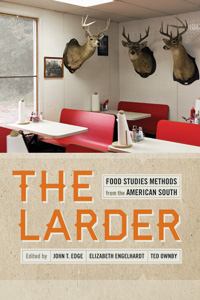
The larderIn his concluding remarks to The Larder: Food Studies Methods from the American South, Ted Ownby hopes it “likely that this book will be one of the last collections of academic essays in which any scholars feel the need to explain or defend their choice of foodways as a topic” (363). Ownby and co-editors John T. Edge and Elizabeth Engelhardt have done as much as they can to realize this aspiration; their collection of essays is timely and scholarly rigorous. By assembling a group of scholars who concentrate “not on food but on foodways”—which comprise the production, preparation, or consumption of food—the editors have delved into questions about food studies and southern studies that bridge boundaries between different disciplines and historical time periods (364). Continue reading

Teaching Through Primary Sources: Henry Drax’s Plantation Instructions

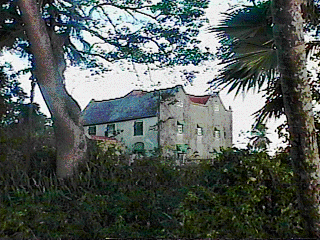
draxhallPrimary sources form an important part of the assignments for any of my undergraduate classes. As with any set readings, some of these sources work more successfully than others. One source that has proven reliably successful is Henry Drax’s instructions on running a sugar plantation in seventeenth-century Barbados. Back in my graduate student days, I prepared an initial transcription of the instructions as a research assistant. Thankfully, my students don’t have to grapple with some of the more eccentric approaches to handwriting in the original copy, and can instead read the 2009 William and Mary Quarterly “Sources and Interpretations” piece written by Peter Thompson. [1]

Continue reading

“Nor Any of the Rights of Citizenship”: Indians, Property, and International Law

In the years after the American victory at Yorktown, a series of debates took place over questions of citizenship and international law. Who counted as an American citizen, and what did that mean? What did the new American republics, and their confederation, owe to those who fell outside that category? In an earlier post, I discussed these matters in regard to one group of outsiders—suspected loyalists. Here I want to continue the theme as it touches a different group—Native Americans. Continue reading

The Week in Early American History

TWEAHAre you looking for a break from a busy weekend of watching the NFL playoffs? Or maybe you need some light relief while finishing up your syllabi for the new semester? Never fear, The Week in Early American History is here!
(All I’ll say is that it’s not because I’m British that I’m angry at the Patriots this weekend.)

On with the links! Continue reading

Using Blogs in the Classroom


Hist339schedule
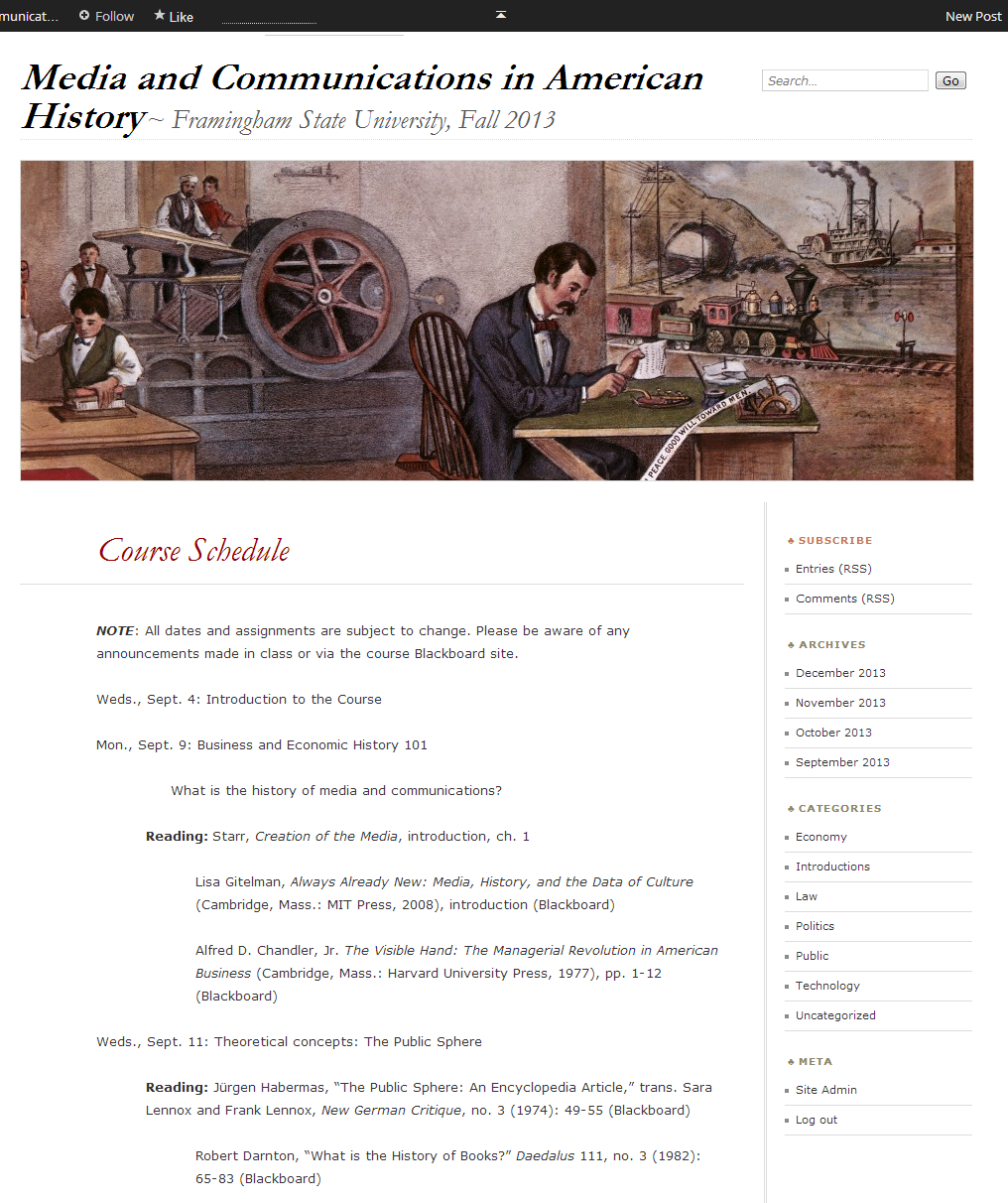
This week Framingham State University held its annual faculty professional development day (known on campus by its chronological moniker, January Day). As part of the day, I and a colleague in the English department put together a session on using social media in the classroom. What follows is an approximation of my half of the discussion, which focused on using blogs in a classroom setting. With the semester looming for almost everyone (though not, apparently, Rachel), it’s a good time to think about course syllabi, readings, and assignments. These sessions are aimed broadly at generating discussion among the faculty across disciplines about pedagogy, so I tried less to talk about how innovative I am (in some ways, not in others) but rather to provide a narrative of my experiences and raise a few questions.

Continue reading

Preparing for Final Exams…Wait, What?

end of semesterI am still learning how things work in England. Prime example: a couple of months back, I referred to the place where one purchases delicious, delicious beer-battered cod and fries as a “fish and chippery” before a kind(?) soul on Twitter alerted me to the fact that it’s called a “chippy,” here. So perhaps it’s understandable that I still find it a little weird that my students are about to take their final exams. Continue reading

Looking Less Backward: Ten (Relatively) Recent Books That Anyone Interested In Early American History Should Read

The day after Christmas, The New Republic published a piece by Senior Editor, John J. Judis, entitled “Looking Backward: Ten Books Any Student of American History Must Read.” The piece began promisingly (flatteringly, even): “I woke up on Christmas morning thinking about American historians.” [Editor’s Note: Wouldn’t the world be a better place if more people did that?] Judis closed the opening paragraph with the following caveat: “They’re my favorites; they’re not the best books.” Each book was followed by a paragraph with some combination of a brief synopsis and Judis’s own reactions. I have linked to the article but, just for reference, I’ll list his ten picks here: Continue reading

The Week in Early American History

TWEAH

Happy New Year, dear readers! Hope you had a merry Christmas. Did you watch the ball drop in Times Square? The technology dates back to the early 19th Century, when the Royal Navy ruled the waves and captains needed a way to periodically recalibrate their ships’ chronometers. In the New Netherlands, Dutch colonists spent New Year’s Day going over to each other’s houses for nieuwjaarskoeken. We here at The Junto, meanwhile, have been busy collecting all the links of note you may have missed over the holidays. Continue reading