 Happy New Year! Like the British Army two centuries ago, historians are descending on Washington this week in massive numbers (though likely with somewhat better results for the White House and Library of Congress) for the annual meeting of the American Historical Association. It’s an exciting time for the profession overall as discussions and meetings take place, and a harrowing time for those attending for job interviews. And apparently we’ll all get to see how badly the region handles winter weather.[1]
The “War on Christmas” in Early America
With Christmas right around the corner, we are re-posting this piece from three years ago. All of us at The Junto would like to wish happy holidays to all our readers.
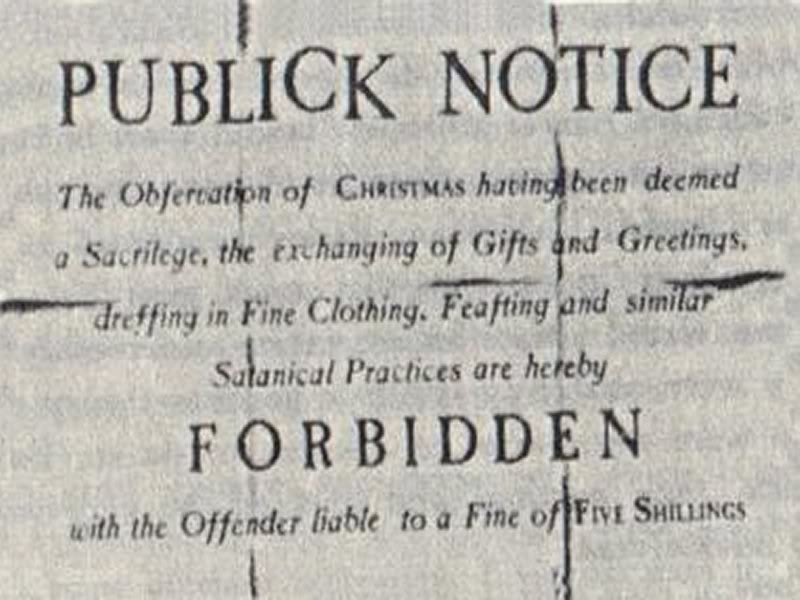
As an historian of early America, I suspect I am not alone in sighing a little bit to myself when hearing the often heated rhetoric about the “War on Christmas” emanating from right-wing and evangelical media outlets at this time of the year. That, of course, is because the real war on Christmas was not waged by 21st-century godless, liberal secular humanists and the ACLU but by 17th-century New England Puritans, particularly the clergy.
Saturnalia was a pagan Roman festival held annually from December 17-25. Its customary celebrations were both chaotic and violent and, hence, were popular amongst lower-class Romans. In the fourth century, as the Catholic Church sought to bring the pagan masses into the Christian fold, the Church adopted the final day of the festival as Jesus’s birthday, which the New Testament does not indicate and on which, until this time, there had been no widespread consensus. The Church effectively killed two birds with one stone. Throughout the centuries, the most violent aspects of the celebration (which, allegedly, may have included human sacrifices) fell away, but the customs of near-lawless revelry persisted, and indeed defined the celebrations in the early modern period.

At the start of the early modern period, the holiday was not yet the priority it has become, as Easter dominated the Catholic calendar. But the Reformation had a significant impact on the perception of Christmas, both positively and negatively. The holiday celebration customs were continued by the Church of England. The often uninhibited revelry of the holiday (which Puritans derisively referred to as “Foolstide”) appealed to the English lower classes while the gentry celebrated with “eating and drinking, [and] banqueting and feasting.”
In addition there was a distinct class aspect to one of the customs, in which the poorest man in the town was named “The Lord of Misrule” and treated like a gentleman.[1] Another custom, known as “wassailling” involved lower-class persons going to the homes of wealthy individuals and “asking” for food and drink, which they would then use to toast that individual. Due to the penchant for disorder, immodesty, gluttony, and the (temporary) breakdown of the social order, it should come as no surprise that in the late sixteenth and early seventeenth centuries, English dissenters began to take a very dim view of the holiday. Indeed, the hotter the Protestant, the stronger the aversion to Christmas. But their opposition to Christmas was not just due to the overtly social nature of its celebration. Puritan faith derived wholly from scripture, and, in 1645 and again in 1647, the Long Parliament declared the abolition of all holy days except the Sabbath, which was the only day described as such in the Bible.[2]
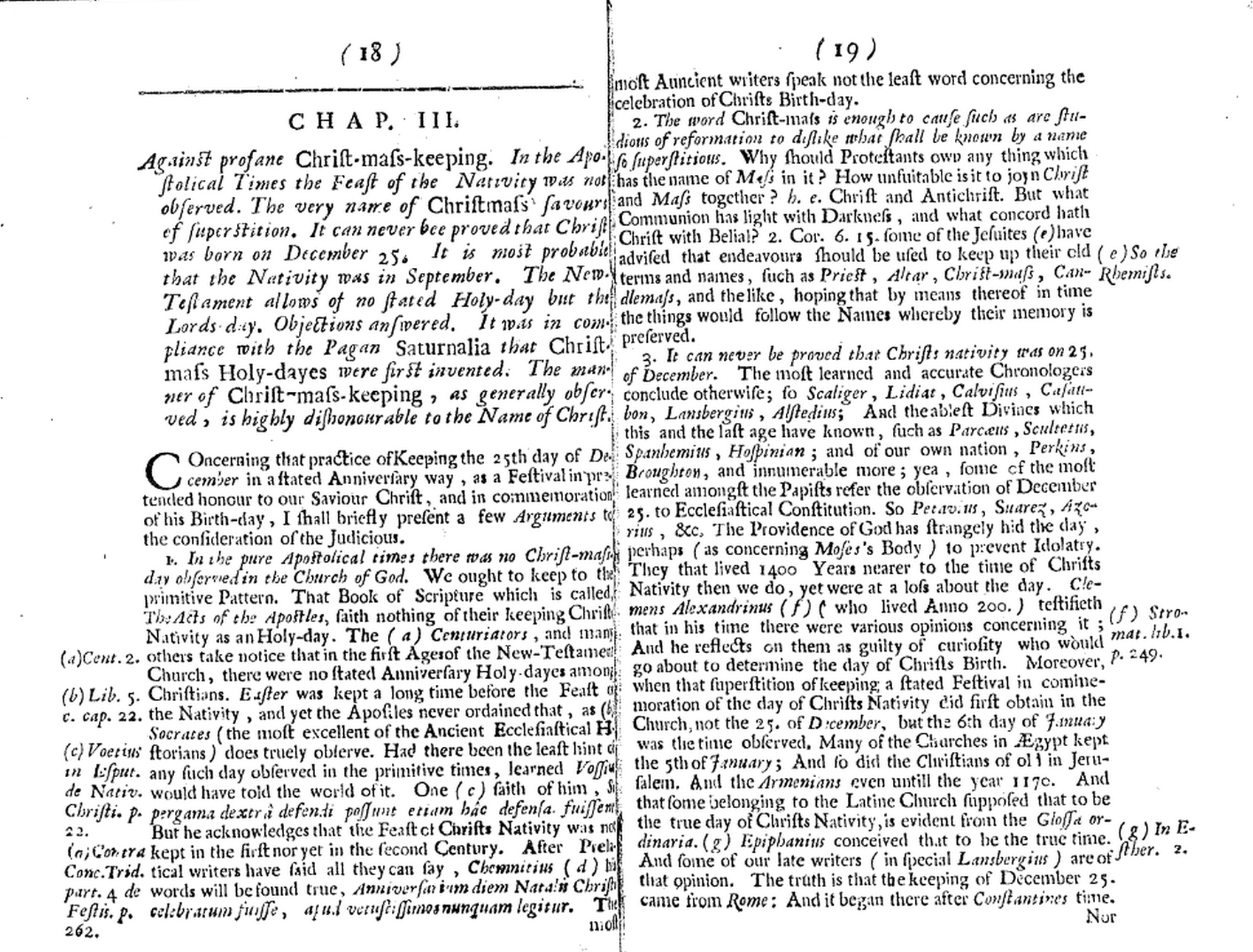
And so the first English dissenters who settled New England in the early seventeenth century were, like their brethren back home, decidedly anti-Christmas. Puritans were keenly aware of the holiday’s pagan origins, as Increase Mather wrote in A Testimony against Several Prophane and Superstitious Customs, Now Practiced by Some in New England: [3]
In the pure Apostolical times there was no Christ-mass day observed in the Church of God. We ought to keep the primitive Pattern. That Book of Scripture which is called The Acts of Apostles saith nothing of their keeping Christ’s Nativity as an Holy-day.
[. . .]
Why should Protestants own any thing which has the name of Mass in it? How unsuitable is it to join Christ and Mass together? [. . .] It can never be proved that Christ’s nativity was on 25 of December.
[. . .]
[They] who first of all observed the Feast of Christ’s Nativity in the latter end of December, did it not as thinking that Christ was born in that Month, but because the Heathens’ Saturnalia was at that time kept in Rome, and they were willing to have those Pagan Holidays metamorphosed into Christian ones.
By mid-century, the Puritan “City on a Hill” was already losing its spiritual homogeneity and the combination of new settlers and a new generation less committed to Puritan strictures forced the Massachusetts General Court to take action. On May 11, 1659, the following was entered into the General Court’s records:[4]
For preventing disorders, arising in several places within this jurisdiction by reason of some still observing such festivals as were superstitiously kept in other communities, to the great dishonor of God and offense of others: it is therefore ordered by this court and the authority thereof that whosoever shall be found observing any such day as Christmas or the like, either by forbearing of labor, feasting, or any other way, upon any such account as aforesaid, every such person so offending shall pay for every such offence five shilling as a fine to the county.
Despite being told to repeal the “penalty for keeping Christmas” as early as May of 1665 for its “being directly against the lawe of England,” the law was not stricken until 1681, followed by renewed pressure from Charles II.[5] But even though the legal war was over, the cultural war on Christmas continued. In 1686, the unpopular royal governor of the new Dominion of New England, Sir Edmund Andros, required an armed escort at a Christmas service he sponsored (somewhat brazenly) in Boston. Indeed, Christmas was not celebrated widely in New England through the eighteenth century, and, when it was, it was done privately. All this is not to imply that Christmas was celebrated broadly outside of New England. Even after the Revolution, the Congress was known to meet on Christmas Day, if they were in session. Throughout the nineteenth century, as well, there are numerous reports from all over the United States attesting to the lack Christmas observance, particularly by various Protestant and German Pietist sects.
A few days ago, Bill O’Reilly claimed that—thanks to him and Fox News—the “War on Christmas” had been won and Christmas had been saved for all the true Americans out there wishing to celebrate the “traditional American Christmas.” However, the history shows that waging a “war on Christmas” is one of the very oldest of all American traditions and is a far more American tradition than the current twentieth-century, commercial capitalist version of Christmas that Bill O’Reilly claims to have saved.
____________________
[1] This tradition had its roots in a Saturnalian custom of Masters exchanging roles with their servants.
[2] If there could be said to have been a war “over” Christmas, it would have been in the 1640s and 1650s as Oliver Cromwell and Parliament tried to enforce their ban on Christmas by attempting to stop public celebrations by Anglicans (and the few remaining Catholics) and force shop keepers to remain open. In many localities, the result was fighting in the street between the authorities and those intent on celebrating the holiday in its traditional manner. For more on the English context, see Chris Durston, “The Lords of Misrule: The Puritan War on Christmas, 1642-60” History Today 35, no. 12 (1985).
[3] Increase Mather, A Testimony against Several Prophane and Superstitious Customs, Now Practiced by Some in New England (London, 1687), 18-9; 35. Early English Books Online.
[4] Records of the Governor and Company of the Massachusetts Bay in New England, 5 vols., ed. Nathaniel B. Shurtleff (Boston: From the Press of W. White, printer to the Commonwealth, 1854), 4:366.
[5] Ibid., 5:212; For repeal, see William H. Whitmore, A Bibliographical Sketch of the Laws of the Massachusetts Colony from 1630 to 1686 (Boston: Rockwell and Churchill, City Printers, 1890), 126.
The Week in Early American History

‘TWEAH, two nights before Christmas, when thr’out the blog roll
Not a creature was stirring, not even a troll;
The grades were all posted to Blackboard with care,
In hopes that strong evals soon would be there;
The grad students were nestled all snug in their beds,
While visions of fellowships danc’d in their heads,
And Ben Park in his ‘kerchief, and I in my cap,
Had just settled our brains on an early Americanist recap.
Archiving Abolition
 Today, we chat about making digital history with Lauren Klein, Assistant Professor in the School of Literature, Media, and Communication at the Georgia Institute of Technology. Her writing has appeared in Early American Literature and American Quarterly, with a piece forthcoming in 2014 in American Literature. She is currently at work on two book projects: the first on the relationship between eating and aesthetics in the early republic, and a second that provides a cultural history of data visualization from the eighteenth century to the present. Continue reading
American Enlightenment! Which American Enlightenment?
James MacGregor Burns, Fire and Light: How the Enlightenment Transformed Our World. New York: Thomas Dunne Books/St. Martin’s Press, 2013.
 Earlier this year, the Journal of American History published an essay bemoaning the lack of attention Americanists give to the idea of an American Enlightenment. The authors suggested some provocative reasons, like a latent exceptionalism that has made American scholars reluctant to pick up a topic still seen as rooted in Europe. Equally problematic was America’s religious character, which has left Americanists wary of a movement still viewed as secular. Despite noteworthy scholarship on an American Enlightenment being produced “at the margins of university research” (though I hesitate to call scholars like James Delbourgo, one such scholar, “marginal”), I sympathize with the authors’ case. There just isn’t that much good recent scholarship that American historians can readily incorporate into their work. Continue reading
Rethinking the Early American Map
 It’s time we remake the North American map.
Open up most any early American history book and flip to the list of tables and figures. Chances are you’ll find—if provided—maps devoid of almost any indigenous peoples. If the book is more recent, perhaps instead you’ll find that the author included two maps: one of European settlements, and one of Native American peoples. Or, just maybe, you happen to have on hand one of the few books to merge all of these together. But look closely and see if you can find the usual tension—an unbalance resulting from the projection of European empire on one hand, and the illustration of limited, isolated, scattered indigenous nations on the other.
How can so many maps of colonial North America display European power and political influence, but not do the same for American Indian polities and groups?
Maybe the better question is, how can we overcome our own historiographical strictures and the limitations of seventeenth and eighteenth-century maps to better portray the American landscape?
Interviews with Historians: Carol Berkin
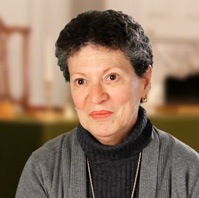 Carol Berkin is Presidential Professor Emerita at Baruch College and the CUNY Graduate Center. She received her bachelor’s degree at Barnard College. In 1972, she received her PhD at Columbia University, where she also worked on the Papers of John Jay and Alexander Hamilton. Her dissertation on Jonathan Sewall won the Bancroft Award for Outstanding Dissertation and the subsequent book, Jonathan Sewall: Odyssey of an American Loyalist, was nominated for the Pulitzer Prize in 1974. She then spent her entire teaching career at Baruch College and the CUNY Graduate Center. Her most popular works include A Brilliant Solution (2002), which has been translated into Polish and Chinese, First Generations: Women in Colonial America (1996), Revolutionary Mothers: Women in the Struggle for American Independence (2005), and Civil War Wives (2009). She is a pioneer in early American women’s history and also the author and editor of numerous textbooks, readers, and teaching guides for women’s history including Women of America (1980), Women’s Voices, Women’s Lives: Documents in Early American History (1998), In the Words of Women: The Revolutionary War and the Birth of the Nation, 1765 – 1799 (2011), and Clio in the Classroom: A Guide to Teaching Women’s History (2009). She is also the editor of History Now, an online magazine published by the Gilder Lehrman Institute of American History. She has appeared in numerous television documentaries, including Founding Brothers and Founding Fathers on the History Channel and Ric Burns’ New York on PBS. Continue reading
Connecting the Past with the Present: A Trip to the Grocery Store
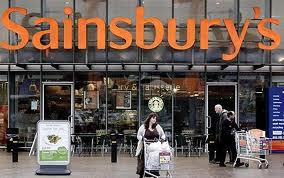 I think it’s important for historians to try to make connections with the present, not only because it more thoroughly engages students, but also because the past is not static. I haven’t always been great at explicitly drawing these parallels, but when the first day of the U.S. government shutdown coincided with my first Revolutionary America class, I sort of lost it. I thought to myself, “I have to go into class prepared to talk about how people in thirteen disparate colonies—some of whom disliked each other immensely—managed to get it together enough to rebel against Great Britain?” It’s no wonder I ended up showing a pop music video and comparing the Revolution to the bad breakup of a dysfunctional relationship.[1] I assume that a teensy bit of pandering to students’ tastes didn’t hurt, either. Continue reading
The Week in Early American History
I may be imagining things, but it seems that every time I take a turn with TWEAH there’s a major weather event going on outside my window. That may not be the case, but this edition comes to you with the first New England snow of the season. So if you’re stuck inside this morning, or just back from shoveling, take a few minutes to make a hot drink and see where The Junto may lead you.
The JuntoCast, Episode 7: The Great Awakening
 In this month’s episode of “The JuntoCast,” Ken Owen, Michael Hattem, Roy Rogers, and Mark Boonshoft discuss the Great Awakening, including its historiography, its relationship to the American Revolution, and its contemporary significance.
You can click here to listen to the mp3 in a new window or right-click to download and save for later. You can also subscribe to the podcast in iTunes. We would greatly appreciate it if our listeners could take a moment to rate or, better yet, review the podcast in iTunes. As always, any and all feedback from our listeners is greatly welcomed and appreciated. Continue reading
 The Junto