 Another week comes to a close and, as usual, The Junto‘s got links…
Tag Archives: Digital History
Buy, Sell, Read

How did eighteenth-century print networks really operate? This week, The Junto asked Jordan Goffin, Special Collections Librarian at the Providence Public Library, how mapping Rhode Island’s early book trade led to the creation of a new digital atlas. Continue reading
A PhD Student’s Case for Embargoes
Note: I welcome this opportunity to expound more fully on a few quotes from me in a New York Times piece about the AHA statement. You can find my Storify of the debates on Twitter and in the blogosphere related to the statement here. It is also worth reminding readers that the opinions in our pieces are those of the author and not of the blog as a whole.
 A recent policy recommendation by the AHA on the embargoing of dissertations—i.e., limiting online access and distribution for a specified period of time—has created quite a stir in the blogosphere and on Twitter. Many are criticizing the AHA for a reactionary policy that concedes the status quo, i.e., the undue influence and interest of university presses in hiring and tenure decisions and the profession’s overall laxity in adapting to the digital revolution.
Let me be clear from the outset: I am not defending the AHA’s statement, per se. It does indeed ignore the broader issue of what the AHA intends to do about the long-term, systemic problem of the profession’s transition into the digital era, more generally. I am, however, going to defend the policy of allowing students the option to embargo. Continue reading
Collecting Pennsylvania
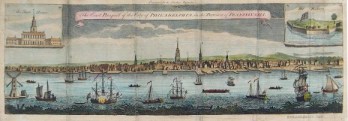
How is digital scholarship charting new prospects for our view of early America? Cathleen Lu, Digital Conversion & Bibliographic Specialist and Dana Dorman, Digital Projects Manager, at the Historical Society of Pennsylvania, kindly described how HSP produces and presents new digital content that’s open for research (along with the library) while renovations continue at 1300 Locust Street throughout early autumn 2013. Continue reading
Collecting Connecticut
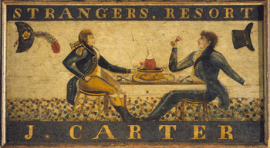 After enjoying the festivities of the Fourth, why not make it a whole weekend of early American history research? The Junto asked Barbara Austen, Archivist at the Connecticut Historical Society, to introduce the institution’s collections and digital projects. Continue reading
Guest Post: Locating Gender in the Stacks
Today’s guest poster is Aaron M. Brunmeier, a PhD student focusing on early American and Atlantic world history at Loyola University Chicago. Aaron is currently finishing up his role as the new media assistant for Common-place Journal and will work next on an AHRC-funded project on Atlantic world library history.

Network analysis for the 11 women and all the texts they borrowed from the NYSL from 1789 to 1792.
I must confess that when it comes to digital history, I am very much a novice. My introduction into this brave new world occurred last semester in Dr. Kyle Roberts’ undergraduate digital history class that I was able to take for grad credit at Loyola University Chicago. The end goal of the course was to create our own collaborative digital history project. I teamed up with two smart, hardworking, and creative undergrads whose backgrounds weren’t even in history and what we produced was Gender in the Stacks (which I should point out is currently a prototype and definitely a work-in-progress). Continue reading
Promised Land
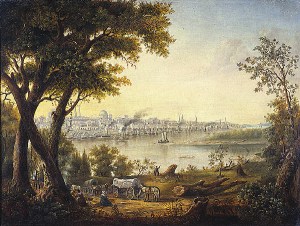
“Saint Louis in 1846”
Henry Lewis
This week, The Junto spoke with Lea VanderVelde, the Josephine R. Witte Professor of Law at the University of Iowa College of Law, a Guggenheim Fellow in Constitutional Studies, and principal investigator of the Law of the Antebellum Frontier project, which “seeks to digitally analyze the legal and economic mechanisms at work on the American frontier in the early 1800s.” She kindly took our questions on her work-in-progress, and why digital research transforms the early American legal history of how the West was run. Continue reading
The Week in Early American History
Let’s get to the links…
Democratizing Pedagogy: The Just Teach One Project

Last week when the Junto hosted the History Carnival we noted the creation of the “Just Teach One” project, co-sponsored by the American Antiquarian Society and Common-place. Today we’d like to take a closer look at what promises to be an exciting addition to thinking about how to teach early American studies (for both literary scholars and historians).
The Week in Early American History
In Rome, art restorers have uncovered what they say are American Indians in the background of a 1494 fresco in the Vatican’s Borgia Apartments. Some commentary on the imperial-religious context is available here.
“Unity,” writes Ilan Stavas, “is the great elusive dream of Latin America, and Bolívar is its Don Quixote.” A review of Marie Arana’s new biography of El Libertador reflects on his contradictory legacy in Latin American politics.
 The Junto